Video Walkthrough
In this video, we'll go over some best practices, general information, and how-to tips when working on the second page of a Qujam campaign's setup that focuses on selecting the best geofence targeting type and some of the goals of the campaign.
If the video is blurry, your device may have reduced it's quality. Simply click the gear icon in the lower right corner of the video and select a higher quality.

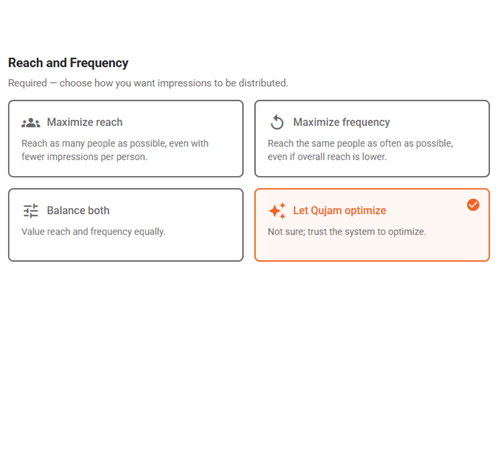
Tips for Selecting Your Reach & Frequency Goals
Maximize reach:
This option will tell the system that you want to reach as many people as possible and it will slightly limit the number of times each devices is served an ad, so the impressions are spread out across more people.
Maximize Frequency:
This option is great to reduce your cost per thousand (CPM) a bit, but tends to result in a slightly smaller reach (number of total devices/people you served ads too). It also ensures you increase the number of average times each individual person experiences your ad.
Balance both:
This simply tells the system that you want to try to maintain a mix of reach and frequency, so it can try to find the ideal balance between the two without favoriting one over the other.
Let Qujam optimize:
Very similar to the balances both approach, but it lets the Qujam team know that you are open to optimization work from the system and support team to try to get the best results.
Tips for Audience Segments Selection
Hyper-grid's Audience Segments:
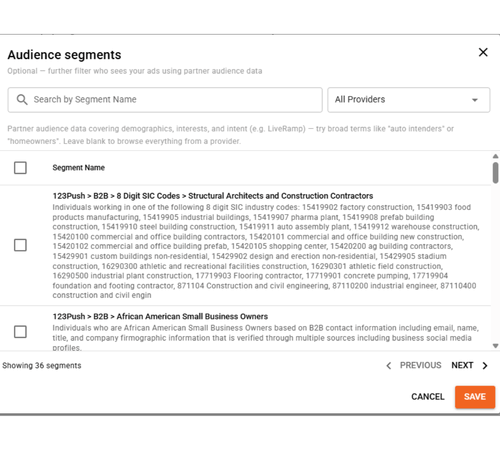
If you have selected hyper-grid geofencing, you will have the option to select demographic segments to help narrow your targeting even further. Qujam taps into 10 different third party date sources.
Using the Segment Selection Too:
We recommend typing in key search words/terms into the "Search by Segment Name" box and selecting all segments that apply. It's a go idea to try different searched to track town all compatible segments.
Select Multiple Segments:
It is best practice grab as many relevant segments that you an get. There is a small increased cost in the CPM when a demographic segment is selected, and each segment might come with a different cost. Selecting multiple segments averages a better CPM. It additionally allows the system to identify the most amount of desirable people.
Tips for Selecting Your Conversion Tracking
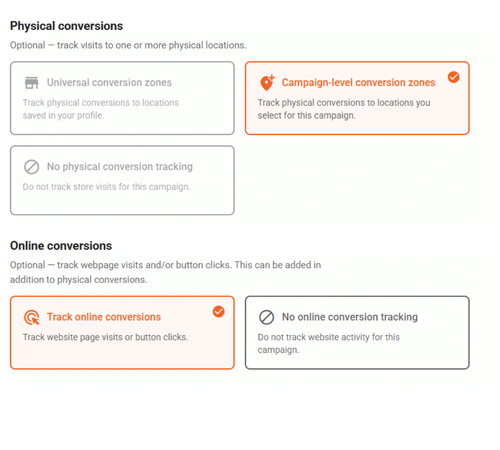
When to Select Physical Conversions:
Physical conversions allow you to identify when someone who saw your Qujam ad comes into a location you want them to go to like your store, office, restaurant, etc... It's ideal for brick and mortar businesses.
Physical Universal vs Campaign-Level Conversions Zones:
If you tend to use the same physical conversion zones, it's a good idea to identify them in your Qujam profile, so you can select "Universal conversion zones" and auto track conversions to those locations. However, if you want to set conversions up at a campaign level, you can do that too with the "Campaign-level conversion zones" option.
When to Select Online Conversions:
Online conversions are available with hyper-grid geofencing and allow you to track people to experienced your Qujam ad and then navigated to a particular URL or clicked on a converting button on your website. This is ideal for companies looking to tract contact requests, form submissions, on-site purchases, demo schedules, etc...
Use Both:
If you have a company that has physical and online conversion points, it's a great idea to leverage both options for your hyper-grid geofencing campaign. For precision geofencing, only physical conversions are available.