

In the fast-paced world of digital advertising, timing and location are invaluable resources. Whether you are targeting a music festival, trying to capture foot traffic from a competitor’s trade show, or ensuring your brand is top-of-mind during a local sporting event, event geofencing is the secret weapon you may have been looking for.
Is it effective? Yes. Is it advanced and exciting? Yes. Will it alone solve all of your marketing problems? Honestly… probably not, if you think it’s going to identify every single person at the event and guarantee that they will see your ad. Just like all advertising, there are a lot of factors that goes into it. Event geofencing is highly technical, so it’s a good idea to get a clearer understanding of what event geofencing is and how it works.
As technology evolves, for some advertisers, the ability to target audiences based on their precise physical location has shifted from a “nice-to-have” luxury for big brands to a resourceful tool for businesses of all sizes. However, until event geofencing’s release on Qujam, running these campaigns normally required expensive managed services, high minimum spends, and long lead time.
At Qujam, we are on a mission to simplify hyper specific location based advertising and make it more accessible to all. This now includes event geofencing. With the launch of our new DIY event geofencing feature, you can now build, launch, and manage sophisticated event geofencing campaigns on your own terms.
This article will walk you through everything you need to know about event geofence advertising—from what it is and how to use it, to understanding the nuances of capture rates and physical conversion tracking.
What Is Event Geofencing?
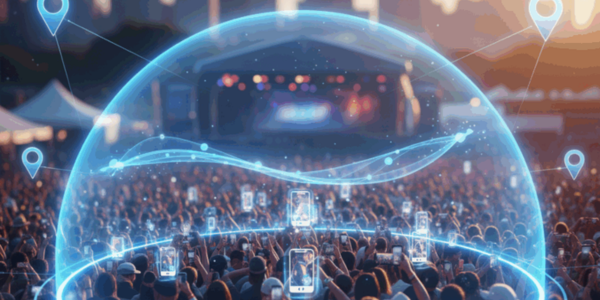
Event geofencing is a location-based advertising strategy that creates a virtual boundary (a “geofence”) around a specific physical location during a set time period, typically an event like a concert, conference, festival, or game.
Unlike broader geographic targeting used by social media platforms, event geofencing is precise. It uses GPS technology to capture the Device IDs (unique identifiers on devices like smartphones) of people who physically enter that specific boundary. Once a device is captured, you can serve targeted digital ads to that person’s captured device and other devices connected to it (smartphone, tablet, compute, and TVs) both during the event and for up to 30 days after they leave.
How It Works in 3 Steps:
- The Geofence: You draw a custom polygon shape around the event venue (e.g., the exact outline of a convention center or stadium). You’ll set your dates of the event and the date you want you ad campaign to end after the event.
- The Capture: As attendees walk inside your fence with their GPS-enabled devices, their device is anonymously added to your audience pool.
- The Ad Delivery: You serve ads to these high-intent users across thousands of apps and websites, not just when they are at the event, but as they browse the internet later at home or work. Qujam’s advertising medium options for event geofencing are OTT/CTV, video pre-roll, display, and digital audio ads.
Top Tips for Running a Successful Event Geofencing Campaign
Event geofencing is powerful, but it requires strategy. Simply drawing a circle and hoping for the best won’t cut it. Here are three expert tips to maximize your ROI:
- Timing is Everything: Don’t just run your ads during the event hours. Sometimes it’s smart to start your campaign 1-2 days before the event if you are targeting the venue setup crew or early arrivals. More importantly, utilize the retargeting window of time. The real magic often happens after the event. Attendees are busy during the show; catching them for up to 30 days later when they are back in their hotel, home, or office is often when the click or conversion happens.
- Creative Context Matters: Your ad creative should speak to the event goers. If you are geofencing a “Home and Garden Show,” don’t just use your generic brand ad. Use copy like, “The Deal You Missed at the Home Show? Click for your exclusive discount.” Contextual relevance significantly boosts Click-Through Rates (CTR).
- Geofence the Parking Lots and Hotels: Sometimes the best signal doesn’t come from the crowded convention floor where cell service is spotty. Geofence the official event hotels and the main parking lots could help improve your capture rate. These areas often have better GPS connectivity and slower-moving foot traffic, leading to higher capture rates.
- Align You Landing Page: A few years ago Adobe did a research study and found that a landing page’s that user experience and alignment with their ad creative had the greatest positive impact on a campaign.
- Leverage Multiple Mediums and Creative: Integrated Marketing Communication is the proven theory that levering a similar message in multiple mediums is more effective than using a singular message in one medium. It’s ideal to run multiple sets of creative across multiple ad mediums like mixing together display, OTT/CTV, video pre-roll, and digital audio ads. It’s also smart to couple your event geofencing campaigns with a paid and/or organic search and/or social media strategy and other marketing and sales efforts.
- Attend the Event: Sometimes you can’t be at all the events and event geofencing give you at least the option to capitalize on the event even when you can’t be there. However, attending the event and actually meeting people and marketing yourself in person will improve the effectiveness of event geofencing and vice versa.
5 Examples of Effective Event Geofence Advertising
Not sure how to apply this to your business? Here are five distinct ways marketers use event geofence advertising to drive results:
- The Trade Show “Conquest”:
- Scenario: You are a SaaS company, but you couldn’t afford the time and money to have a booth at all of the biggest industry expo of the year.
- Strategy: You geofence the convention center where the expos are happening.
- Result: You serve ads to attendees with messaging like, “The [your type of Saas] you were looking for at [Event]. Try [Your Brand] Free.” You effectively steal attention from your competitors who paid thousands for a physical presence.
- Music Festival Brand Awareness:
- Scenario: A local energy drink brand wants to reach young adults.
- Strategy: They geofence the grounds of a major 3-day music festival.
- Result: They run high-energy video pre-roll ads on mobile devices. Attendees waiting in line for food or between sets see the ads. Later, when they are home, they are retargeted with a “Buy One Get One” coupon to redeem at a local store. Additionally they had a promotional team at the event giving out free samples to really drive the campaign home.
- Recruitment at University Graduations:
- Scenario: A regional hospital needs to hire nurses.
- Strategy: They geofence the graduation ceremonies of local nursing schools.
- Result: They capture the devices of new graduates and their families, serving ads highlighting signing bonuses and career benefits directly to the talent pool they need most.
- Sports Fan Merchandise Sales:
- Scenario: An online retailer sells vintage sports apparel.
- Strategy: They geofence the stadium during a rivalry football game.
- Result: Fans inside that were inside stadium are targeted with ads for vintage jerseys of the teams playing. The emotional high of the game drives impulse purchases once the fans right after the game and even after they return home.
- VIP Event Retargeting:
- Scenario: A luxury real estate agent hosts an open house gala. Your real estate company wants to get your high end listings in front of the same audience.
- Strategy: You geofence the specific estate during the party.
- Result: You get exposure to the hyper-niche audience of the 200 wealthy individuals who attended. Over the next month, you serve premium OTT/CTV ads on the prospects’ living room TVs, reinforcing the luxury lifestyle of the brand.
Physical Conversion Tracking: Did They Actually Show Up?
One of the most powerful features of Qujam’s event geofencing is Physical Conversion Tracking.
In digital marketing, a “conversion” is usually a form fill or a purchase. But for brick-and-mortar businesses, a conversion is a foot traffic visit.
- The Conversion Zone: This is a secondary geofence you draw around your business location(s).
- The Logic: If a person’s device is captured at the Event Zone (where they saw your ad) and is later seen inside your Conversion Zone (your store) within 30 days of seeing the ad, Qujam tracks that as a “Physical Conversion.”
This helps you to answer the ultimate ROI question: “Did my ads at the stadium actually drive people to come eat at my restaurant?”
Understanding Capture Rates: The 5% – 70% Range
When you run an event geofencing campaign, you might wonder: “Will I capture every single person at the event?” The honest answer is no. The Capture Rate: the percentage of actual attendees whose devices are successfully identified and added to your audience, typically falls between 5% and 70%.
Why is this range so wide? It depends on several variables:
- App Permissions (Privacy): For a device to be captured, the user must have Location Services enabled.
- Venue Environment: A multi-story, concrete “bunker” convention center might block GPS signals, lowering the capture rate. An open-air festival in a park with clear skies allows for excellent GPS triangulation, pushing capture rates much higher.
- Wi-Fi vs. Cellular: Venues with congested cell towers may limit data transmission. However, if users connect to public Wi-Fi, capture precision can improve as long as the Wi-Fi’s transmission equipment is at the same geofences location. If it isn’t the Qujam system will see that the GPS and the Wi-Fi data doesn’t match and not collect that device due to the conflicting data.
- Dwell Time: Someone running through a zone in 90 seconds is harder to capture than someone sitting in a stadium seat for 3 hours.
- Shorter Campaign: Event geofencing campaigns tend to be shorter than traditional geofencing campaigns. This doesn’t effect the capture rate, but we still need the user to navigate to an app, website, or streaming service that has ad inventory. You have a greater chance of someone doing that over a longer period of time than just a month long campaign.
The Qujam Advantage: While we can’t control the laws of physics or user privacy settings, our technology launches two backend campaigns to ensure maximum capture rate, and you only pay for the impressions that are actually served if your entire budget isn’t used for a campaign due to lower than expect capture and delivery rates. If even a small percentage of the event population is desirable for you, then event geofencing makes sense.
The Power of Multiple Ad Mediums
Don’t limit your event geofencing campaign to just small banner ads. A robust campaign engages users across multiple senses and devices. With Qujam, you can retarget your event audience across four distinct mediums:
- Display Ads: Standard banners that appear on websites and apps. Great for frequency and keeping your brand visible.
- Video Pre-Roll: 15 or 30-second videos that play before content on sites like CNN, local news sites, weather apps, ESPN, etc… Perfect for storytelling.
- OTT/CTV (Streaming TV): The “Holy Grail” of prestige. Serve TV commercials to event attendees when they are back home watching Hulu, Sling, or Tubi. This adds massive credibility to your brand.
- Digital Audio: Audio spots that play on music streaming and podcast apps. Ideal for reaching attendees while they are commuting or working out post-event. These also come with companion display ads.
Why mix them? A user might ignore a banner ad, but after seeing your TV commercial and hearing your audio spot, that banner suddenly becomes more clickable. Multi-channel campaigns have been shown to increase conversion rates by up to 60%.
How Qujam Differs from the Rest
You might be thinking, “Can’t I just target ‘people interested in football’ on Facebook?” or “Don’t other ad platforms do geofencing?” Here is how Qujam’s DIY Event Geofencing stands apart:
Qujam vs. Meta (Facebook/Instagram) & Google
- Precision: Meta and Google use “Radius Targeting” (usually a minimum of 1 mile) and sometimes pass it off as “geofencing.” It’s not geofencing. If you try to target a stadium, you are also wasting money targeting the highway next to it, the residential neighborhood behind it, and the gas station down the street. Qujam uses polygon shaped fences to draw around a location more precisely. We let you trace the exact walls of the building, greatly improving your ability to reach people actually at the event.
- Intent vs. Interest: Facebook targets people based on what they like online through their first and third party data. It’s very useful, but Qujam targets people based on where they are in real life. Physical presence at an event is often a stronger indicator of intent and can reach people the data systems miss or become out of date on.
Qujam vs. Other Service Geofencing (GroundTruth, Propellant, Simpli.fi)
No Minimums: Most competitors require a minimum spend of $1,500 to $10,000+ per month or campaign. Qujam has NO minimums. You can run a $100 campaign for a small local event if that’s all your budget allows.
True DIY (Do It Yourself): With other providers, you have to “Request a Demo,” talk to a salesperson, sign a contract, and wait for an account manager to build your fence. With Qujam, you log in, draw your fence on a map, upload your creative, and launch. You are in total control. (We do have managed service option available for very large or multiple event just in case anyone needs that level of support. Contact us for more info.)
Transparency: Live reporting dashboard and no hidden/additional management fees. You see exactly what you are paying and exactly where your ads are running via our 24/7 reporting dashboard.
Ready to Launch Your First Event Geofence?
Event geofencing was once a tool reserved for big companies with massive budgets. With Qujam’s new DIY feature, we are putting that power in everyone’s hands. Whether you are a small local business or a growing agency, you can now capture the intent of real-world foot traffic and turn it into digital conversions.
Don’t let the next big event pass you by. Register to create your free account and start planning your event geofencing campaign today….or schedule a demo to talk to a real person.
Glossary of Terms
- Event Geofencing: A location-based advertising tactic that captures device IDs within a virtual boundary around a live event (concert, trade show, festival) to build an audience for targeted advertising.
- Polygon Targeting: A precise method of geofencing that traces the exact physical shape (or footprint) of a building or venue. Unlike “Radius Targeting,” which draws a simple circle, Polygon Targeting ensures you only capture devices actually inside the venue, not on the street or highway nearby.
- Capture Rate: The percentage of total event attendees whose mobile device IDs are successfully identified by geofencing technology. This rate varies (5%-70%) based on app permissions, venue connectivity, and device settings.
- Dwell Time: The length of time a mobile device remains active inside a geofenced boundary. Advertisers use this metric to distinguish between a high-intent attendee (someone who stayed for 2 hours) versus a passerby (someone who walked through the zone in 2 minutes).
- Conversion Zone: A secondary geofenced boundary drawn around the advertiser’s physical business location. It is used to track “Physical Conversions”—measuring how many people saw an ad at the event and subsequently visited the advertiser’s store.
- Cross-Device Targeting: The capability to capture a user’s Device ID via their smartphone at an event and subsequently serve ads to their other linked devices, such as laptops, tablets, or Connected TVs (CTV).
- Programmatic Advertising: The automated buying and selling of online advertising space in real-time. This is the underlying technology that powers the distribution of Qujam’s display, video, and audio ads across the internet.
- CPM (Cost Per Mille or Cost Per Thousand): The standard pricing model for programmatic and geofence advertising, representing the cost an advertiser pays for every 1,000 ad impressions served.


