
About Display Ads
Display ads are your workhorse, they ensure that more people who has been inside your virtual fence sees your compelling visual message, helping to drive that crucial foot traffic and conversions.
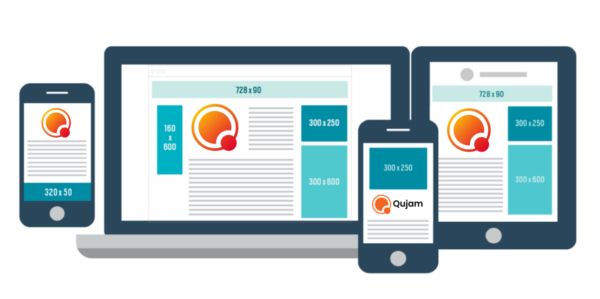
A display ad (AKA banner ad) is a boxy, visual advertisement, typically a static image, an animated GIF, or a short HTML5 creative, that appears on a website, within a mobile app, or on a platform.
Image (JPEG, PNG, GIF) or Rich Media (HTML5 with animation/interaction).
To drive brand awareness, reinforce a message, and encourage a click to a landing page or website.
It uses outbound marketing—it proactively seeks the user out (via geofence targeting in Qujam's case), unlike Search Ads, which wait for the user to search.
Display advertising networks are vast. They encompass millions of websites and mobile apps globally. When you create a geofence (e.g., around a competitor or event), the display ad format allows you to serve your message to devices that entered that precise location across a huge volume of available inventory.
Display ads are highly effective for maintaining brand awareness. By repeatedly showing your visual ad to devices that have been in your target zone (a concept often called retargeting or geo-conquesting), you stay top-of-mind with potential customers.
Compared to premium video (OTT/CTV), display inventory is typically more affordable on a Cost Per mille (CPM, or cost per thousand impressions) basis. This allows you to generate a significant volume of impressions within your geofenced area, maximizing the visibility of your message for a lower budget.
About OTT/CTV Ads
The terms Over-The-Top (OTT) and Connected TV (CTV) are often used interchangeably, but they refer to two distinct, yet interconnected, elements of modern streaming media. Essentially, CTV is the “big screen” in the living room, and OTT is the content streaming service that runs on it.
The method of delivery. It refers to video content and applications delivered directly to the viewer over the internet, bypassing traditional cable or satellite providers (e.g. Roku, Tubi, Hulu, TCL, Sling, Fawesome).
The physical device used for viewing this content. This includes smart TVs, gaming consoles (PlayStation, Xbox), and streaming sticks (Roku, Amazon Fire TV, Apple TV).
Video (typically 15 or 30 seconds). High-definition video with full audio, similar to traditional TV commercials. It is generally non-interactive (no click-through) but is designed for maximum branding and impact. The format ensures a professional, high-impact message. Since the ads are unskippable, you achieve near 100% Video Completion Rate (VCR) for geofenced audiences.
Within Streaming Content. The ad is placed during ad breaks on Connected TV (CTV) devices—Smart TVs, Roku, Fire Stick, Apple TV, gaming consoles—across Over-The-Top (OTT) streaming platforms (e.g., Roku, Tubi, Sling, local news apps, etc.).
Brand Lift, Awareness, and Attribution. To tell a compelling story, elevate brand perception, and drive measurable real-world actions (e.g., store visits, phone calls, website searches) from the targeted household audience. Driving foot traffic from geofencing campaigns. The purpose shifts from a direct click (like display) to leveraging the TV screen’s trust factor to motivate a local, measurable conversion (e.g., Geo-Conversion Lift).
Outbound Marketing on a Premium Channel. It proactively delivers a high-quality video message to a highly defined audience based on their location/household address before and while they watch their desired content.
High Impact: These are full-screen, high-definition, and often non-skippable video commercials running on the largest screen in the home, commanding undivided visual and auditory attention that fragmented mobile or display ads simply cannot achieve.
Memory Retention: The viewing takes place in a "lean-back," relaxed, long-form content environment (like watching a movie or TV show), which academic studies have shown fosters higher unaided recall and stronger cognitive attention compared to the distracted, "lean-forward" experience of small-screen digital feeds.

About Video Pre-Roll Ads
Video Pre-roll provides a great middle ground option to get the impact of video at a rate (CPM) that is more affordable than OTT/CTV.
A Video Pre-Roll Ad is a short video commercial (typically 15 seconds or 30 seconds) that plays immediately before the user's selected video content starts. This advertising can also appear during or at the end of an online video as well. Technically that's called mid-roll and post-roll, but we use video pre-roll for short since that's what most of our inventory is in. These ads appear across online video players on websites, in-app videos, and platforms like YouTube (if not classified as a CTV ad).
Video (usually 15 or 30 seconds, but it can be other lengths as well). Can be skippable (after 5 seconds) or non-skippable. They require high-quality resolution and compelling messaging to hook the viewer quickly. The short length is ideal for repeating a high-frequency message to a device that recently exited a geofenced area, maintaining top-of-mind awareness.
In-Stream. The ad is served within a video player, appearing before (pre-roll), during (mid-roll), or after (post-roll) the content the user intended to watch. It is typically viewed on a desktop computer, laptop, or mobile device. Qujam uses this placement to capture the user's attention when they are actively waiting for content, ensuring the geo-targeted ad is seen directly before they are allowed to proceed.
High Visibility and Engagement. To deliver a visual, audible message to a captive audience with the goal of driving both immediate brand recall and often a direct click-through to a specific landing page. Unlike non-clickable CTV, pre-roll on desktop/mobile is usually clickable, allowing a geofence campaign to drive immediate traffic and conversions from the targeted audience.
Sequential Messaging and Retargeting. It works to deliver a forceful message to a user who is actively engaged with digital video content, serving as a powerful follow-up to other geo-targeting efforts. It ensures that users who may have seen your Display ad, but perhaps not your premium CTV ad, still receive a high-impact video touchpoint based on their location history.
Because the ad plays directly within the video player before the desired content loads, the ad is guaranteed to be in the active viewport, resulting in very high viewability rates. For non-skippable formats, you maintain a high VCR. Even with skippable formats, the initial impact is delivered before the skip button appears, guaranteeing crucial brand exposure to the geo-targeted user. Additionally, the CPM is much lower than OTT/CTV resulting in more impressions for that same budget.
Another advantage of Video Pre-Roll is its sheer scale and omnipresence across the internet. Unlike premium OTT/CTV, which is confined to streaming services on TV sets, Pre-Roll inventory is served through programmatic ad exchanges across. This includes tens of thousands of publishers websites (news, blogs, entertainment) and apps.
About Digital Audio Ads
Digital Audio Ads represent one of the most exciting growth areas in our industry, precisely because they will allow Qujam to reach your geo-targeted audience during moments when they are highly attentive but looking away from their screens.
A Digital Audio Ad is a short, fully audible commercial that is delivered programmatically to listeners through internet-connected devices while they stream audio content. This includes streaming music platforms (like Pandora, Blog Talk Radio,and iHeart Radio), digital radio broadcasts, and podcasts.
Audio Only (typically 15 to 30 seconds). A sound file with voiceover, music, and effects. Many platforms also offer an optional Companion Banner (a visual display ad) that appears while the audio is playing. The audio format allows your message to be delivered to a geofenced user's device (or connected device) while they are driving or walking—key moments when they are physically closest to your location.
In-Stream Audio. The ads are placed during natural breaks in the streaming content (between songs, at podcast ad markers) on devices like smartphones, smart speakers, tablets, and smart car infotainment systems. Placement in these channels means we are reaching the targeted device (captured by the geofence) in environments where display and video ads cannot be seen, maximizing total touchpoints.
High Ad Recall and Non-Intrusive Branding. To create a strong, memorable sensory link between your brand and the geo-targeted user in a relaxed, focused environment. The purpose is to leverage the high ad recall of audio to ensure the user remembers your business (e.g., your jingle or offer) after they have visited your geofenced location.
Companion Medium and Sequential Messaging. It acts as a companion to the user's activity (running, working, driving) and is used to reinforce a geo-targeted message multiple times throughout their day. The function is to capture the attention of an audience segment proven to be highly engaged with audio, leading to measurable foot traffic, site traffic, brand awareness, and eventually sales.
Audio is a "screenless" format, meaning listeners are typically highly focused on the content, leading to higher levels of cognitive attention and superior ad recall compared to fragmented visual formats.
Audio ads allow you to target devices that have been in your geofence during times and activities when they are not actively looking at a screen (e.g., during their morning commute or workout). The addition of audio advertising will not only expand Qujam and your inventory, reach, and frequency, but also the key moments to reach your audience.