
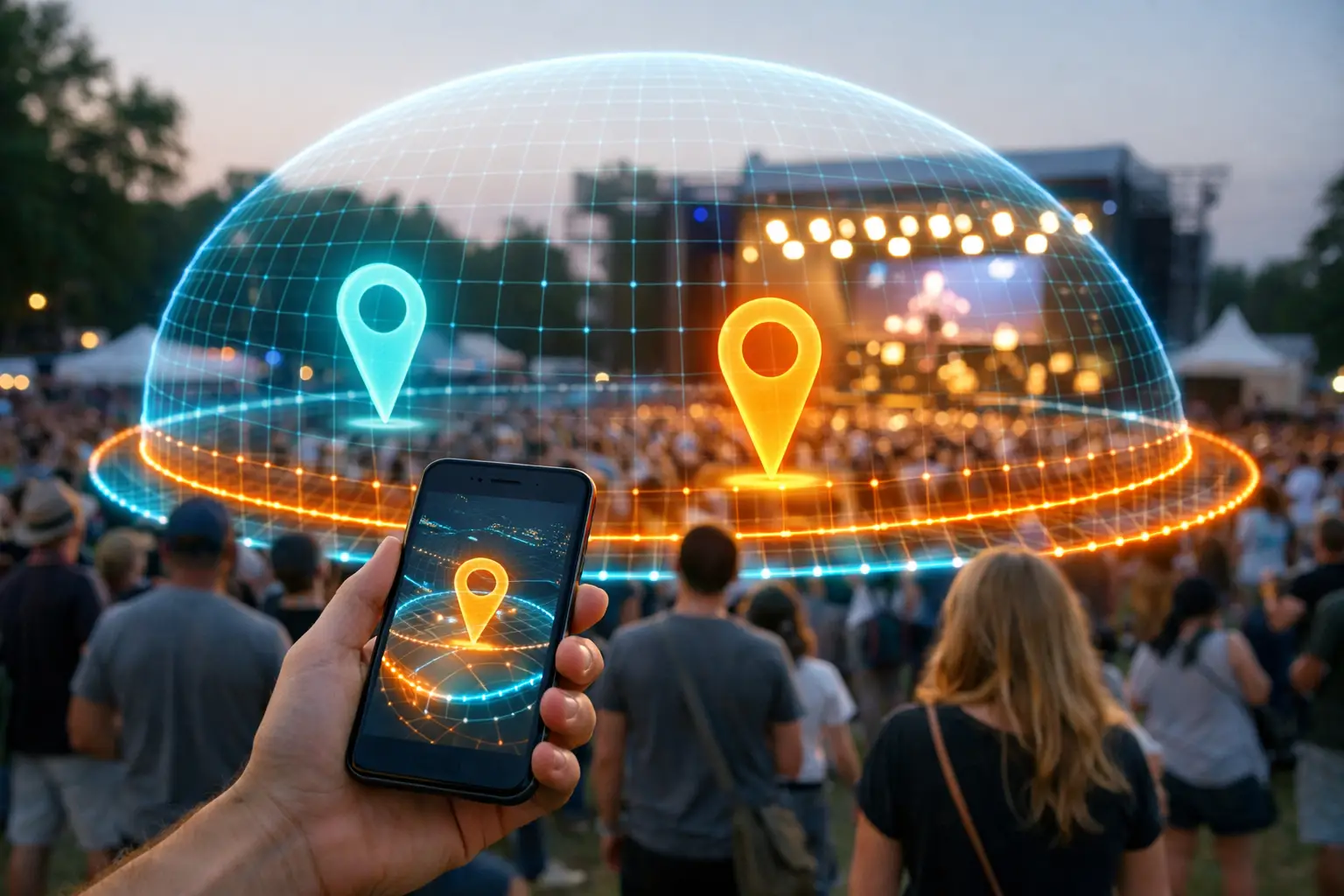

A packed convention hall is full of intent. People traveled, showed up, and spent real time around a specific topic, brand category, or buying decision. That is exactly why marketers ask, how does event geofencing work? They want a way to turn event attendance into a measurable ad audience instead of hoping booth traffic alone carries the whole result.
Event geofencing is a location-based advertising method that draws a precise virtual boundary around an event space so advertisers can identify devices seen within that footprint and later serve ads to those visitors across those devices and other connected devices to the identified device (called cross-device matching). The key idea is simple: you are not buying broad local traffic around a city or ZIP code. You are targeting people who physically appeared at a conference, trade show, festival, stadium, expo hall, or another defined venue.
How does event geofencing work in practice?
At a practical level, event geofencing starts with mapping the event area. That boundary can be built around a convention center, a fairground, a hotel hosting an industry conference, parking lots, concert venues, or even smaller sections of a larger property when the technology allows for tighter precision. This matters because event campaigns often fail when advertisers rely on loose radius targeting that scoops up nearby traffic from roads, coffee shops, parking lots, and unrelated businesses, or misses temporary event attendees all together.
Once the geofence(s) and event dates are set, the system looks for mobile ad IDs or other eligible device signals associated with users who enter that defined area during the day(s) of the event. Devices are observed over time, and the platform applies rules to determine whether those visits count toward the audience. For example, a brief pass-by may not be as valuable as a person who stayed at the venue for several hours. That distinction helps separate actual attendees from incidental traffic.
After validation, those audiences can be used for ad delivery across available inventory such as mobile apps, websites, connected TV, desktop, video pre-roll, and digital audio. The event itself creates the audience, but the majority of the ads usually appear later, after attendees have left the venue and gone back to their normal media habits. Event geofencing can serve ads to event goes for up to 30 days following the event.
The four parts behind event geofencing
The mechanics are easier to understand when you break them into four pieces: the location boundary, the audience capture window, the identity match, and the ad delivery layer.
The location boundary is the digital fence itself. This is where precision matters most. If the fence is too wide, the audience gets polluted. If it is too narrow or poorly placed, you can miss legitimate attendees. A strong setup uses property-level or venue-level targeting rather than lazy radius assumptions.
The audience capture window is the period during which devices can qualify. Some campaigns target only the dates and hours of the event. Others include setup day, registration periods, or post-event activity in adjacent spaces. It depends on the goal. A brand looking for pure attendee targeting may stay tight. A sponsor trying to reach exhibitors, vendors, and attendees may allow a wider capture schedule.
The identity match is what allows later ad delivery. A device seen at the event becomes part of an audience segment that can be reached later across supported inventory. This is where event geofencing becomes more than a pin on a map. It turns real-world behavior into a targetable advertising audience.
The ad delivery layer is where campaign strategy matters. Some advertisers run display ads to stay fresh in memory. Others use video, audio, or OTT/CTV to make a stronger impression. Often, it’s best practice for ads to run the full 30 days after the event, but sometimes a shorter time frame might be required to match up with other time sensitive initiatives like elections, holidays, or sales.
Why event geofencing is different from regular location targeting
A lot of advertisers think event geofencing is just local targeting with a fancier name. It is not. Standard location targeting often means a radius around an address, a city, or a ZIP code. That can work for broad awareness, but it is inefficient when your real goal is reaching people who physically attended one specific event.
Event geofencing is narrower and more behavior-driven. You are not saying, show ads to anyone in downtown Chicago. You are saying, show ads to people who were inside this convention center during this trade show. That difference cuts waste and gives the audience much stronger intent.
It also makes event geofencing useful for competitor targeting. If your competitor is exhibiting at a large conference, you may be able to build an audience from attendees at that event and continue the conversation after the show. The catch is that event size, venue shape, and targeting precision all affect quality. Bigger is not always better if the audience becomes less relevant.
What happens after attendees are captured?
This is where the business value shows up. Once event attendees are in an audience segment, advertisers can retarget them with messages built for the next step. A law firm sponsoring an HR conference might run ads offering a compliance checklist. A home services brand at a local expo might promote a limited-time estimate. A software company may follow up with a demo request, case study, or webinar invitation.
The best post-event campaigns match the stage of intent. Not every attendee is ready to buy right away, so the creative should reflect that. Sometimes the right move is brand reinforcement. Other times it is a direct lead offer. If your audience is warm but not yet decision-ready, aggressive sales messaging can backfire.
This is also why multi-channel delivery matters. Display can build repetition, video can tell a clearer story, OTT/CTV can extend reach into the household, and Digital Audio helps show up during non-screen time activities. Event geofencing works best when it is part of a complete follow-up plan, not a one-off tactic.
How accurate is event geofencing?
This is the right question, because accuracy is where many providers overpromise. Event geofencing can be highly effective, but precision depends on the quality of the geofence setup, the signal sources available, venue layout, foot traffic density, and how the campaign defines a qualifying visit.
Indoor venues can be tricky. Large convention centers, stadiums, and mixed-use properties may have overlapping traffic patterns. If the event is held next to restaurants, hotels, or public walkways, careless targeting can pull in people who were never part of the event. That is one reason hyper-specific geofencing matters more than broad radius methods.
There is also a scale trade-off. A smaller, tightly defined audience is often more valuable than a larger, sloppier one. Some advertisers focus too much on how many devices can be captured and not enough on whether those devices represent the right people. Good event geofencing is not about stuffing the audience. It is about reducing wasted impressions.
Events do add a layer of catch complexity with large building interference with the GPS tracking and potential Wi-Fi location confusion. However, the system is designed to qualify the audience, so if there is any indicator the person was not at the location it will exclude the device from the target list. This is obviously helpful, but can limit the captured audience when the validation process over protects.
Common uses for event geofencing
Event geofencing is flexible, but a few use cases show up again and again. Brands use it to retarget trade show attendees. Agencies use it to build local audiences from festivals, sporting events, and community gatherings. Franchise groups use it to reach people who attended relevant expos or regional events. Political and advocacy campaigns may use event-based audiences to keep messaging in front of supporters or persuadable groups.
It is also useful when your team cannot rely on booth scans or lead forms alone. Plenty of event attendees never stop to talk, even when they fit your ideal customer profile. Geofencing gives you another way to stay in front of that audience after the event ends.
What to watch out for before launching
The biggest mistake is poor boundary planning. If you geofence the wrong footprint, nothing else fixes it. Another common issue is weak creative and limited ad size variations. Even with a strong audience, unconvincing ads will underperform, and not having enough sizes will limit your inventory options. Event attendees need context. Why are you following up? What problem do you solve? What should they do next?
Timing matters too. If you wait too long, recall drops. If you start too early with the wrong message, you risk feeling repetitive. Budget allocation also matters. Some campaigns work best with a short, concentrated push after the event, while others need a longer nurture window.
And yes, reporting matters. If you cannot see delivery, engagement, conversions, and audience behavior clearly, event geofencing becomes harder to optimize. That is one reason self-serve control has become more attractive. Advertisers want faster setup, better visibility, and fewer managed-service bottlenecks.
How does event geofencing work best for advertisers?
It works best when the event audience is clearly relevant, the venue can be mapped precisely, and the follow-up offer matches real buyer intent. It is especially effective for businesses that want more than event-day exposure. If your goal is to stay in front of attendees after they leave, event geofencing gives you a practical way to do that without spraying ads across a broad market.
For many advertisers, the smartest move is not just targeting an event. It is targeting the right event, with the right footprint, and a campaign plan ready to go the moment the audience is captured. That is where event geofencing stops being a buzzword and starts acting like a real performance channel.
If you are considering it for your next conference, expo, or local event, think less about the map and more about the follow-up. The fence gets the audience. The strategy after that is what turns attendance into actual business results.


