
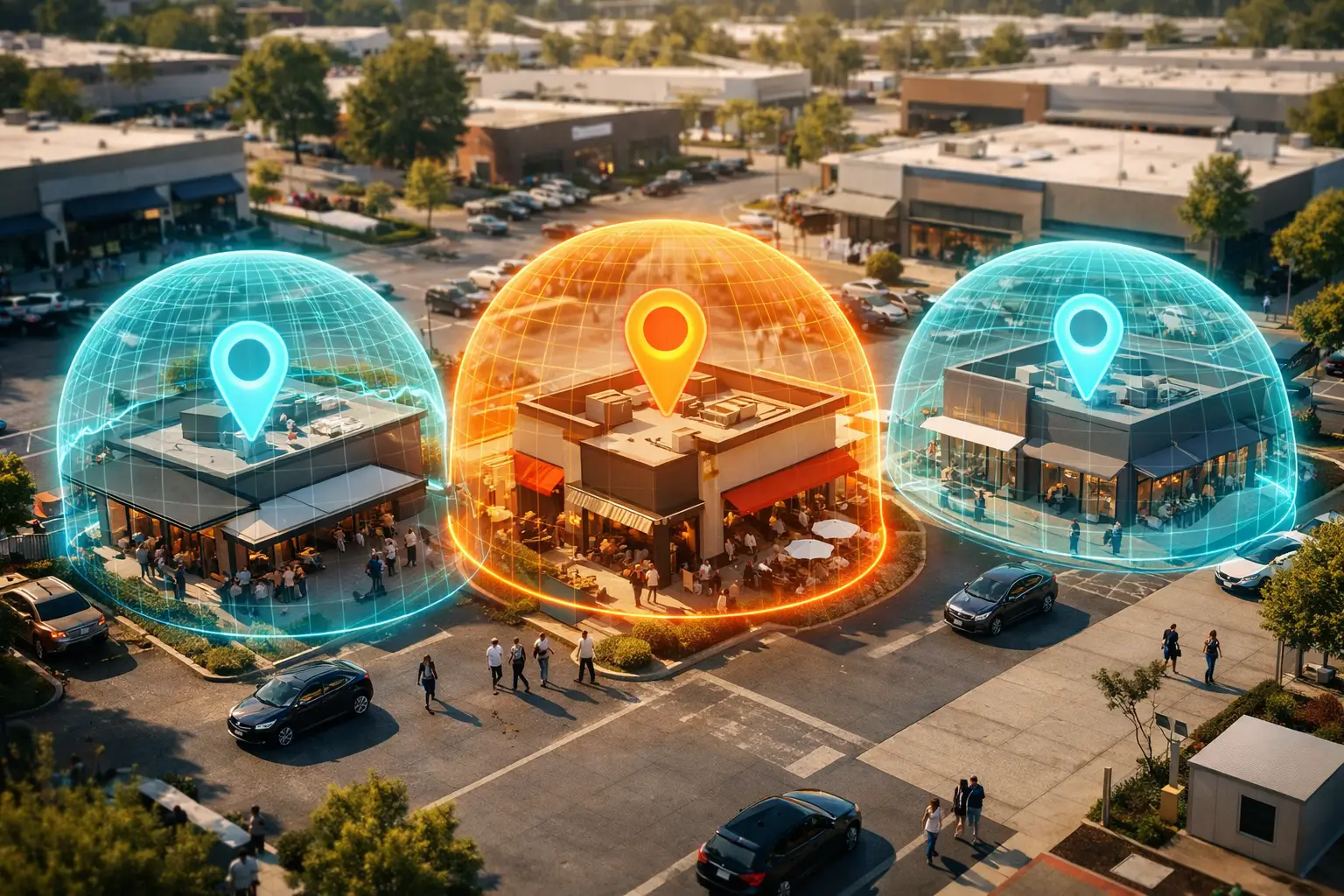

One franchise location is struggling with foot traffic. Another is packed every weekend. A third sits three blocks from a major competitor. Treating all three with the same media plan is a fast way to waste budget. Geofencing for franchise marketing works because it lets brands advertise based on where people actually go, not just broad assumptions about who they are.
For franchise systems, that matters more than it does for a single-location business. You are balancing national brand standards with local market reality. Every store shares the same name, but not the same trade area, competitive pressure, seasonality, or customer behavior. Location-based targeting gives franchise marketers a practical way to respect both sides of that equation.
Why geofencing fits the franchise model
Franchise marketing usually breaks down in one of two places. Either the brand team keeps too much control and local relevance suffers, or individual operators run disconnected campaigns that create inconsistency and wasted spend. Geofencing sits in a useful middle ground.
A franchise brand can set the strategic framework, define approved audiences, and maintain creative standards. At the same time, individual markets can target the places that actually influence buying decisions nearby. That might mean competitor locations in one city, apartment communities in another, and event venues or commuter corridors in a third.
This is what makes geofencing more than a niche ad tactic. It solves a structural problem that franchise systems deal with all the time: how to market locally without losing operational control.
How geofencing for franchise marketing actually works
At its simplest, geofencing means drawing a virtual boundary around a real-world location and delivering ads to people associated with that area. In franchise marketing, those boundaries can be built around your own stores, competitor stores, nearby businesses, event venues, neighborhoods, or specific service areas.
The most effective campaigns usually go beyond simple proximity. Instead of just reaching anyone near a location at one moment, many advertisers focus on users who have physically visited a relevant place. That changes the value of the audience. Someone who drove past a shopping center is not the same as someone who spent time inside a competing franchise location last week.
Once that audience is identified, ads can continue across devices, including phones, tablets, desktops, and connected TV. That extended reach matters because most franchise purchases do not happen the second a person crosses a parking lot. People compare options, talk to family members, wait until payday, or make a decision later that week. Geofencing helps brands stay visible during that window.
The best franchise use cases are highly local
A lot of marketers hear “franchise” and immediately think scale. Scale matters, but geofencing performs best when the local use case is clear.
A quick-service restaurant franchise might target customers who recently visited competing burger chains within a five-mile trade area. A fitness franchise may focus on people who have been to nearby gyms, health clubs, or wellness centers. A home services franchise can geofence ZIP codes, neighborhoods, and home improvement retailers to stay in front of likely buyers. Retail franchises often use geofencing to capture traffic from nearby shopping centers or promote a new location opening.
The difference is intent. Broad audience targeting can find people who fit a demographic profile. Geofencing can find people whose real-world behavior suggests they may actually convert.
That does not mean every location should run the same campaign type. A suburban franchise with little direct competition may get better results targeting residential pockets and commuter patterns. An urban location with dense competition may benefit more from conquesting nearby rivals. It depends on what drives visits in that market.
Where franchise brands get geofencing wrong
The most common mistake is over-centralization. Corporate teams often build a campaign once and force every location into the same targeting map. It is efficient on paper, but it ignores the fact that local conditions are different. A radius that makes sense in Dallas may be far too wide in Chicago and far too narrow in a smaller market.
The second mistake is the opposite: giving local operators full freedom without guardrails. That creates inconsistent creative, overlapping geofences, duplicated spend, and reporting that no one can compare across the system.
Then there is the vendor problem. Many franchise marketers have run into geofencing providers that make the channel harder than it needs to be. High minimums, managed-service bottlenecks, slow setup, unclear reporting, and limited visibility turn a smart local tactic into a frustrating procurement exercise. For franchise systems with many locations, that friction adds up fast.
A better setup gives central teams control over standards while still making it easy for local marketers or agency partners to launch, adjust, and measure campaigns without waiting on someone else to push every button.
How to build a geofencing strategy across franchise locations
The first step is deciding what should be standardized and what should stay local. Your brand should standardize core creative rules, conversion goals, attribution windows, and reporting definitions. That keeps performance measurement clean across markets. But the target locations themselves often need local flexibility.
Start by grouping franchise locations by market type instead of treating them as one giant pool. Dense urban stores, suburban stores, rural stores, and new openings often need different geofencing logic. So do owner-operated locations versus those supported heavily by corporate marketing.
Next, match geofences to business goals. If the goal is conquesting, target competitors with clear overlap. If the goal is awareness, focus on trade areas, events, and nearby destinations with strong foot traffic. If the goal is lead generation for a service franchise, build around neighborhoods and high-intent places tied to the service category.
Then get disciplined about measurement. Franchise marketers often care about store visits, leads, booked appointments, coupon redemptions, and market-level lift. Pick the KPI that reflects the actual customer path. A connected TV campaign aimed at future recall will not behave the same way as a display campaign built to drive same-week traffic.
Creative matters more than many franchise teams expect
Precise targeting does not rescue weak messaging. If your ad reaches the right person at the right time but says nothing useful, the campaign still underperforms.
For franchise brands, the best creative usually combines national consistency with local relevance. Keep the logo, offer structure, and brand voice aligned, but tailor the copy to the market when possible. Mention a grand opening, a local promotion, a seasonal service need, or a neighborhood-specific value point. That small shift can make ads feel less generic and more actionable.
Frequency also matters. Because geofencing audiences can be tightly defined, it is easy to overexpose users if the campaign is not managed carefully. The fix is not to abandon the tactic. It is to watch pacing, rotate creative, and make sure the audience size matches the campaign budget.
Reporting is where good franchise programs separate from bad ones
If you cannot see what each location is doing and what each location is getting back, the program will eventually lose support. Franchisees want proof. Corporate teams want comparability. Agencies want enough transparency to optimize without guesswork.
That means reporting cannot stop at impressions and clicks. You need market-level visibility into audience source, delivery, conversion activity, and timing. It should be easy to tell whether one location is underperforming because of weak creative, a poor target set, low spend, or simply a market with different buying behavior.
This is one reason self-serve geofencing platforms have become more appealing to franchise marketers. They reduce the lag between question and action. If a location needs to swap creative, refine a target area, or launch a new campaign around a local event, you should not have to wait through a managed-service queue to get basic changes made.
Is geofencing for franchise marketing worth it?
Usually, yes – if the campaign is built around real local behavior and not treated like a plug-and-play checkbox.
Geofencing is especially strong for franchise brands that need to cut waste, defend territory, win customers from competitors, and give local operators more relevant advertising without giving up visibility. It is less effective when the offer is weak, the trade area is misunderstood, or the campaign is forced into the same template everywhere.
That is the real opportunity. Franchise marketing does not need more complexity. It needs better control at the local level, clearer data, and targeting that reflects how people actually move through the market. Geofencing can do that when the tools are practical enough to use and the strategy is grounded in each location’s reality.
If you run franchise marketing, the smartest next move is not chasing more impressions. It is getting closer to the places that shape buying decisions, then building campaigns your local teams can actually act on.


