
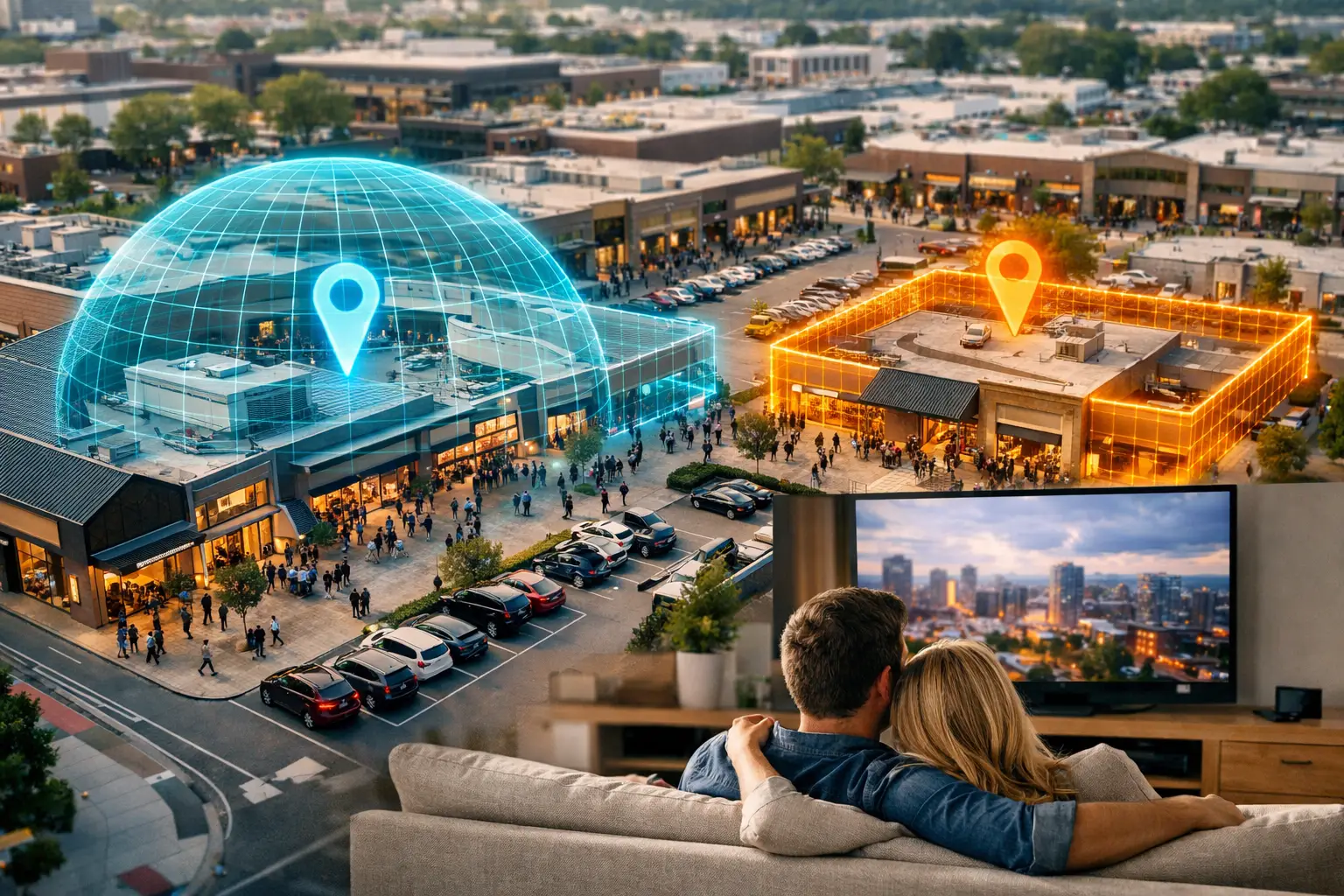

A streaming TV campaign looks impressive on paper until you realize half the budget went to households that were never likely to buy from you. That is exactly why CTV advertising with geofencing gets attention from local businesses, agencies, and multi-location brands. It gives you a way to combine the reach of Connected TV with the precision of real-world location data, so your ads show up in front of people who have actually been somewhere that matters to your business.
What is OTT and how is it different than CTV?
In programmatic video marketing, OTT (Over-the-Top) refers to the delivery mechanism of streaming video content over the internet, bypassing traditional cable, satellite, or broadcast networks via streaming services like Roku, Tubi, LG, Samsung, Sling TV, etc… While often used interchangeably with CTV (Connected TV), they represent two distinct elements of the streaming ecosystem: OTT is the content delivery method (which can be watched on any screen, including smartphones, tablets, and laptops), whereas CTV refers specifically to the physical internet-connected device used to display that content (such as a Samsung Smart TV, Roku stick, Apple TV, or Xbox).
The primary similarity between the two is that both bypass linear television to unlock premium, digital, non-skippable video inventory that can be bought programmatically. The fundamental difference lies in screen size and viewer context—all CTV advertising is technically OTT, but not all OTT advertising happens on a television screen.
For a DIY geofencing platform like Qujam, this distinction is a massive targeting superpower. We capture anonymous location data (Mobile Device IDs) from users walking through physical boundaries in the real world, map those devices to a unified household graph, and give you the flexibility to deploy your ads across the entire OTT landscape—whether you want to catch a prospect on their smartphone tablet during a lunch break or dominate the living room on a dedicated CTV big screen later that evening.
What CTV advertising with geofencing actually means
Connected TV, or CTV, refers to ads served through internet-connected televisions and streaming devices. Think smart TVs, Roku, Fire TV, Apple TV, and streaming apps. Geofencing is the practice of defining a real-world location and building an audience based on device activity tied to that place. This includes cross-device matching where a mobile device enters a geofence and is identified, but if that device is connected to another device (TV, computer, tablet, other cell phone) then the campaign can serve ads to those connected devices as well. That’s how geofence targeting can get CTV ads on your TV even though the TV never enters a geofence.
When you put them together, you are not just buying TV inventory by age or broad interest. You are reaching households linked to mobile devices that visited a specific location, such as your store, a competitor location, an event venue, a neighborhood, or a commercial district. That changes the value of the impression. Instead of hoping the right person happens to be watching, you are starting with intent or relevance and extending your message onto the biggest screen in the home.
That distinction matters because CTV on its own can still be wasteful. Streaming inventory may feel more targeted than traditional television, but without strong audience inputs, it can drift into the same old problem – broad delivery, vague reporting, and a lot of spend that looks better in a deck than in your pipeline.
Why businesses are pairing CTV with geofencing
For many advertisers, the appeal is simple. You want TV-level attention without TV-level waste.
A local home services company can target households associated with devices seen in high-value ZIP codes or neighborhoods inside its service area. A restaurant group can build audiences from people who visited nearby entertainment venues and then serve video on streaming TV while those customers are still deciding where to eat next. A retail brand can target visitors to competing stores and stay in front of them beyond the parking lot.
This approach is especially useful for advertisers who care about local market control. If you manage multiple locations, franchise territories, or regional campaigns, geofencing lets you shape an audience by the places people actually go. Then CTV helps you deliver a stronger brand message than a standard display ad often can.
There is also a practical advantage. People may ignore banners, scroll past social ads, or skip around digital clutter. A well-placed CTV ad gets more focused attention. It is lean-back media, viewed on a full screen, often with sound on. If you already know the viewer is tied to a relevant location, that impression becomes much more valuable.
How the targeting works in the real world
The mechanics are more straightforward than they sound. First, an advertiser defines the places that matter. That could be competitor storefronts, your own business location, event venues, apartment complexes, medical offices, dealerships, or targeted neighborhoods.
Then, mobile device data tied to visits in those places is used to build an audience. From there, that audience can be extended across devices in the household, including CTV. The result is not random TV buying. It is location-informed household targeting.
The quality of the setup matters a lot. A sloppy geofence around a busy shopping center can pick up people who were never relevant. A smarter setup may isolate a specific building, store footprint, or event space and apply time thresholds to reduce accidental passersby. That is where campaigns either get efficient or get noisy.
The creative strategy matters too. A 15-second CTV spot aimed at people who visited a competitor should feel different from a brand-awareness ad shown to a broad local audience. If the targeting is specific, the message should be specific too.
Best use cases for CTV advertising with geofencing
This strategy is not for every campaign, but it is powerful in a few situations.
Competitive conquesting is one of the clearest examples. If someone has physically visited a competing business, they have shown real market activity. Serving that household a streaming TV ad gives you a chance to change the next decision, not just increase generic awareness.
Event follow-up is another strong use case. Conferences, festivals, trade shows, fairs, and sports events generate temporary but valuable audiences. Geofence the venue, capture attendee visits, and continue the conversation later through CTV and other digital channels. For agencies and event marketers, that can stretch the impact of a one-day or one-weekend activation.
Multi-location brands also benefit because each location can have its own audience logic. One store may target nearby neighborhoods, another may conquest a rival down the road, and another may focus on recent visitors for retention messaging. You are not forced into one-size-fits-all regional targeting.
Service businesses can also make this work, even without a storefront. If your company serves defined territories, geofencing can focus on the places and audience signals most likely to generate quality leads, then use CTV to reinforce your offer in those households.
The trade-offs advertisers should understand
This is where a lot of marketing content gets too polished. CTV advertising with geofencing is effective, but it is not magic.
First, scale depends on the audience source. If your geofence is too narrow or the location does not generate enough qualified traffic, your CTV audience may be limited. That is not always bad. A smaller, better audience often beats broad local waste. But if you need fast mass reach, CTV plus geofencing may need to be paired with broader tactics.
Second, timing affects performance. A campaign targeting recent visitors to a car dealership will likely need a different recency window than one targeting event attendees or quick-service restaurant traffic. Some buying decisions happen within days. Others take weeks. If your audience window is off, performance can suffer even if the targeting concept is solid.
Third, measurement requires realistic expectations. CTV is excellent for awareness, recall, and influence, but it may not produce instant click-heavy results the way paid search can. The right way to evaluate it depends on the campaign. Website traffic lift, branded search lift, conversion zone activity, foot traffic, and assisted conversions may matter more than direct response alone.
And finally, not every provider makes this easy. Some platforms still hide behind managed-service models, unclear reporting, and high minimums that make testing expensive. That is one reason self-serve tools have become more appealing. Advertisers want control over setup, budgets, and reporting instead of waiting on someone else to push buttons.
How to build a smarter campaign
If you are planning a campaign, start with the audience before the inventory. The most common mistake is getting excited about streaming TV and treating geofencing like an add-on. It should be the opposite. The location strategy is what makes the CTV buy smarter.
Pick a location set tied to real business value. That might be competitors, past event attendance, service-area neighborhoods, or your own stores. Then define what success looks like. Do you want more store visits, branded search, appointment requests, or general local awareness among likely buyers?
From there, match the creative to the audience. A generic brand video can work, but location-based audiences usually deserve a sharper message. If you are targeting people who visited a competitor, give them a reason to switch. If you are targeting event attendees, reference the category or need state that brought them there.
Budgeting should stay practical. Start with a test large enough to gather signal, but not so large that you commit before learning. Watch delivery, audience quality, and post-view outcomes. Then adjust the fence, recency window, creative, or geographic focus based on what the reporting shows.
For advertisers who want more control without the usual ad-tech friction, platforms like Qujam make this process a lot more accessible. That matters because the strategy works best when you can launch quickly, see what is happening, and refine campaigns without getting trapped in a slow managed-service cycle.
Where this fits in a broader media mix
CTV should not be treated like an island. It works best when it is part of a coordinated campaign.
A strong setup often combines geofenced display, video pre-roll, audio, and CTV/OTT so the audience sees your brand across multiple moments and devices. CTV and OTT handles high-impact storytelling. Display helps with repetition and response. Video pre-roll and digital audio can reinforce the message. Combined, that creates a fuller path from awareness to action.
That does not mean every campaign needs every format. It means the best media plans are built around how the customer actually moves through the market. Someone might first see your brand on TV, then search later, then convert after another reminder on mobile. If your targeting is rooted in real visitation behavior, each impression has a better chance of landing.
CTV has become easier to buy. That does not mean it should be bought casually. The advertisers getting the best results are not just buying streaming impressions because the channel is popular. They are using real-world location data to decide who matters, where those people came from, and how to stay visible after the visit. If your goal is less waste and more relevance, that is a much better place to start.


