
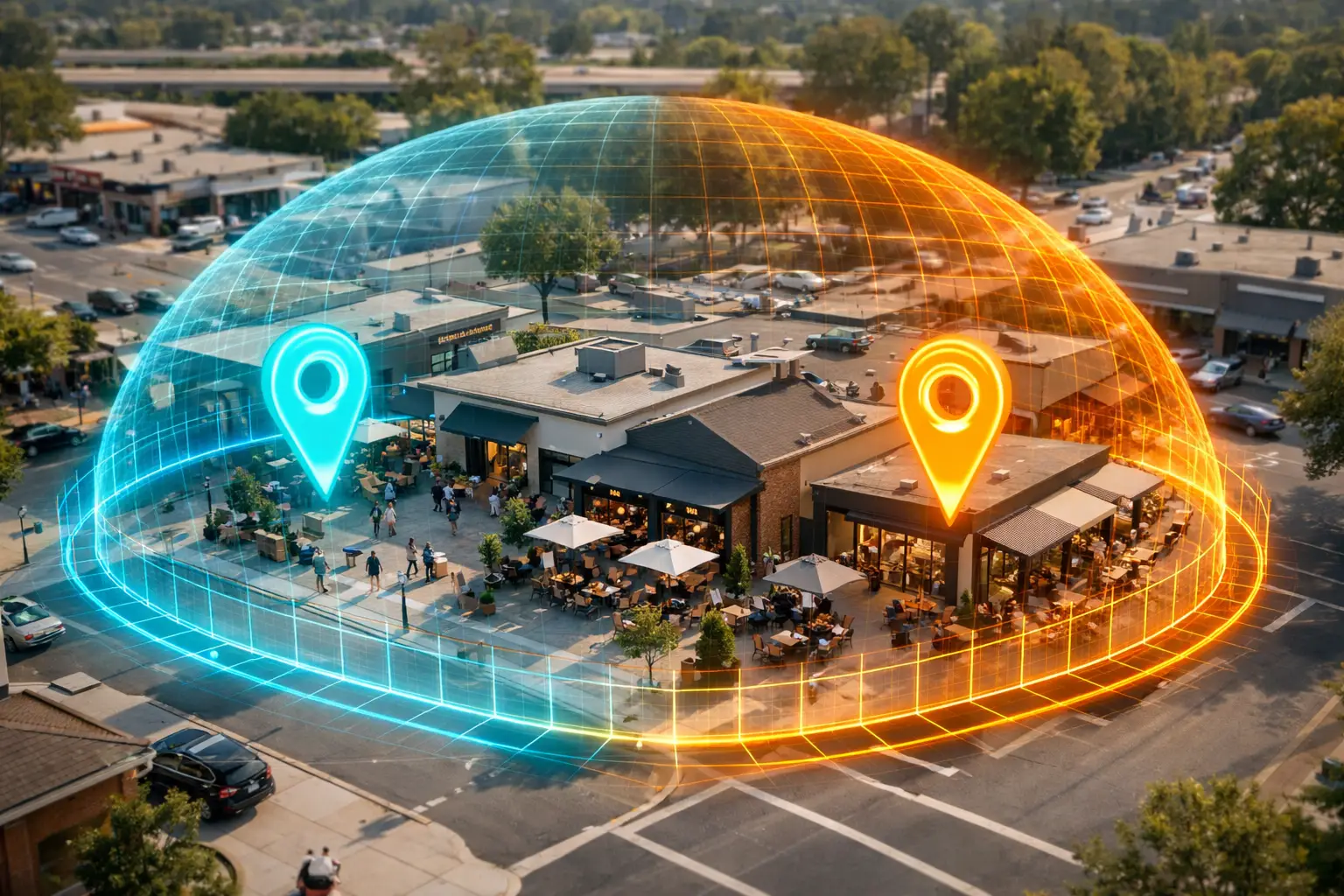

A coffee shop two blocks away is stealing your lunch traffic. A competitor across town is pulling in the exact customers you want. A local event just brought thousands of likely buyers into your market for one weekend. Geofencing for small business gives you a way to target those people based on where they actually go, not just who they might be on paper.
That matters because most local advertising still wastes money. Broad audiences sound good until you realize half your budget went to people outside your service area, outside your price range, or outside your category altogether. Geofencing changes that by letting you draw a virtual boundary around a location and serve ads to devices tied to people who entered that area.
What geofencing for small business really means
At its simplest, geofencing is location-based advertising. You define a place that matters to your business, such as your own storefront, a competitor location, a trade show, a neighborhood, a stadium, or a service area. When someone enters or has visited that defined area, they can become part of an audience for future ad delivery across devices like phones, tablets, desktops, and connected TV.
For small businesses, the appeal is obvious. You are not trying to reach everyone. You are trying to reach likely customers in a specific place, at a specific moment, or after a specific visit. That makes geofencing useful for local lead generation, foot traffic campaigns, awareness pushes, event follow-up, and conquest campaigns aimed at competitor shoppers.
It also helps level the playing field. A small business usually cannot outspend a large chain, but it can often out-target one. If your budget is tight, precision matters more than volume.
Where geofencing fits in a local marketing plan
Geofencing works best when the business has a clear geographic advantage or a clear location signal to act on. Restaurants can target nearby offices, apartment complexes, and competitor dining locations. Auto dealers can target competing lots and local events. Home service companies can target neighborhoods within their actual service radius instead of paying for clicks from the wrong ZIP codes.
It is also strong for businesses with sales cycles that are not instant. If someone visited a furniture store, an urgent care clinic, a senior living facility, or a bridal expo, they may not convert that same day. Geofencing lets you stay in front of them after that real-world visit with display, video, audio, or TV ads.
That said, geofencing is not magic. If your offer is weak, your creative is generic, or your landing page is confusing, precise targeting will not save the campaign. Better targeting improves efficiency, but the message still has to do its job.
How a small business should choose geofencing targets
The biggest mistake is starting too wide. If you geofence half a city because it feels safer, you usually dilute the audience and the budget. Good geofencing starts with business intent.
If your goal is conquesting, target competitor locations where buyers are already showing category intent. If your goal is foot traffic, target a tight radius around your store plus nearby places that over-index for your customers. If your goal is event follow-up, target the venue during the event window and retarget attendees afterward.
The strongest targets usually fall into five buckets: your own locations, competitor locations, relevant events, high-value neighborhoods, and practical service areas. Each one can work, but the right one depends on how people buy from you.
A dental office, for example, may get better results targeting nearby households and competitor practices than targeting a downtown business district. A B2B company may care more about conference venues and office clusters. A local gym may want apartment communities, supplement stores, and competing fitness centers. The point is not to geofence everything. The point is to geofence places that reveal intent.
What makes a geofencing campaign effective
The targeting gets attention, but performance comes from the setup. Start with one clear objective. Do you want calls, form fills, store visits, booked appointments, or simple brand lift in a defined market? If you try to do all of that at once, the campaign usually turns muddy.
Then match the ad format to the goal. Display ads are flexible and cost-efficient for awareness and retargeting. Video pre-roll helps when you need stronger storytelling or want to stand out in a crowded category. Digital audio can work well for frequency and local recall. OTT and CTV are strong when your audience spends time on streaming platforms and you want bigger-screen visibility tied to real-world location behavior.
Creative matters more than many advertisers expect. If your ad says nothing beyond your business name, location targeting can only carry it so far. A better ad gives people a reason to act now. That could be a specific offer, a clear differentiator, a deadline, or a local message that feels relevant to where they were.
Timing also matters. Some audiences should be reached quickly after a visit, while intent is still fresh. Others benefit from a longer message cadence over days or weeks. A weekend event audience may respond best right after attendance. Someone researching roofing companies may need repeated exposure over a longer consideration window.
The trade-offs small businesses should know
Geofencing is powerful, but it is not the right fit for every campaign. If your business sells nationally with no local angle, geographic targeting may be less important than behavior or demographic targeting. If your audience is too niche and the geofence is too small, scale can become a problem.
There is also a balance between precision and volume. Smaller fences usually improve relevance, but if they are too tight, audience size drops and delivery can slow. Larger fences increase scale, but can introduce waste. The right setup is usually a middle ground based on the actual foot traffic and buying behavior of the locations you choose.
Measurement can also vary by objective. Some businesses care about store visits. Others care about online leads. Others need both. That is why conversion zones, post-click actions, and transparent reporting matter so much. If you cannot see what happened after the impressions, it becomes hard to improve the campaign with confidence.
Why many small businesses get frustrated with geofencing
A lot of frustration has nothing to do with the strategy itself. It comes from how the campaigns are sold and managed. Some providers hide geofencing behind high minimum spends, slow setup, managed-service bottlenecks, and reporting that tells you very little beyond impressions. That is a problem for small businesses that need speed, control, and a realistic budget.
The better approach is simple: make campaign setup fast, let advertisers control targeting and spend, and show performance clearly enough that they can make smart adjustments. That is one reason self-serve geofencing has become more appealing. Businesses do not want to wait for a sales rep to change a radius or explain where their money went.
For small teams and agencies, direct access is not just convenient. It is operationally better. You can test a competitor audience against a neighborhood audience, adjust creative, monitor delivery, and refine the campaign while it is still live.
Getting started with geofencing for small business
If you are new to geofencing, keep the first campaign tight. Pick one audience, one goal, and one offer. A local retailer might target competitor store visitors with a limited-time discount. A med spa might target women who attended a bridal expo. A home service company might target a handful of high-value neighborhoods within its actual service area.
From there, watch the metrics that match the goal. Do not obsess over clicks if the campaign is built for store visits or view-through conversions. At the same time, do not accept vague performance claims. You should know where the campaign ran, who it aimed to reach, what creative was used, and what happened after delivery.
This is also where platform simplicity matters. A tool like Qujam is built around the reality that most advertisers want geofencing without the usual friction – no bloated process, no unnecessary minimums, and no mystery around results.
The businesses that win with geofencing are rarely the ones with the biggest budgets. They are the ones that understand local intent, build a focused audience, and keep refining the message. If your marketing dollars need to work harder, start where customer behavior is easiest to spot: the places people already choose to go.


