
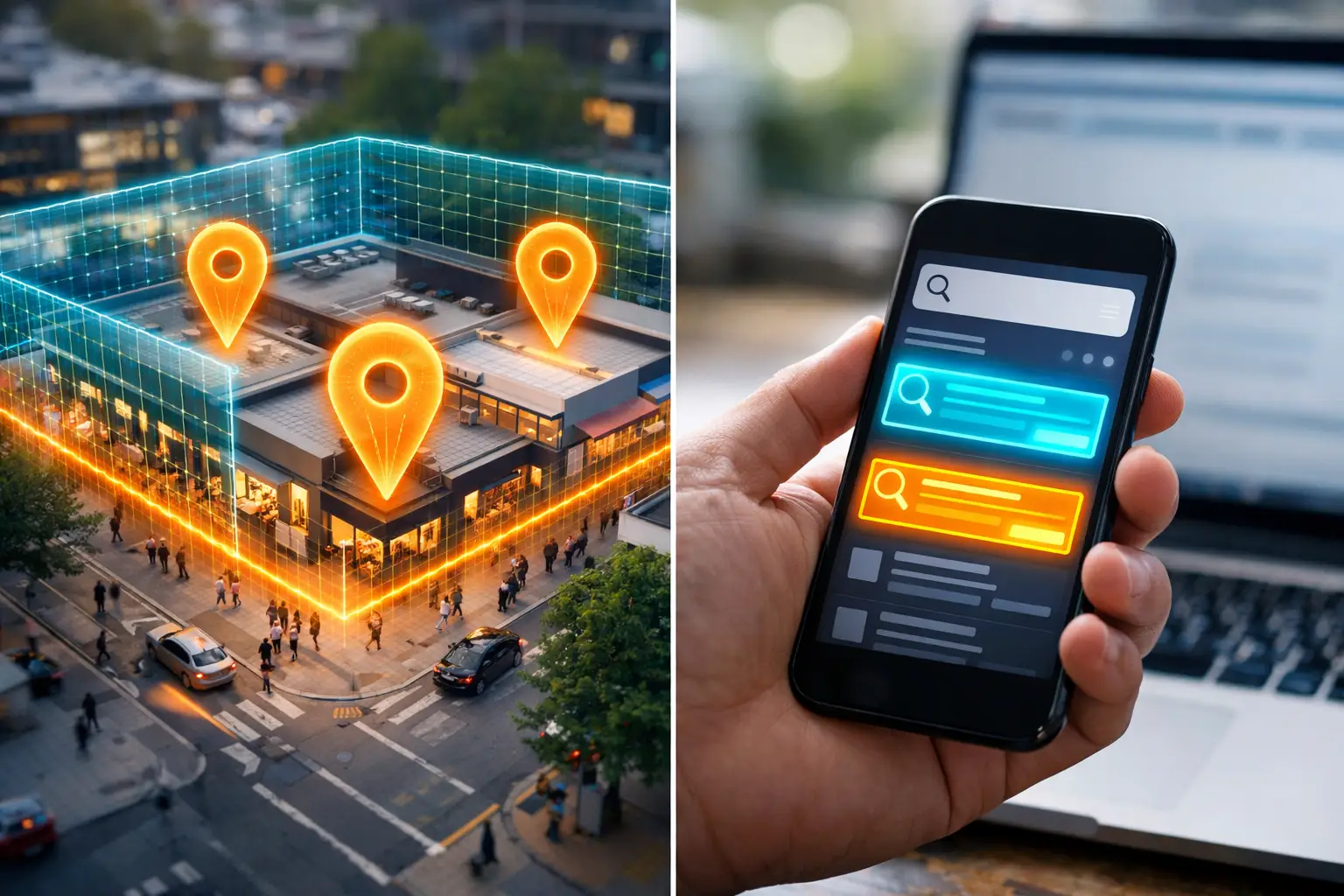

A homeowner searches “roof repair near me” on their smartphone immediately after a severe storm passes. Another homeowner lives in an ideal, high-value subdivision that just got pummeled with hail, but they never execute an online search at all. If you are analyzing geofencing vs search ads, that behavioral gap changes everything. These programmatic channels do not merely deploy different targeting mechanisms—they solve entirely separate operational business problems.
Search advertising is custom-built to capture existing, active demand. A prospect types a query into a search engine, and your business attempts to intercept them at the exact moment of consideration. Geofencing approaches intent from the opposite direction. It enables you to target consumers based entirely on where they have physically been in the real world—whether that is a competitor’s showroom floor, a major convention center, an apartment complex, a dealership lot, or a specific neighborhood territory you actively serve.
Geofencing vs search ads: the real difference
The easiest way to think about it is this: search ads respond to stated intent, while geofencing responds to real-world, physical based behavior.
With search, the user raises their hand. They are looking for something, and your ad appears because their words match your targeting. That is powerful, especially for categories where people know what they need and are ready to act.
With geofencing, the user may never type a search at all. But their location history tells you something useful. If someone visited three car dealerships in the last two weeks, that is not random foot traffic. If someone attended a home and garden show, visited an amusement park, or spent time at a competitor’s gym, those are signals too. Geofencing turns physical movement into ad targeting.
That is why this is not a simple either-or comparison. Search is often best when demand already exists. Geofencing is often best when you need more control over who sees your ads and less waste in where impressions go.
Ad Mediums: Text-Based Search vs. Multi-Channel Geofencing
Beyond how these channels target audiences, they look, feel, and sound completely different to the end consumer. The technical medium of the ad shapes how your prospect digests your message.
Paid Search: The Text-Based Directory Paid search is purely an information-driven, text-based medium. When a user types a query into Google or Bing, your ad appears disguised as a highly relevant search result. It relies strictly on written headlines, brief text descriptions, and click-to-call snippets. There are no images, no motion, and no sound. It is a digital directory designed for one thing: giving a fast, text-based answer to someone who has already raised their hand.
Geofencing: The Immersive, Multi-Sensory Canvas Conversely, geofencing is a visual and auditory multi-channel experience. Because you are building an audience pool from physical device IDs, you aren’t trapped on a search results page. You can serve ads across a rich variety of media formats that capture attention when consumers are browsing apps, listening to music, or watching television:
-Display Ads: High-visibility, hyper-local visual banners that appear inside local apps, weather trackers, and news sites.
-Video ads (Pre-Roll & CTV/OTT): Short-form, clickable Video Pre-Roll that plays before web content on laptops and mobile devices, or premium, non-skippable Connected TV (CTV) commercials streaming directly onto the living room television screen through apps like Sling, Tubi, and Roku.
-Digital Audio Ads: 15-to-30 second audio tracks delivered during screen-free routines on streaming networks like Spotify, Pandora, and major podcast streams.
When search ads are the better play
Search ads tend to shine when urgency is high and the buying journey is short. Think emergency plumbing, pest control, locksmith services, towing, or a same-day dentist appointment. In these cases, the customer is actively asking for help. You do not need to create awareness first. You need to show up fast, with the right message and a landing page that converts.
Search also works well when the keywords are clear and commercially strong. If your audience reliably searches phrases tied to your service, and the cost per click still makes sense, search can drive efficient lead flow.
But search has limits that marketers sometimes ignore. First, you are only reaching people who search. That sounds obvious, but it rules out a big group of potential buyers who are in-market but have not yet gone to Google. Second, the competition can get expensive fast. If several advertisers are fighting over the same local intent terms, cost per lead can climb even when your campaign is well managed.
There is also the quality issue. Not every click is equal. Broad match settings, weak negative keyword management, and vague local queries can pull in traffic that looks promising on paper but does not convert. Search can be excellent, but it is not automatically precise just because someone typed words into a box.
When geofencing is the smarter move
Geofencing becomes especially useful when location is a stronger buying signal than search behavior.
Say you run a med spa and want to reach people who visit luxury fitness clubs, beauty retailers, and competing spas. Or you manage marketing for a moving company and want to stay in front of people who recently visited apartment complexes, storage facilities, and new-home communities. Maybe you are promoting a local event and want to retarget attendees after they leave. Search does not handle those scenarios well. Geofencing does.
The key advantage is precision. Not broad city targeting. Not ZIP codes. Not a loose radius that catches plenty of people you do not actually want. True geofencing lets you target specific buildings, venues, properties, and defined areas where the audience signal is meaningful.
That precision helps cut waste. Instead of paying to appear for every possible related keyword, you can focus spend on people whose physical behavior already suggests relevance. That can be especially valuable for local businesses, franchise groups, agencies, and service area brands that want tighter audience control.
Geofencing also works well higher up the funnel. You can build awareness before a search happens, keep your brand visible across devices, and stay in front of people after they have visited a relevant location. For businesses trying to influence consideration, not just intercept final-click demand, that matters.
Where each channel falls short
Search ads are limited by volume and intent timing. If people are not searching enough, or if they search in inconsistent ways, scale gets hard. If cost per click is inflated by aggressive competition, performance can become frustrating fast.
Geofencing has its own trade-offs. It usually does not capture immediate hand-raiser intent the way search does. If someone needs a tow truck right now, geofencing is not the first channel you would choose. It can influence, persuade, and retarget, but it is not always the best direct response tool for urgent need states.
Creative also matters more with geofencing. Because you are often reaching people while they browse content, stream TV, use apps, or move across devices, your message has to earn attention. A weak ad will not get rescued by intent in the same way a strong search query sometimes can.
Measurement can differ too. Search tends to produce cleaner last-click reporting. Geofencing often requires a broader view that includes store visits, conversion zones, assisted conversions, and post-exposure behavior. That is not a downside, but it does require marketers to judge performance based on how the channel actually works.
Which channel is better for local businesses?
For many local businesses, the honest answer is that it depends on the sales cycle, the category, and how specific the target audience is.
If you need immediate inbound leads from people actively looking, search usually deserves budget. If you want to conquest competitor traffic, target event attendees, reach people in a service area without wasting impressions outside of it, or stay visible to high-value audiences before they search, geofencing often has the edge.
A lot of businesses get better results when they stop asking which channel is universally better and start asking which one fits the job.
A criminal defense attorney may value search because urgency is high. A regional dental group opening a new office may benefit from geofencing nearby neighborhoods, competing practices, and major retail anchors. A home services brand might use search for bottom-funnel leads and geofencing to build familiarity in the exact communities it serves.
This is where many older ad buying models fall short. They push broad geography, high minimums, and vague reporting, then call it targeted. That is not enough anymore. Marketers want control, usable data, and the ability to launch without getting trapped in a managed-service maze.
The strongest strategy is often both
The smartest media plans often combine geofencing and search because they cover different moments in the buyer journey.
Geofencing can introduce your brand to people who visited relevant locations, competitors, neighborhoods, or events. It can keep your message in front of them across mobile, desktop, tablet, connected TV, or audio environments. Then search can capture the people who later decide to look you up, compare providers, or search for the category directly.
That combination gives you both influence and capture. One channel creates demand pressure. The other catches demand when it surfaces.
For smaller advertisers, that does not mean you need a huge budget or a complex media mix. It means being honest about what you need right now. If volume is limited and every dollar has to work, start with the channel that matches your buying cycle most closely. Then expand.
How to choose without overthinking it
If your customer is actively searching with high urgency, start with search. If your best prospects can be identified by where they have been, start with geofencing. If both are true, use both with clear roles.
A simple test helps. Ask yourself what signal is stronger: what they type, or where they go?
If the answer is what they type, search likely deserves the first budget allocation. If the answer is where they go, geofencing is probably the better fit. And if your audience gives off both signals, a blended approach usually performs better than forcing one channel to do everything.
That is the real answer to geofencing vs search ads. It is not about picking a winner for every business. It is about choosing the signal that gives you the best shot at reaching the right person before your budget gets wasted. The marketers who get this right are usually not the ones spending the most. They are the ones using the right targeting at the right moment, with enough control to adjust when the market pushes back.


