
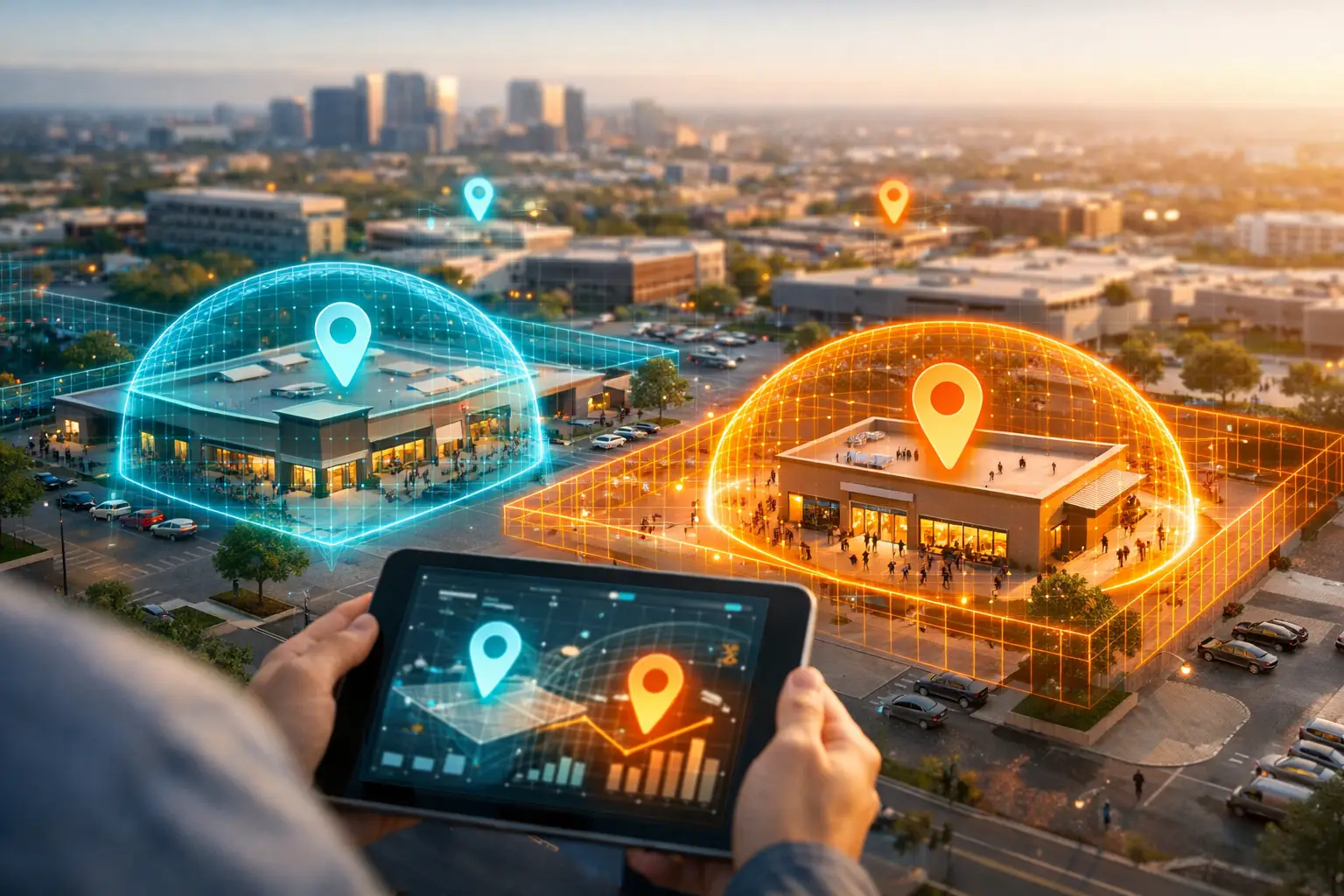

If your geofencing campaign got plenty of impressions but barely moved leads, store visits, or sales, the problem usually is not geofencing itself. It is measurement. Knowing how to measure geofencing roi starts with tracking the right business outcomes, not just the easiest ad metrics to screenshot.
Geofencing can outperform broader digital targeting because it reduces wasted impressions. But that advantage only matters if you can prove what the campaign produced and what it cost to get there. For a local business, agency, or multi-location brand, ROI is less about vanity numbers and more about answering a simple question: did this campaign generate profitable action from the people we targeted?
What geofencing ROI actually means
At its simplest, ROI is the return you generated compared to what you spent. The basic formula is straightforward:
ROI = (Revenue from campaign – Campaign cost) / Campaign cost x 100
That sounds easy until you hit the real-world problem. Geofencing campaigns often influence actions that happen later, on another device, or in a physical location. Someone may see an ad on mobile, research on desktop, and buy in-store three days later. That means measuring geofencing ROI requires attribution logic, not just a cost report.
For some advertisers, revenue is the right outcome to track. For others, it is better to measure qualified leads, booked appointments, quote requests, phone calls, store visits, or completed forms. The right ROI model depends on your sales cycle and how directly digital activity connects to revenue.
Start with the outcome that matters most
A common mistake is trying to measure everything at once. That usually creates noisy reporting and weak decisions. Before launch, decide what counts as success.
If you run a retail campaign, your primary KPI may be store visits or in-store sales lift. If you are a home services company, it may be phone calls and form fills. If you are an agency running campaigns for a franchise group, you may need a blended view that includes reach, conversions, and cost per location-level result.
This matters because impressions and clicks are supporting metrics, not final outcomes. They help explain performance, but they should not be confused with business value.
The metrics you actually need
When advertisers ask how to measure geofencing roi, the most useful answer is to separate delivery metrics from outcome metrics.
Delivery metrics tell you whether the campaign ran efficiently. These include impressions, click-through rate, CPM, video completion rate, frequency, and reach. They matter because poor delivery can point to targeting, creative, or budget issues.
Outcome metrics tell you whether the campaign created value. These are the numbers that should carry the most weight in your analysis: store visits, conversion rate, cost per lead, cost per acquisition, appointment bookings, online purchases, phone calls, and estimated revenue.
Then there is the middle layer – assisted indicators. These include branded search lift, website engagement, time on site, pages per session, and retargeting conversion rate. They do not prove ROI on their own, but they often show whether geofencing is warming up the right audience.
How to measure geofencing ROI with attribution that makes sense
Attribution is where good campaigns either get validated or undersold. If you rely only on last-click reporting, geofencing will often look weaker than it really is because many users do not click the first ad they see. They view it, remember it, and act later.
A better approach is to use a practical attribution model tied to your business. For direct-response campaigns, track conversions within a set lookback window after ad exposure. For retail and event campaigns, use foot traffic or conversion zone reporting where available. For longer sales cycles, compare exposed audiences against similar non-exposed audiences and watch for lift in lead rate or sales rate.
No attribution model is perfect. View-through conversions can overstate impact if your targeting is broad or your frequency is too high. Last-click can understate impact if geofencing is primarily creating awareness. The goal is not perfect certainty. It is a measurement setup that is consistent enough to guide budget decisions.
Set up conversion tracking before you spend a dollar
This is where many campaigns go sideways. Marketers launch fast, then try to patch together measurement later. By then, key signals are missing.
Before your campaign starts, define the conversion events you want to count. That may include website form submissions, calls from ads, calls from the site, map clicks, coupon redemptions, online orders, and visits to a designated physical location. If your business closes offline, assign estimated values to each lead type so you can calculate return even when revenue takes time to show up.
For example, if your average booked consultation is worth $2,000 in revenue and 25% of consultations become customers, one consultation is worth about $500 in expected revenue. That gives you a usable ROI model even before all sales close.
This is one reason self-serve platforms with live reporting and conversion zone tools are useful. They make it easier to connect campaign activity to business outcomes instead of forcing you to wait on vague monthly recaps.
Use a simple ROI model first, then add nuance
You do not need a complex dashboard to get started. Begin with a basic model:
Campaign spend + creative costs + any setup costs = total investment
Tracked conversions x average conversion value = estimated return
Estimated return – total investment = net return
Net return / total investment x 100 = ROI
Let’s say you spent $3,000 on a geofencing campaign targeting competitor locations and event attendees. The campaign produced 40 leads. If your historical data shows each lead is worth $150 on average, your estimated return is $6,000. Net return is $3,000. ROI is 100%.
That does not mean the campaign is perfect. It means it appears profitable under your current assumptions. The next step is to pressure-test those assumptions by checking lead quality, close rate, and time to sale.
Watch for the signals that explain performance
When ROI is weak, the issue is rarely just one thing. Low returns can come from poor audience selection, weak creative, a bad offer, too short a campaign window, weak landing pages, or tracking gaps.
If click-through rate is low, the audience may be right but the ad may not be compelling. If clicks are healthy but conversions are low, the landing page or offer may be the problem. If online conversions look soft but foot traffic is strong, your campaign may be doing exactly what it was meant to do and your reporting framework is just too narrow.
This is why you should review geofencing ROI in layers. First ask whether ads reached the right people. Then ask whether those people engaged. Then ask whether engagement turned into a meaningful action. That sequence helps you find the real bottleneck faster.
Benchmark by campaign type, not by one universal number
There is no single good ROI benchmark for geofencing. A restaurant promotion, a B2B event retargeting campaign, and a personal injury firm targeting courthouse visitors will all behave differently.
Short sales cycles usually produce cleaner ROI data faster. Retail, quick-service, and event-driven campaigns often show results in days or weeks. Higher-consideration services may need a longer attribution window and more patience before ROI becomes clear.
Compare campaigns against similar goals, audience types, geographies, and offers. That is far more useful than copying a generic industry benchmark that ignores your business model.
Don’t ignore incrementality
One of the harder questions in geofencing is whether the campaign caused the result or simply reached people who were likely to convert anyway. This is where incrementality matters.
If possible, compare exposed audiences to a holdout group, another location, or a previous period with similar conditions. If one region ran geofencing and another comparable region did not, the difference in lift can help you estimate the campaign’s real contribution.
This will never be perfectly controlled in most local advertising setups, and that is fine. Even directional lift data is better than pretending every conversion came entirely from one touchpoint.
What strong geofencing ROI measurement looks like
Strong measurement is not flashy. It is disciplined. You know your target audience, you define your conversion event before launch, you assign values to those conversions, and you review delivery and outcome metrics together.
Most importantly, you do not treat geofencing as a black box. If a campaign is underperforming, change one variable at a time. Tighten the locations. Adjust the creative. Improve the offer. Extend the run time. Refine the conversion zone. A platform like Qujam makes that process easier because you are not stuck waiting for someone else to decide what you can test or when you can see the data.
The best ROI measurement gives you more than a number. It gives you confidence to scale what works and cut what does not, which is exactly what local advertisers need when every dollar has a job to do.


