
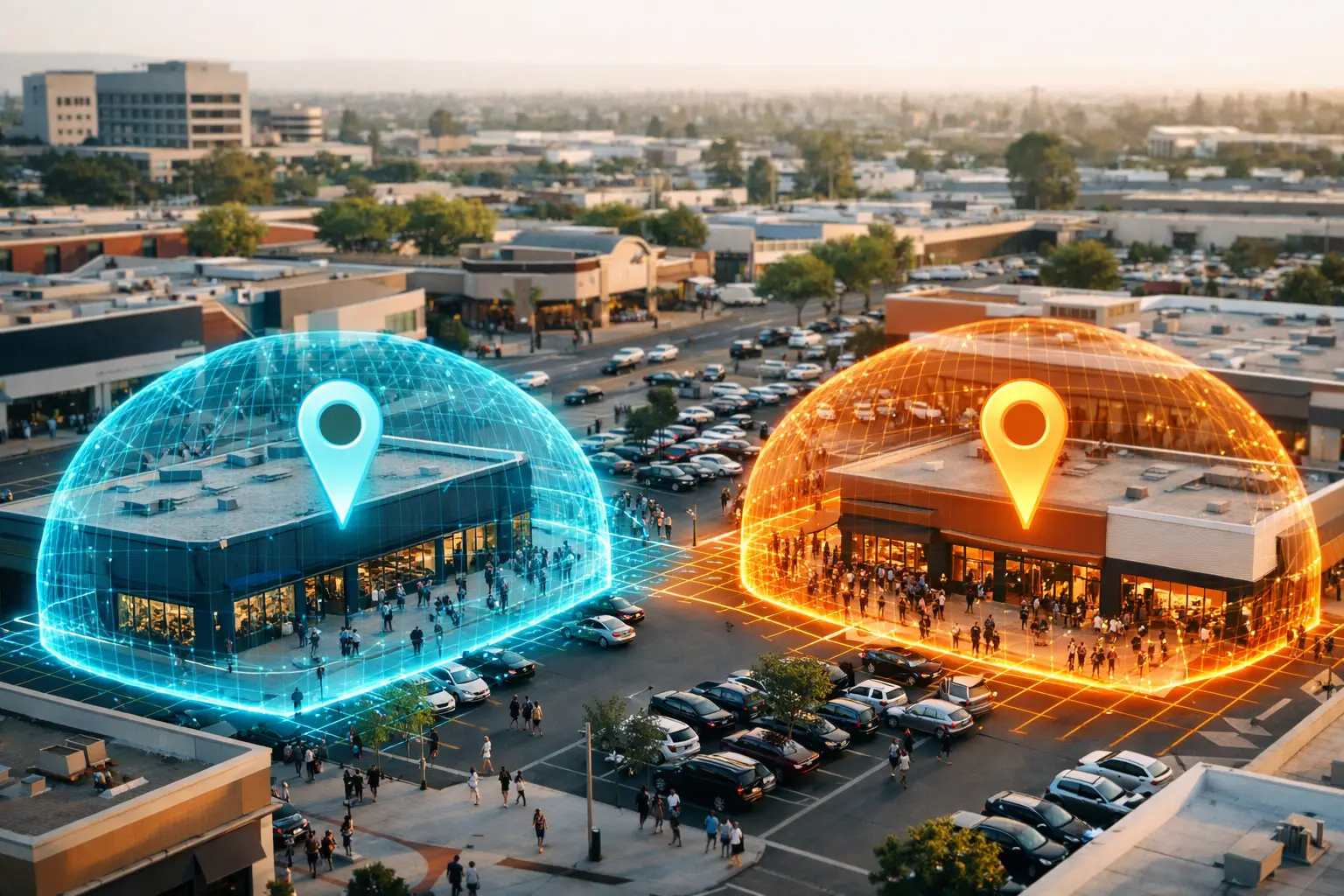

A customer walks into your competitor’s location, spends ten minutes there, leaves, and later sees or hears your ad on their phone, laptop, tablet, or TV. For many companies, depending on the industry’s sales cycle, this can be extremely valuable. It gives local businesses and agencies a way to reach people who have already shown real-world buying intent, while reducing wasted budget on broad audience targeting.
That sounds simple, and the core idea is. The part that trips advertisers up is execution. If your targeting is sloppy, your audience gets polluted. If your offer is weak, even a perfectly built campaign underperforms.
What competitor geofencing advertising actually does
Precision competitor geofencing advertising uses location data to build an audience of devices associated with people who visited a competing business location. Instead of serving ads only while someone is physically at that location, most campaigns work by identifying the visit first and then retargeting that audience later across digital channels.
You are not trying to interrupt someone in a parking lot with a banner ad and hoping for the best. You are building a more valuable audience based on an offline behavior, then reaching them after the visit when they are browsing websites, using apps, watching connected TV, or listening to digital audio.
For many businesses, this is far more useful than standard radius targeting. A radius around a shopping center might include people who live nearby, work nearby, or are just driving through. A competitor-visit audience is narrower and usually stronger because it is tied to a specific action. It also helps steal market share away from the competition.
When competitor geofencing advertising makes sense
This strategy works best when a competitor visit is a meaningful signal of interest. That is often true in categories like [automotive](https://qujam.com/geofencing-for-automotive/), home services, healthcare, fitness, furniture, retail, legal services, higher education, and restaurants with strong local competition.
If somebody visited three dealerships this week, they are probably in-market. If they spent time at a home improvement store, they may soon need a contractor. If they visited another gym, med spa, senior living property, or urgent care location, there is a clear chance to present a better offer or a different reason to choose you.
It is less useful when the competitor location is too broad or too noisy. Big-box stores, mixed-use centers, and dense retail corridors can introduce a lot of irrelevant traffic. It can still work, but only if the geofences are carefully placed and the campaign is built with realistic expectations. Competitor geofencing is better served with precision geofencing than hyper-grid geofencing, so there are a few start that would run into a limitation with using precision geofencing (VA, OR, MD, CT, and NJ).
The biggest mistake: confusing geofencing with map drawing
A lot of advertisers think the hard part is drawing a fence around a competitor’s address. It is not. The real job is defining a visit accurately enough that your audience reflects genuine prospects instead of random passersby. Then making sure the messaging and marketing funnel or flywheel is strong enough to convert.
For example, an urban coffee shop next to a train station may generate constant foot traffic that has nothing to do with coffee buyers. A medical office inside a larger building may be hard to isolate if the geofence captures people visiting other tenants. A car dealer on a busy auto row may overlap heavily with neighboring lots.
This is where precision matters. Good competitor geofencing campaigns are built around clean location inputs, sensible dwell-time logic when available, and enough campaign duration to gather a usable audience. More data is not always better. Better data is better.
How to build a competitor geofencing campaign that can actually perform
Start with the right competitor set. Do not target every business in your category just because you can. Pick locations that represent the customers you actually want. If you are a premium provider, target premium competitors. If you win on convenience, target nearby alternatives where fast switching is realistic.
Next, think about volume. One competitor location may not generate enough audience for meaningful reach, especially in smaller markets. On the other hand, twenty loosely related locations can make the audience messy. Most campaigns perform better when the footprint is selective but large enough to sustain delivery.
Your creative has to do more than announce that you exist. People who visited a competitor already had a reason to consider that option. Your ads should answer that reason directly. Better pricing, faster service, stronger reviews, more convenient scheduling, exclusive offers, broader selection, or a clearer differentiator all work better than generic branding.
The landing page matters just as much. If the ad promises a quote, discount, free consultation, or appointment, the page should make that action obvious and easy. Sending a high-intent competitor audience to a vague homepage is one of the fastest ways to waste a good targeting strategy.
Competitor geofencing advertising across channels
Display is efficient, flexible, and easy to scale. It is a practical starting point for most advertisers because it can build frequency without blowing through budget.
Connected TV can be strong when you want more impact or need to reach households instead of just individual devices. It works especially well for higher-consideration categories where decision-making involves more than one person. But it typically needs stronger creative and enough budget to support video delivery.
Video pre-roll is useful when a short explanation can sell the difference between you and the competitor. Digital audio can also support frequency well, especially for local brands with a clear offer or strong name recognition.
The best channel mix depends on your budget, sales cycle, and creative assets. If you are just getting started, it is often smarter to launch with one or two channels you can measure clearly rather than spreading thin across everything at once.
What success should look like
Clicks are nice, but they are not the whole story. Competitor geofencing campaigns often influence people before they are ready to act immediately, especially in categories with longer consideration cycles.
A better measurement approach looks at post-click conversions, view-through activity, location-based outcomes when available, and the quality of leads generated. If your campaign drove more calls, quote requests, form fills, appointment bookings, or in-store visits from the right areas, that matters more than a flashy click-through rate.
This is also why conversion zones and clear reporting are not optional extras. If you cannot see where performance is coming from, you cannot improve it. Too many geofencing campaigns get sold with big promises and then reported with thin metrics that leave advertisers guessing.
Trade-offs to keep in mind
Competitor geofencing advertising is powerful, but it is not magic. Audience quality depends on location accuracy and campaign setup. Results depend on the strength of your offer. Timing matters too. Some audiences convert quickly, while others need repeated exposure over days or weeks.
There is also a scale-versus-precision trade-off. Tight targeting can improve relevance, but if the audience is too small, delivery may be limited. Broader targeting can increase reach, but it may also bring in weaker prospects. The right balance depends on your category and market.
Budget is another factor. You do not need enterprise-level spend to run geofencing, but you do need enough budget to build audience, maintain frequency, and gather meaningful results. Underfunded campaigns often get judged too quickly when the real problem is that they never had enough room to work.
Who gets the most value from it
Local businesses with clear competition often see the fastest payoff because the use case is straightforward. Multi-location brands can use it to defend territory or enter new markets with more control. Agencies like it because it gives clients a targeting strategy that feels tangible and measurable, not abstract.
It is also a strong fit for advertisers who are tired of old geofencing vendors making everything harder than it needs to be. If campaign setup takes forever, minimum spends are too high, reporting is weak, or every change requires a managed-service ticket, the strategy starts to feel more complicated than the results justify. That frustration is exactly why self-serve platforms like Qujam are gaining traction with businesses that want speed, visibility, and direct control.
The smart way to think about competitor conquesting
The goal is not to stalk your competitor’s customers. The goal is to show up with relevance after someone has demonstrated interest in a category you sell in. When done well, competitor geofencing becomes a practical way to reduce wasted impressions and spend more of your budget on people who are already in motion.
That is the real advantage. You are not guessing who might care. You are building campaigns around real location behavior, then pairing that signal with creative, offers, and reporting that give the campaign a fair shot at producing leads.
If you approach it with clean targeting, realistic budgets, and a message that gives people a reason to switch, competitor geofencing advertising can be one of the most efficient local tactics in your media mix. The businesses that win with it are usually not the ones doing something flashy. They are the ones making it easy for the right customer to notice a better option at the right moment.
Key Takeaways: Competitor Geofencing Advertising
– The Strategy: Competitor geofencing captures the mobile device IDs of people who physically visit a rival’s storefront, allowing you to retarget them with digital ads across their devices after they leave.
– The Advantage: It eliminates the wasted ad spend of broad ZIP-code targeting by focusing exclusively on audiences who have demonstrated real-world, offline buying intent.
– The Ad-Tech Landscape: Enterprise platforms and managed-service agencies often require high minimums and slow down campaign adjustments. Self-serve platforms (Qujam) provide real-time control without the bloated fees.


