
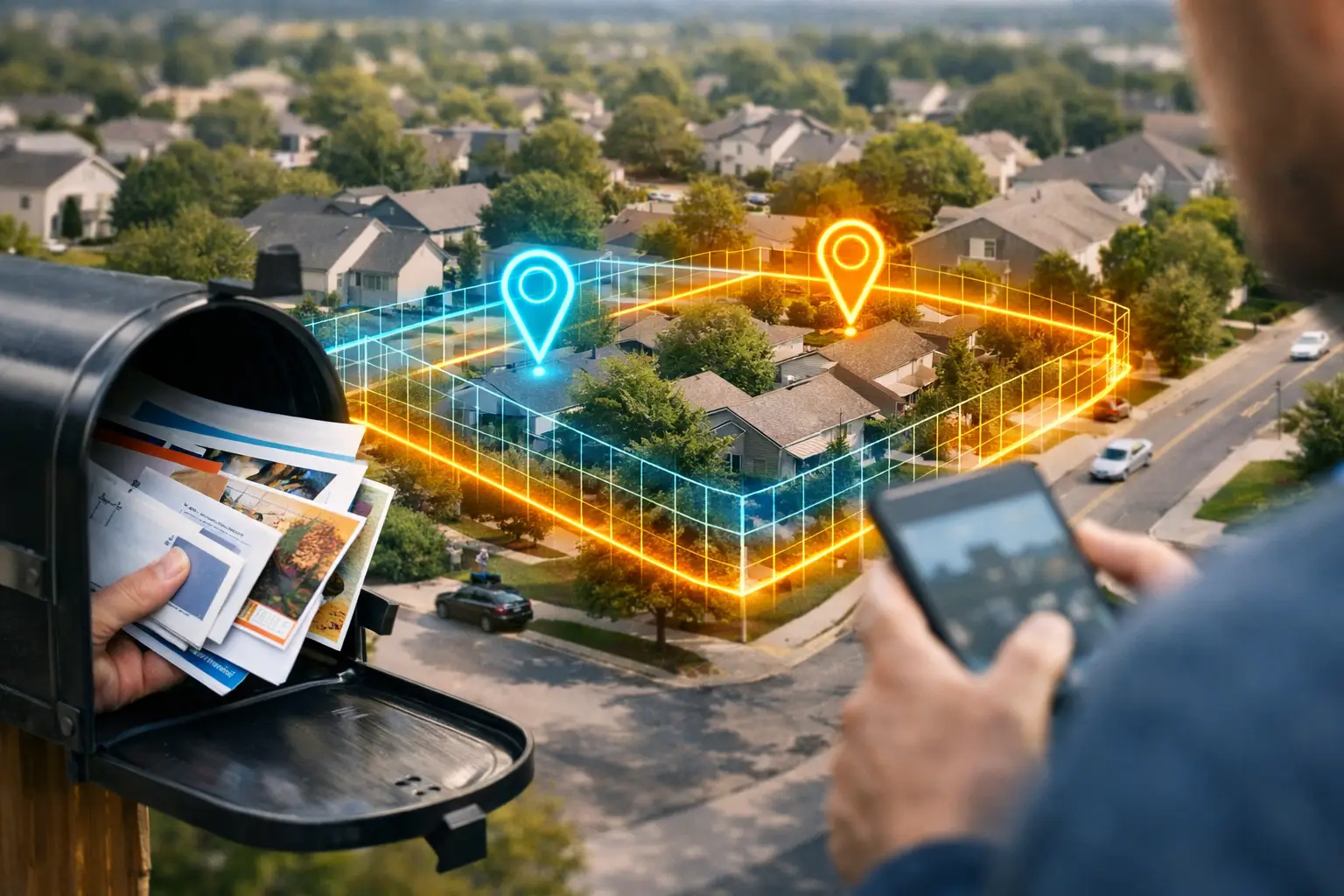

A postcard hits the mailbox on Tuesday. One, tangible message. One chance to get the reaction you want… Now imagine if that same household has been seeing your ad on a phone, laptop, or streaming TV for the last few weeks and they continue to see your digital ads for a few more weeks after your direct mail piece arrives. That is how direct mail and EDDM work well with addressable geofencing – not as separate tactics competing for budget, but as a coordinated local campaign that reinforces the same message across channels.
For local businesses, agencies, and multi-location marketers, this matters because mail still gets attention, but it does not always create immediate action. Digital ads can create that lead-up and follow-up pressure. On the other hand, digital targeting alone can miss the credibility and physical presence that mail delivers. Put them together, and you get a stronger sequence: the mailbox introduces the offer, and geofencing keeps the message in front of the right people after that first touch.
Why direct mail and EDDM work well with addressable geofencing
The short answer is repetition with better targeting. Direct mail gives you a tangible impression in the home. EDDM gives you broad neighborhood coverage without needing a mailing list. Addressable geofencing adds a digital layer that keeps your campaign visible after the mail lands.
That combination helps solve a common local advertising problem: one impression is rarely enough. A homeowner might glance at a postcard for a roofing company, put it on the counter, and forget about it. If they later see the same brand while scrolling on their phone or watching streaming TV, the message gets a second chance. Familiarity goes up. So does the likelihood of response.
There is also a practical budget advantage. Mail can be expensive if you try to use it for precision and frequency all by itself. Digital ads can handle the follow-up frequency more efficiently. Instead of printing and mailing multiple times to create repetition, you can use one strong mail drop and let geofencing carry the reminder stage.
The role each channel plays
Direct mail is usually strongest at introduction and credibility. It feels established. It gives people something they can hold, save, or show to someone else in the household. That is especially useful for higher-consideration services like home improvement, healthcare, legal services, real estate, and local retail promotions.
EDDM is different from list-based direct mail because it is built for geographic coverage at the mail route(s) or zip code(s) level rather than named recipients. If you want to blanket a carrier route around a store, event venue, or service area, EDDM is often the fastest route. The trade-off is obvious: you get reach, but less precision.
Addressable geofencing helps close that gap. Instead of relying only on broad neighborhood delivery, you can digitally target households or audiences connected to very specific places. This is where the campaign gets smarter. Mail handles presence in the market. Geofencing tightens the audience and extends the message beyond the mailbox.
Where the strategy works best
This approach is most effective when geography strongly influences buying behavior. A restaurant opening a new location, a dental group trying to pull patients from nearby competitors, a home services company targeting a specific subdivision, or a franchise brand promoting a local offer can all benefit.
It also works well when timing matters. If you are promoting a seasonal service, grand opening, open enrollment period, or event follow-up, mail alone can feel slow and digital alone can feel easy to ignore. Together, they create a more durable window of attention.
That said, it is not automatically the right fit for every campaign. If your audience is highly national, extremely niche, or driven by immediate search intent, this combo may support your media plan rather than lead it. A plumber handling emergency calls may get more direct value from search ads than from a mail-plus-geofencing sequence. But for businesses that need local awareness plus repeated exposure, the pairing is hard to beat.
How to build the campaign without wasting money
The best campaigns start with geography, not creative. Decide exactly where you want coverage and why. That could be neighborhoods around your location, carrier routes that map to strong customer value, competitor trade areas, apartment communities, event sites, or a service radius translated into real place-based targets.
Then decide what role mail is playing. If you are using EDDM, you are usually buying broad local visibility. If you are using list-based direct mail, you may be leaning into household selection and personalization. Either can work, but they should shape the digital plan.
If the mail is broad, the geofencing should tighten things up. For example, a med spa using EDDM across nearby postal routes could run addressable geofencing and device-targeted digital ads to households in the highest-value neighborhoods while also reaching people who have visited competing clinics. That gives you efficient digital pressure where it matters most.
If the mail is already highly targeted, geofencing can focus on reinforcement. In that case, your digital creative should match the mailer closely. Same offer. Same visuals. Same timing. Consistency is what makes the campaign feel coordinated rather than random.
Matching the message across mail and digital
This is where many campaigns fall apart. The postcard says one thing, the digital ad says another, and the landing page says something else. That disconnect weakens response.
The better approach is simple. One audience. One offer. One visual direction. You do not need identical creative, but the campaign should feel obviously connected. If the mail piece promotes a free consultation, the digital ads should not suddenly switch to a discount bundle unless there is a clear sequence behind it.
You also need to respect the limits of each format. Mail can carry more detail. Digital ads need faster communication. So keep the core message the same while adapting the format. The postcard can explain the value. The display ad can remind. The CTV ad can build recall. The landing page can close the loop.
Timing matters more than most marketers think
A common mistake is running mail and digital on totally separate timelines.
The strongest setup usually begins digital right before and keeps the campaign going during and after the mail is expected to arrive, then continues for several weeks after. That creates a sense that your brand is everywhere in the market at once, even if the spend is modest. For event-based campaigns, you can also use geofencing before and after the event while mail supports the broader local audience around it.
Frequency matters too. One or two digital impressions after a mail drop is not enough. You want enough follow-up to reinforce recall, but not so much that the campaign becomes repetitive or inefficient. The right level depends on your audience, sales cycle, and offer value.
Measurement is where digital makes mail smarter
One of the biggest reasons this pairing works is that geofencing adds visibility to a channel that has traditionally been harder to measure. Direct mail response can be tracked through calls, promo codes, landing pages, and in-store traffic, but digital reporting gives you a clearer picture of reach, engagement, and post-impression activity.
That does not mean every sale can be traced perfectly. Local advertising rarely works that cleanly. A customer may receive the mailer, see three ads, search your brand later, and then convert a week after that. What you are looking for is directional performance: stronger branded search, more site visits, more store traffic, more calls, better response in targeted areas, and lift compared with markets or households not exposed to the full sequence.
This is also why self-serve control matters. If a campaign is underperforming, you should be able to adjust creative, geography, pacing, or budget quickly instead of waiting on a slow managed-service process. That flexibility is especially useful when you are coordinating mail dates with digital delivery windows.
Common mistakes to avoid
The biggest mistake is treating EDDM as precise targeting. It is hyper localized, but no precise. It is broad geographic distribution. That is useful, but it needs digital support if you want more audience control.
The second mistake is using geofencing too broadly. If your digital targeting is just a loose radius around a city, you are giving back the efficiency you hoped to gain. The real advantage comes from targeting specific buildings, neighborhoods, competitor locations, event venues, and other meaningful places tied to buying behavior.
The third mistake is failing to plan for response. If the mailer drives people to call, your phones need to be answered. If the ads drive traffic to a landing page, that page needs to load fast and make the next step obvious. Good targeting cannot rescue a weak handoff.
For marketers who want more out of local campaigns, this is one of the smartest combinations available. Mail gets you into the home. Addressable geofencing keeps you in the conversation. When the geography is tight, the message is aligned, and the timing is coordinated, your campaign stops acting like separate tactics and starts working like a system.


