
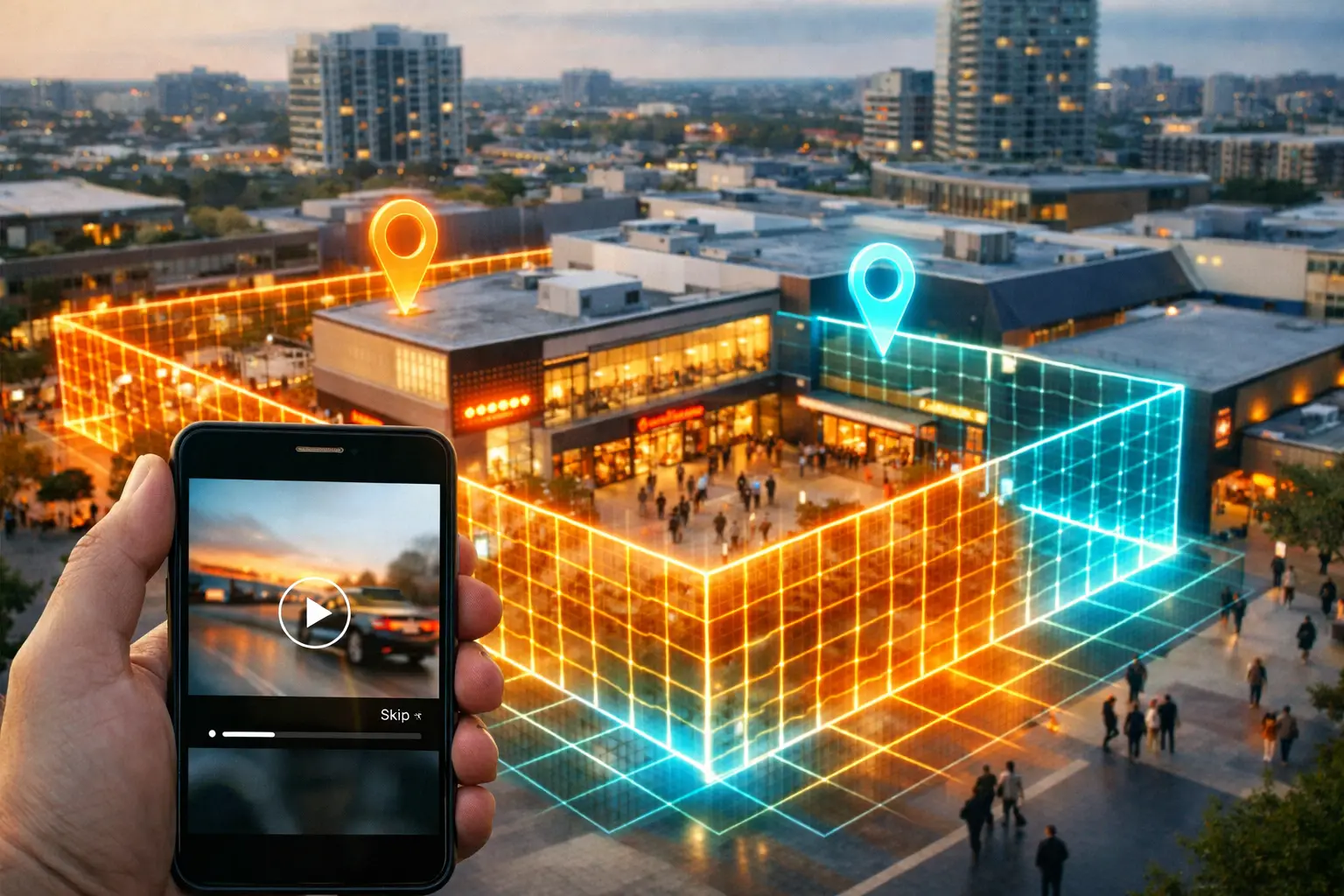

A lot of local video ad spend gets wasted for one simple reason: the targeting is too broad for most brands. You can have strong creative, a fair budget, and a clear offer, but if your ad is shown to the wrong audience, results flatten fast. That is where video pre roll geofencing changes the equation. It gives advertisers a way to put video in front of people based on where they have actually been, not just what content they happen to be watching.
For businesses trying to reach real local prospects, that difference matters. If someone recently visited a competing dealership, attended a home show, walked into a medical office, or spent time in a target neighborhood, that location behavior can become the foundation of a smarter campaign. Instead of buying generic audience segments and hoping they line up, you are building video delivery around real-world movement.
What video pre roll geofencing actually does
Video pre roll geofencing combines two tactics. First, a geofence(s) is placed around a physical location such as a business, event venue, competitor address, apartment complex, or service area. Then, when eligible mobile devices are observed within that boundary, those visits can be used to build an audience for future ad delivery. The video ad itself is then served within online video content across mobile, desktop, tablet, or TV environments.
The practical benefit is simple: your message follows intent. You are targeting people whose physical behavior suggests they are more likely to care.
That is especially useful for advertisers who sell locally and cannot afford broad waste. A roofing company may want to reach homeowners in storm-affected neighborhoods. A gym may want to target people who visited nearby fitness competitors. A franchise brand may want to support individual locations with market-specific messaging. In each case, video becomes more relevant because the audience is more deliberate.
What is the difference between video pre-roll and OTT/CTV?
While both formats leverage geofenced location data to reach verified audiences, the core difference between video pre-roll and OTT/CTV comes down to screen environment and clickability. Video pre-roll consists of short, highly clickable ads that play before online content on mobile phones, tablets, and laptops, making it a direct-response powerhouse for driving immediate web traffic. Conversely, OTT (Over-the-Top) content and CTV (Connected TV) devices deliver non-skippable, premium television-style commercials directly to the household’s big screen via streaming networks like Sling and Roku, prioritizing deep brand authority and household influence over instant clicks. A true DIY platform like Qujam completely eliminates the expensive, muddy packaging used by legacy enterprise providers, giving you un-gated freedom to split your geofenced audiences—deploying cost-effective mobile pre-roll for immediate traction or dominating the living room with premium CTV spots on your own terms.
Why video pre roll geofencing works better than broad local video
Traditional local video buying often relies on loose assumptions. You choose a region, layer in some demographic filters, maybe pick a few content categories, and hope performance follows. Sometimes that works. Often it does not, especially for businesses with tight margins or a very specific customer profile.
Video pre roll geofencing improves that by narrowing the audience based on observed visits. That usually means fewer impressions overall, but better ones. And better impressions tend to produce stronger engagement, better recall, and a cleaner path to measurable action.
There is also a timing advantage. Someone who visited a competitor last week or attended an event yesterday is often more valuable than someone who merely fits a broad consumer profile. Physical presence can signal active consideration. That does not guarantee a conversion, of course, but it is a much stronger starting point.
This is also why geofenced video fits well with multi-location brands and agencies. Instead of running the same local awareness campaign everywhere, they can build audiences around each store, territory, or target footprint. The result is tighter control and less wasted spend.
Where this strategy makes the most sense
Not every campaign needs geofenced video pre-roll, and that is worth saying plainly. If you are launching a national brand campaign with no geographic pressure and no location-based customer journey, broad video may be enough. But when physical location shapes buying behavior, geofencing becomes much more useful.
It tends to work well for automotive, healthcare, home services, legal, restaurants, retail, education, events, and franchise campaigns. These are categories where consumers often compare options nearby, visit in person, or make decisions based on convenience and local familiarity.
Event marketing is another strong fit. If a business sponsors a trade show, festival, fair, or conference, it can geofence the venue and continue reaching attendees after they leave. That is often more effective than relying on event-day visibility alone. The same logic applies to competitor conquesting. If your audience is already walking into rival locations, you have a clear opportunity to stay in the consideration set.
Still, there are trade-offs. A highly specialized audience in a small footprint may limit scale. A very short campaign window may not leave enough time to build reach. And weak video creative can still underperform, even with great targeting. Better targeting improves the odds. It does not rescue a bad offer.
How to set up video pre roll geofencing without overcomplicating it
The best campaigns usually start with a simple question: whose attention are you trying to earn, and what location behavior proves they matter?
That question helps determine the geofence strategy. In some campaigns, the right move is to target your own location and re-engage recent visitors. In others, competitor targeting is stronger because the goal is customer acquisition. For service businesses, neighborhood or service-area targeting may make more sense than a single address. For events, the venue itself is the audience source.
Pick the right location target
The fence should reflect actual business intent. A hospital campus, a concert venue, a cluster of apartment communities, or a competing retailer can all be smart targets if they align with the offer. Random radius targeting, on the other hand, is where a lot of waste starts. Bigger is not better if the extra area has no strategic value.
Match the message to the visit behavior
The video should make sense for the audience source. Someone who visited a luxury apartment complex should not get a generic brand spot with no local relevance. Someone who attended a county fair may respond better to a time-sensitive promotion or a location-specific offer. The closer the message matches the observed behavior, the stronger the campaign usually performs.
Keep the video short and clear
Most pre-roll ads do not have long to make the point. That means quick branding, one core message, and a clear next step. If your logo appears too late or the value/offer take too long to explain, you are asking too much from the format.
Watch frequency and reporting
Geofenced audiences can be highly qualified, but they can also be smaller. That means frequency matters. Too little and people forget you. Too much and you create fatigue. The right balance depends on the audience size, budget, and campaign length, which is why live reporting and adjustment matter so much.
Common mistakes that hurt results
One common mistake is treating video pre roll geofencing like a magic switch. It is not. If the target location is weak, the offer is unclear, or the landing experience is poor, the campaign will struggle just like any other ad campaign would.
Another mistake is choosing locations based on convenience instead of strategy. Advertisers sometimes geofence their own business because it is easy, even when the real opportunity is reaching competitor visitors or event attendees. Others cast the fence too wide and end up collecting people who happened to pass by, not people who showed meaningful intent.
Creative mismatch is another problem. A local audience should feel like the ad was meant for them. Generic corporate video can work for awareness, but if you are trying to move people toward action, relevance matters. Local proof, clear offers, and direct messaging usually beat polished but vague brand footage.
Measurement can also go sideways if expectations are unrealistic. Not every video campaign should be judged only by immediate clicks. Some are better measured by completed views, engaged visits, lift in branded search, or physical store visits over time. It depends on the objective. The point is to define success before launch, not after the fact.
What advertisers should expect from a good platform
This is where many businesses get frustrated with geofencing vendors. The strategy sounds smart, but the execution is buried under high minimums, slow setup, opaque reporting, or managed-service gatekeeping. That makes it harder than it needs to be.
A good platform should let you build the location audience, launch the campaign, monitor delivery, and make changes without waiting on someone else to email a spreadsheet. It should also make reporting understandable enough for a business owner and detailed enough for an agency. Those two things are not mutually exclusive.
For advertisers who want control without added friction, self-serve matters. That is one reason platforms like Qujam appeal to local businesses and agencies that are tired of the old model. They want location-based precision, but they do not want to fight the platform to get it.
Is video pre roll geofencing worth it?
If your customer journey has a real location component, yes, it often is. It gives video buying a sharper edge by grounding audience targeting in actual movement, not assumptions. That usually leads to less waste and a better chance of reaching people while they are still making decisions.
The bigger point is not that every campaign needs more targeting. It is that smarter targeting should make execution easier, not harder. When local advertisers can combine strong video with precise location data and clear reporting, they stop paying for broad awareness they cannot use and start building campaigns that actually reflect how people shop, compare, and decide.


