
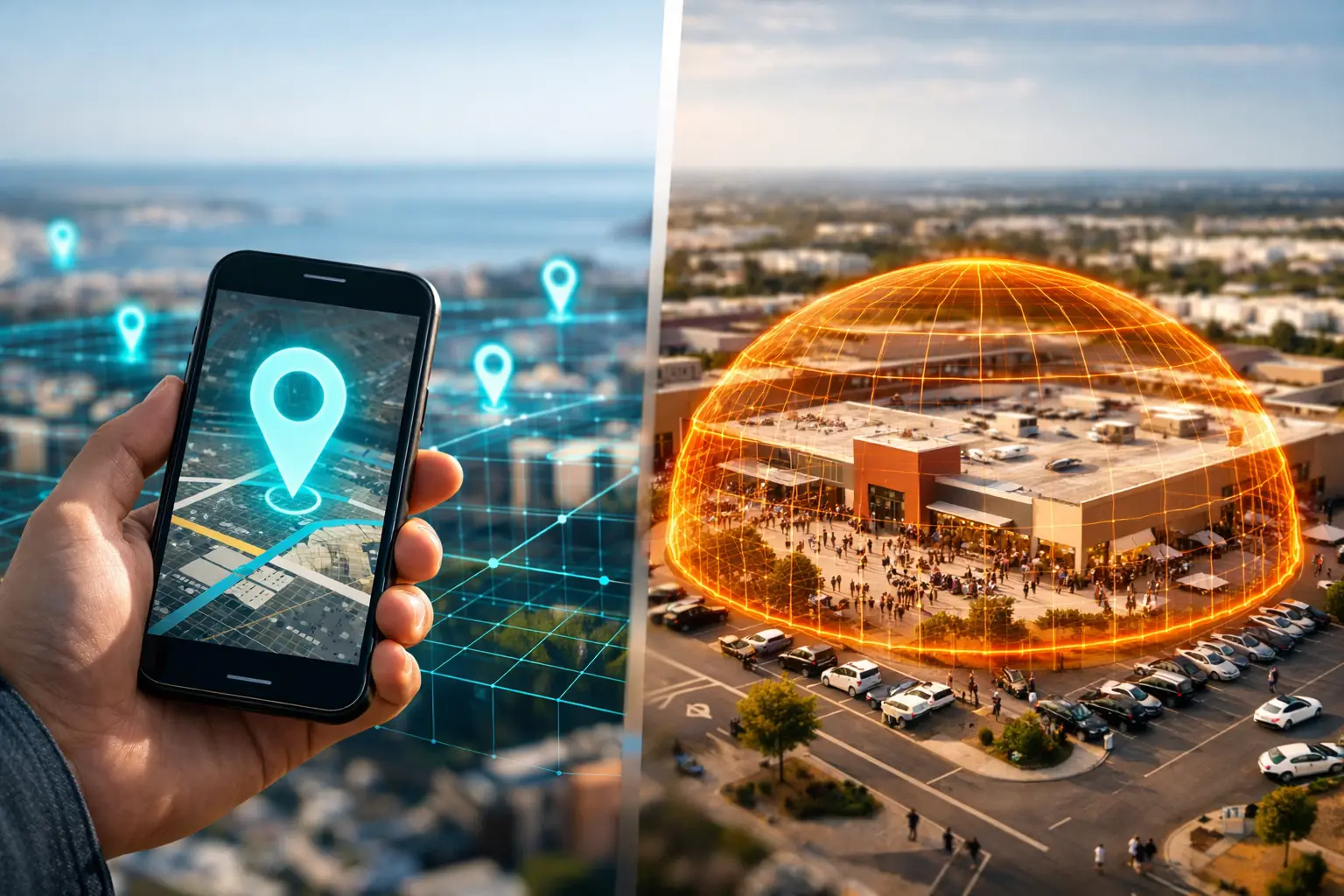

A local business can spend heavily to reach an entire city and still miss the people most likely to buy. The real question is not just where your audience lives. It is where they actually go. So, what is the difference between geolocation and geofence advertising? Geolocation is the broader practice of using location data to inform ad targeting, while geofence advertising uses a specific virtual boundary around a real-world place to reach people who enter or have visited it.
The terms are sometimes mistakenly used interchangeably, which can make campaign planning harder than it needs to be. Both can support local marketing. But they provide very different levels of precision, control, and proof that your budget is reaching the right audience.
What Is the Difference Between Geolocation and Geofence Advertising?
Geolocation advertising uses a device’s approximate or precise location to help determine which ads a person may see. Depending on the platform and campaign, that location can be based on GPS signals, Wi-Fi connections, mobile app data, IP addresses, or other location indicators.
This broad category can include targeting a city, county, ZIP code, designated market area, or a radius. A restaurant, for example, might use geolocation targeting to show ads to people within 10 miles of its location. A regional home-services company might target several cities where it operates.
Precision geofence advertising is a more focused form of location-based advertising. Instead of selecting a large geographic area, an advertiser creates a virtual boundary around a specific physical location. That boundary might follow the footprint of a store, apartment community, event venue, neighborhood, office complex, competitor location, or service area.
When a mobile device enters the defined area, subject to applicable privacy controls and available location data, it can become part of an audience for advertising. Ads may be delivered while the person is nearby, but more commonly, the visit is used to build an audience that can be reached later across connected devices, including phones, tablets, computers, and TVs.
The short version is simple: geolocation tells an ad platform where a person is or has been at a broad level. A geofence defines exactly which real-world location matters to your campaign.
Geolocation Advertising Is Broad by Design
Broad geography has a legitimate place in an advertising plan. If a business serves an entire metro area, needs fast brand awareness, or does not have one specific place it wants to target, city-level or radius-based geolocation can be practical. It is often easier to set up and can create a larger available audience.
The trade-off is waste. A five-mile radius around a storefront can include homes, roads, businesses, parks, and people with no connection to what you sell. ZIP codes can be even less precise because they were designed for mail delivery, not audience intent. They do not tell you whether someone visited a relevant location, attended a local event, or entered a competitor’s store.
Geolocation also varies in accuracy depending on the data source. A mobile device with strong GPS and app permissions may provide useful location precision. IP-based location, especially on desktop devices, can be far less exact. That does not make geolocation advertising ineffective. It means advertisers should match the level of precision to the campaign goal instead of assuming every location signal means the same thing.
For broad awareness, broad geolocation can be enough. For a campaign built around known local behavior, it may be too blunt.
Geofence Advertising Starts With a Specific Place(s)
A geofence is a custom digital boundary placed around a location that matters to your business. The most effective geofences are generally drawn to fit the actual property or area being targeted, rather than relying on a generic radius that captures everything nearby.
Consider a fitness studio that wants to reach people who visited a competing studio. A radius around the competitor could include nearby retail shops, traffic, and neighboring buildings. A properly drawn geofence can focus on the competitor’s actual location instead. That gives the advertiser a more relevant audience and reduces impressions served to people who were only passing by.
The same principle applies to events. A sponsor can geofence a convention center, festival grounds, stadium, or trade show venue and build an audience based on attendees. A multi-location brand can create separate geofences around each store and compare performance by market. A home-services company can focus on specific neighborhoods or communities where it wants to generate leads.
This is why geofencing is often described as hyper-local advertising. It is not simply about targeting people who are near a place. It is about targeting people whose presence at that place is relevant to your marketing objective.
A geofence is not always a real-time ad
One common misunderstanding is that geofence advertising only works when someone is standing inside the boundary. Real-time delivery may be available in some situations, but it is not the only use case and often not the primary one.
Many campaigns use visitation-based audience building. A person enters a geofenced location, becomes eligible for an audience based on that visit, and may later receive display, video, audio, or connected TV ads. This approach gives advertisers more opportunities to reach the audience when they are browsing on another device or consuming media later in the day.
That extended reach matters because a physical visit is a signal of interest, but it is rarely the best moment for a person to stop and respond to an ad. A follow-up message delivered later can be more useful, especially for higher-consideration purchases or local services.
When to Use Geolocation vs. Geofencing
Choose geolocation advertising when reach is more important than pinpoint accuracy. It can work well for a new business opening across a broad market, a regional promotion, or a brand that needs visibility throughout a service territory. It can also be a reasonable starting point when you do not yet know which locations or behaviors produce the best customers.
Choose geofence advertising when the location itself represents intent. Competitor locations, retail stores, event venues, apartment communities, neighborhoods, campuses, and business complexes are common examples. The closer the connection between a visit and a likely purchase, the stronger the case for a geofence campaign.
For many advertisers, the best answer is not one or the other. A retailer might use geofencing to reach competitor visitors, then use broader geolocation to support awareness in the surrounding market. An event marketer might geofence the event itself while using city-level targeting to promote attendance before the event begins.
The goal is to avoid using highly precise targeting where scale is needed, or broad targeting where precision is the whole point.
The Quality of the Geofence Matters
Not all geofencing campaigns are equally precise. A campaign can be called geofencing even when the boundary is a large radius that includes unrelated locations. Before launching, ask how the audience is created, how the boundary is drawn, what devices can be reached, and what reporting you will receive.
A useful geofence should reflect the physical reality of the place. For a shopping center, that may mean targeting the full property. For a competitor’s standalone store, it may mean outlining the building and relevant parking area without collecting nearby traffic. For a neighborhood campaign, it may mean mapping the actual streets and homes that fit the service opportunity.
Audience size matters too. A tiny location with limited foot traffic may not generate enough scale for a short campaign. In that case, expanding the campaign duration, combining several relevant locations, or adding a complementary geographic audience can help. More precision is not automatically better if it leaves you with too little reach to produce meaningful results.
Measure More Than Impressions
Location-based campaigns should be evaluated against the outcome they are meant to produce. Impressions and clicks are useful delivery metrics, but they do not tell the whole story. A local campaign may be designed to generate calls, form submissions, website visits, store visits, or completed purchases.
Set up conversion zones around your own business locations when foot traffic is a goal. Use landing pages or trackable calls when lead generation matters. If you are targeting several locations, review performance by location instead of treating the entire campaign as one audience. That can reveal which competitors, events, or neighborhoods are producing the strongest results.
Transparency is especially important for small and midsize advertisers. You should be able to see what you targeted, how the campaign is pacing, where budget is going, and how performance is developing. A self-serve platform such as Qujam gives marketers more direct control over those decisions without forcing them into a high-minimum, managed-service model.
Make Precision Serve the Strategy
Geolocation advertising is useful when you need broad local reach. Geofence advertising is built for the moments when a specific place tells you something meaningful about an audience. Neither approach is automatically better. The right choice depends on whether your campaign needs coverage, location-based intent, or a combination of both.
Start with the business question behind the campaign: Which real-world behaviors would make someone more likely to become a customer? If the answer points to a specific store, event, community, or competitor, a carefully mapped geofence can turn that local insight into a more efficient advertising audience.
Key Takeaways: Geolocation vs. Geofence Advertising
-The Core Difference: Geolocation targets broad areas (cities, ZIP codes, 5-mile radiuses) based on approximate location data. Geofencing targets hyper-specific boundaries (a single building, an event center) based on precise GPS data.
-The Goal: Use Geolocation for broad brand awareness across a metro area. Use Geofencing to capture high-intent audiences (like people visiting a competitor’s store).
-The Mechanism: Geofencing isn’t just about real-time ads. It is primarily used to build audience pools from physical locations so you can retarget those people later across their devices.


