

A local campaign can look busy on a dashboard and still miss the people most likely to become customers. That is why geofencing trends 2026 matter for small businesses and agencies: the biggest shift is not simply more location data. It is better control over where ads begin, how audiences are built, and whether results can be tied back to a real business goal.
For advertisers, the opportunity is clear. Instead of buying a broad ZIP code or a loose radius around town, campaigns can focus on the specific places that matter: a competitor storefront, a convention hall, a neighborhood, a shopping complex, an event footprint, or a defined service area. The catch is that precision only works when the campaign has a clear audience, a realistic budget, and measurement that goes beyond clicks.
Geofencing Trends 2026: Precision Beats Proximity
For years, many advertisers treated location targeting as a pin on a map with a radius around it. That approach can be useful for broad awareness, but it also creates waste. A five-mile radius around a business may include people who have no reason to visit, especially in dense markets where nearby neighborhoods have very different buying behavior.
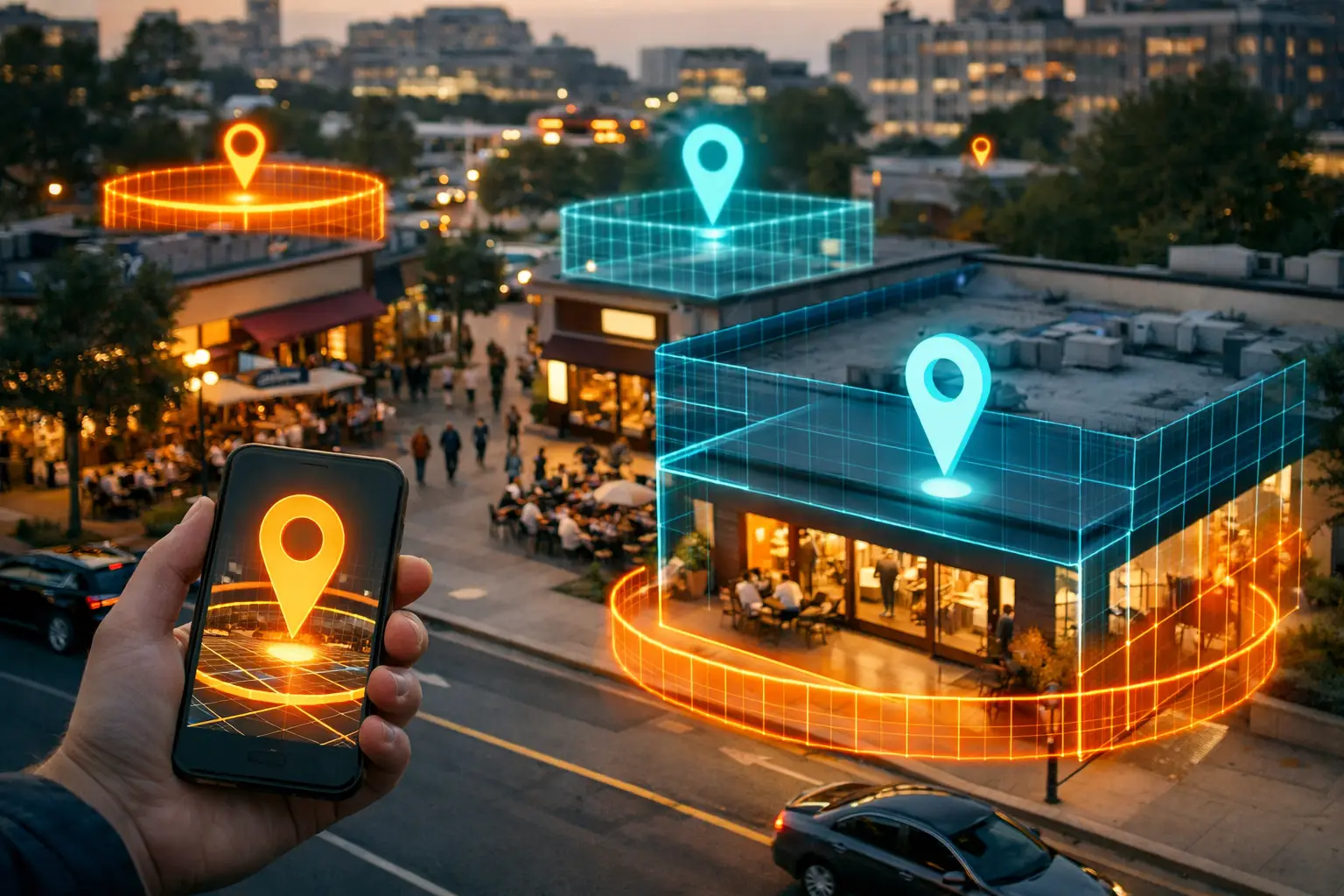
In 2026, more advertisers are moving toward including a layer of hyper-specific, precision geofences. These are custom-drawn polygons around the actual location or footprint they want to target. A retailer may focus on a competitor’s building and parking area. An event marketer may target a venue during the days attendees are present. A home service company may build campaign zones around neighborhoods where it wants more estimates.
This does not mean every campaign needs to be as narrow as possible. A small geofence can produce a highly relevant audience, but it can also limit scale. The right size depends on foot traffic, campaign length, budget, and how often people in that audience can realistically be reached. Precision should reduce wasted impressions, not choke off delivery. Always weigh the pros and cons over every advertising option and remember they all work together. Therefore, a nice mix of hyper-targeted and more broad targeting can often be a good play.
Competitor and event audiences will remain high-value
Competitor conquesting continues to be one of the most practical uses of precision geofencing. When someone visits a competing business, they have shown interest in that type of product or service. A well-timed ad can introduce a better offer, a nearby alternative, or a reason to compare options.
Event geofencing follows the same logic. Attendees at trade shows, local festivals, sporting events, and community gatherings are concentrated in one place around a shared interest. The campaign should match that context. Generic branding may build awareness, but a specific message such as a limited-time offer, appointment incentive, or event follow-up usually gives the audience a stronger reason to act.
The best campaigns also plan for what happens after the event or visit. Rather than trying to force an immediate conversion, advertisers can continue reaching the audience across available display, video, connected TV, and audio inventory after they leave the location.
Privacy and Data Quality Will Shape Campaign Choices
Location-based advertising is getting more scrutiny from consumers, platforms, and regulators. That is a good reason to be more disciplined, not a reason to abandon geofencing. Advertisers need to work with providers that use privacy-conscious processes and understand that available audience size can vary based on consented signals, device settings, and inventory availability.
The practical takeaway is simple: do not build a campaign around inflated audience promises. Ask how the audience is created, what reporting is available, and whether the platform can show delivery and performance clearly. If a vendor cannot explain the basics in plain language, it will be harder to trust the results later.
Data quality matters just as much as privacy. A poorly drawn fence around a large retail center may capture visitors to every business in the complex. That could be acceptable when the goal is broad local awareness. It is less useful when the goal is to reach people who visited one specific store. Reviewing the map before launch is still one of the highest-value steps in the whole process.
Cross-Device Reach Is Becoming the Standard
A customer may notice an ad on a phone, research on a laptop, and later see a video ad on a connected TV. That behavior is one reason geofencing is no longer limited to mobile display ads.
In 2026, local advertisers will increasingly use a location-based audience as the starting point, then extend reach across connected devices where permitted and available. This can make a campaign feel more consistent without relying on one placement type to do all the work.
Each channel has a different job. Display is often efficient for broad reach and repeated exposure. Video pre-roll can quickly communicate a service, offer, or product benefit. Connected TV can help a local brand look established in a market, while digital audio can reach people during commutes, workouts, and daily routines.
More channels do not automatically mean better performance. A limited budget spread across four formats may not generate enough frequency in any one of them. Start with the format that matches the goal, then expand after delivery and results show the audience is responding.
Measurement Will Move Beyond the Click
Clicks are useful, but they are not the whole story for local advertising. Someone can see an ad, visit a website later through another route, call the business, or visit a physical location without ever clicking. Campaign measurement needs room for those paths.
This is why conversion zones are becoming more valuable. A conversion zone is a defined area tied to a desired in-person outcome, such as a business location, dealership lot, store, or event venue. When campaign reporting connects ad exposure with visits to that zone, advertisers have a clearer view of whether the campaign may be driving real-world action.
That said, visit attribution is not a magic answer. It should be read alongside website leads, call volume, sales data, appointment requests, and overall campaign timing. A campaign that runs during a major promotion may show strong activity, but the promotion itself also influenced demand. Good reporting gives you evidence to improve decisions, not a reason to claim every visit came from an ad.
For multi-location brands, location-level reporting will become even more important. One market may respond to competitor targeting, while another performs better with neighborhood awareness or event audiences. Treating every location the same can hide those differences and waste budget.
How to Plan for Geofencing Trends in 2026
The most effective campaigns will be built around a simple operating plan rather than a complicated ad-tech stack. Before launching, decide what a successful result looks like. Is it more store visits, estimate requests, event registrations, calls, or awareness in a new neighborhood? That decision affects the fence, message, channel mix, and measurement setup.
Use this practical checklist to keep the campaign focused:
- Define one primary outcome and one supporting metric, such as store visits and website sessions.
- Draw fences around places with clear business value, not just areas that look large on a map.
- Match creative to the audience’s likely intent, especially for competitor and event campaigns.
- Set a campaign length that allows enough delivery to learn, rather than judging performance after a few days.
- Review live reporting regularly and adjust the geofence, creative, budget, or conversion zone when the data supports a change.
A self-serve platform can make these decisions easier because the advertiser can see the map, launch timing, spending, and reporting without waiting on a managed-service team. Qujam is built for that kind of hands-on control, giving local advertisers a way to create hyper-local campaigns without enterprise-style minimums or opaque reporting.
The Local Advantage Is Getting More Specific
The most useful trend is not a new ad format or a flashy dashboard feature. It is the growing ability for local advertisers to stop paying for vague proximity and start making intentional choices about the places, audiences, and outcomes that matter to their business.
Start with one location your ideal customer already visits. Build a relevant message around that moment, measure what happens next, and use the results to make the next campaign sharper. That is how geofencing becomes a repeatable local growth tool instead of another line item in the media budget.
Key Takeaways: Geofencing Trends in 2026
-Polygons Over Radiuses: Advertisers are abandoning broad, wasteful “radius targeting” in favor of hyper-specific custom boundaries (polygons) around exact buildings.
-Omnichannel Expansion: Geofencing is no longer just for mobile display ads. Location audiences are now the starting point for cross-device targeting on Connected TV (CTV) and digital audio.
-Privacy-First Data: With stricter data regulations, transparent, self-serve platforms that prioritize high-quality, opted-in location data are outperforming opaque managed services.
-Measuring Physical Visits: Campaign success is shifting away from digital “clicks” to tracking offline foot traffic via Conversion Zones.


