
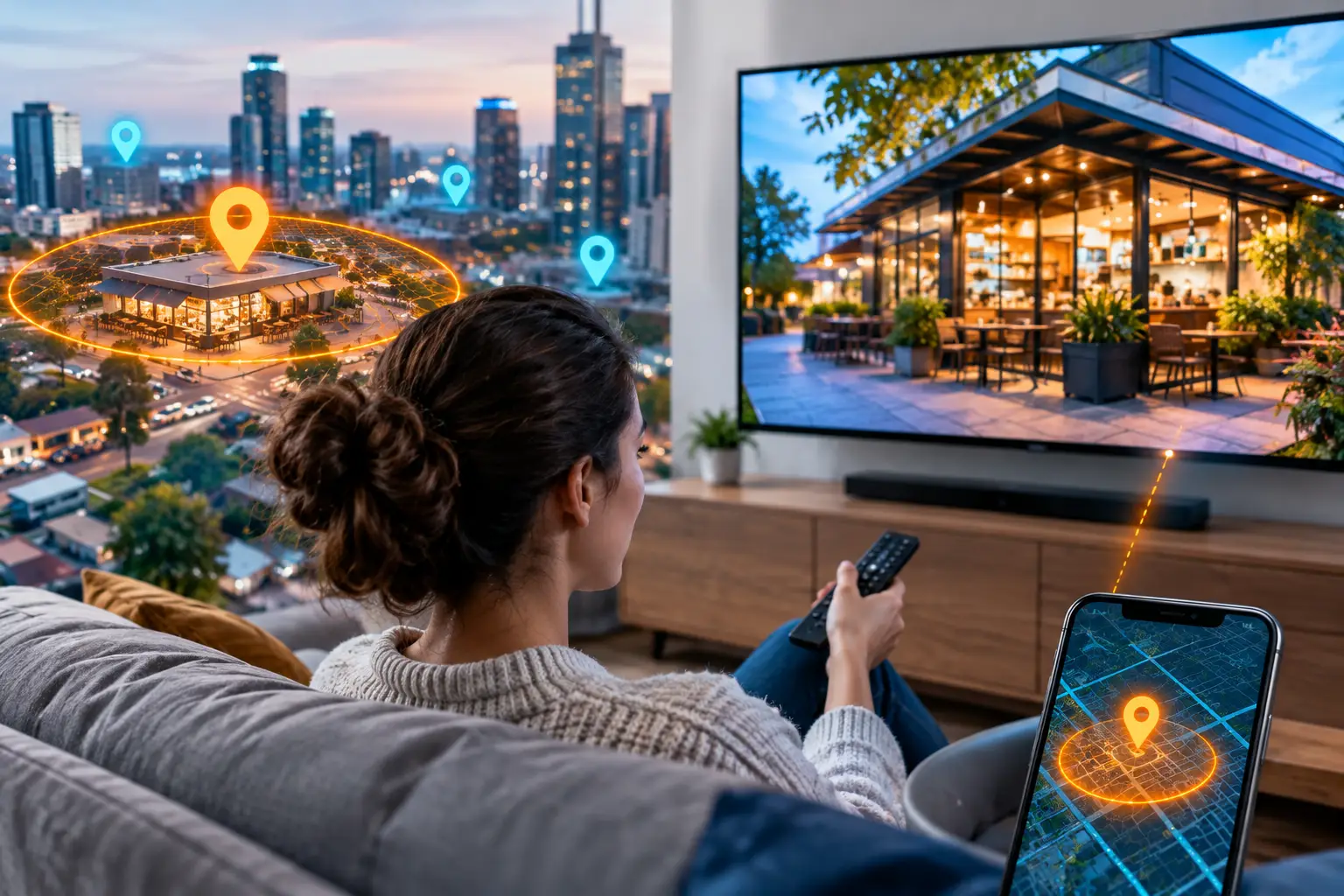

Streaming TV ads can put a local business on the same screen as national brands without breaking the bank. The difference is targeting. A practical guide to location based OTT advertising starts with a simple idea: do not pay to reach every household in a metro area when your best prospects are near a specific store, event, neighborhood, or service zone.
For local advertisers, OTT (Over The Top) can be more than broad awareness. When it is paired with precise location data, it becomes a way to reach people connected to the places that matter to your business, then measure whether that exposure helped drive real-world visits. It is powerful, but only when the audience, geography, creative, and measurement plan work together.
What Is Location Based OTT Advertising?
OTT refers to ads delivered through streaming content rather than traditional cable. Think ad-supported programming watched through connected TVs, streaming devices, smart TVs, tablets, and other internet-connected screens. CTV, or connected TV, usually refers specifically to the television screen and device environment.
Location based OTT advertising adds geographic relevance to that inventory. Instead of buying an entire city, advertisers create an audience from privacy-compliant mobile location signals associated with a defined physical area. That area might be a retail location, a competitor’s storefront, an apartment community, a convention venue, a neighborhood, or a carefully mapped service territory.
The audience is then used to deliver streaming video ads across eligible household and device environments. The goal is not to follow an individual around the internet. It is to build a relevant audience based on real-world location behavior and reach that audience through privacy-compliant advertising technology.
This distinction matters. A simple radius can spill into roads, unrelated businesses, and residential areas you never intended to target. A custom-drawn geofence gives you more control over which physical spaces contribute to your campaign audience.
Why OTT Makes Sense for Hyper-Local Campaigns
Local businesses often assume TV advertising is out of reach because traditional TV buying has been expensive, broad, and difficult to measure. Streaming changes the math. OTT inventory can be purchased with audience and geography controls that make more sense for a single location, a regional franchise group, or an event-based promotion.
The biggest benefit is reduced waste. A restaurant opening near a busy shopping district does not necessarily need impressions across the entire county. A home services company may care more about households connected to its actual service area than viewers in a neighboring market. An event organizer may want to continue reaching people who attended a trade show after the event ends.
OTT also gives advertisers room to tell a story. A 15- or 30-second video can show the product, the location, the offer, and the reason to act in a way a small display ad cannot. For brands that depend on familiarity and trust, that larger-screen experience can make a meaningful difference.
Still, OTT is not automatically the right first move for every campaign. If your offer needs immediate clicks, search or display may play a larger role. If your audience is very limited, frequency can rise quickly. OTT works best when you have enough qualified local audience scale, a clear message, and the budget to run consistently long enough for people to remember you.
How to Plan a Location Based OTT Campaign
Start with the business outcome, not the ad format. Are you trying to increase store visits, build awareness before an opening, win customers from a nearby competitor, promote a local event, or stay visible in a defined service area? Your answer determines the geography and the creative.
Map the places that create your audience
Choose the physical locations that signal real intent or relevance. For a retailer, that could be its own stores and nearby complementary businesses. For a franchise, it may be individual trade areas around multiple locations. For an event marketer, it could be the convention floor, surrounding hotel blocks, and travel paths that make sense for the campaign.
Precision matters here. Broad ZIP code and city targeting can be useful for reach, but they are not substitutes for a well-built location strategy. Draw around the actual building, property, footprint, or neighborhood whenever the campaign calls for it. Then consider exclusions. If a zone includes unrelated areas, narrow it before the campaign launches.
The best setup depends on your goal. A tight geofence can prioritize relevance but may create a smaller audience. A larger custom footprint can produce more scale but may introduce less-qualified users. There is no universal right size. Build for intent first, then expand carefully if delivery is too limited.
Create an audience window that fits the buying cycle
Location data becomes more useful when you decide how recent a visit should be. A lunch promotion may benefit from a shorter recency window because people who were nearby recently are more likely to return soon. A larger purchase, seasonal service, or major event may justify a longer window.
Avoid treating every past visitor as equally valuable. Someone who visited a location last week is usually more relevant than someone who was there many months ago. Match your audience window to how quickly customers tend to make decisions.
Build creative for the living room screen
OTT ads need to communicate quickly. Viewers are not leaning over a keyboard waiting to click. Lead with the business name, the primary benefit, and a visual that makes sense without sound. Add clear on-screen text, a local cue when it is meaningful, and one call to action.
For example, a multi-location business might use the line, “Now serving your neighborhood,” followed by a recognizable storefront, product shot, and simple visit prompt. Do not cram in every service, every promotion, and every disclaimer. One focused message generally performs better than a crowded commercial.
Use a 15-second spot when the goal is efficient reach and a simple offer. Choose 30 seconds when you need a little more explanation, a demonstration, or stronger brand storytelling. If you do not have video assets, start with professionally assembled motion creative rather than delaying a campaign indefinitely.
A Practical Setup Checklist
Before spending a dollar, make sure the campaign has these four decisions in place:
- A defined business goal, such as visits, awareness, event attendance, or competitor conquesting.
- Custom location zones and exclusions that reflect where qualified prospects actually spend time.
- A video message designed for a large screen, with readable text and a clear call to action.
- A measurement plan that identifies what success will look like before results begin coming in.
A self-serve platform such as Qujam can make this process more approachable by letting advertisers draw precise locations, set budgets without daily spend minimums, activate quickly, and view reporting in real time. The operational advantage is control: you can adjust geography, creative, pacing, or budget based on what the campaign is actually doing instead of waiting on a long managed-service process.
Measuring More Than Impressions
Impressions and completed video views are useful delivery metrics, but they are not the finish line for a local campaign. If the goal is physical traffic, measure foot-traffic lift through a conversion zone around your location. This compares observed visits from exposed audiences with an appropriate baseline or control methodology, helping show whether the campaign contributed to more visits.
Set conversion zones thoughtfully. A store visit should mean someone entered the location, not merely passed it on a nearby road. Keep the zone aligned to the actual property and give the campaign enough time to generate a meaningful sample.
Measurement also has limits. Foot traffic does not capture every sale, and not every customer visit can be tied to a single ad exposure. Use it alongside business signals such as in-store redemptions, appointment volume, website activity, and sales trends. The point is to make smarter decisions, not to pretend advertising attribution is perfect.
Common Mistakes That Create Waste
The most common problem is going too broad too soon. Advertisers see a large potential audience and assume more reach is always better. For a local business, broad reach can consume budget without improving relevance. Begin with your highest-value zones and expand only when there is a clear reason.
Another mistake is using one generic ad across every location. If a campaign covers multiple markets, consider versions that reference the closest location, a local offer, or the relevant service area. Small adjustments can make a streaming ad feel far more connected to the viewer.
Finally, do not judge OTT after a few days. Streaming campaigns often need time to build reach and frequency among the right audience. Watch pacing, completed views, frequency, foot-traffic trends, and creative performance, then make measured changes. Constantly rebuilding the campaign can make it harder to learn what is working.
Start with one clearly defined audience, one strong local message, and one outcome you can measure. Once you see how that combination performs, you can expand with confidence instead of paying for a larger audience and hoping it becomes more valuable.
Key Takeaways: Location-Based OTT Advertising
- The Strategy: OTT (Over-The-Top) advertising delivers streaming video commercials to internet-connected devices. Location-based OTT uses geofencing to serve these ads strictly to audiences who have visited specific, high-intent physical locations.
-Waste Reduction: Instead of buying a broad, expensive broadcast market (DMA), local advertisers can focus their budget solely on households connected to their specific service area or a competitor’s storefront.
- State Compliance: For campaigns in states with precision geofencing restrictions, advertisers can use Hyper-Grid Geofencing to target pre-defined 0.5-mile by 0.5-mile bounding boxes to remain 100% legally compliant.
- Actionable Measurement: Success is not just measured by video completion rates. Advertisers can tie OTT exposure directly to offline foot traffic using Conversion Zones to track real-world store visits.


