
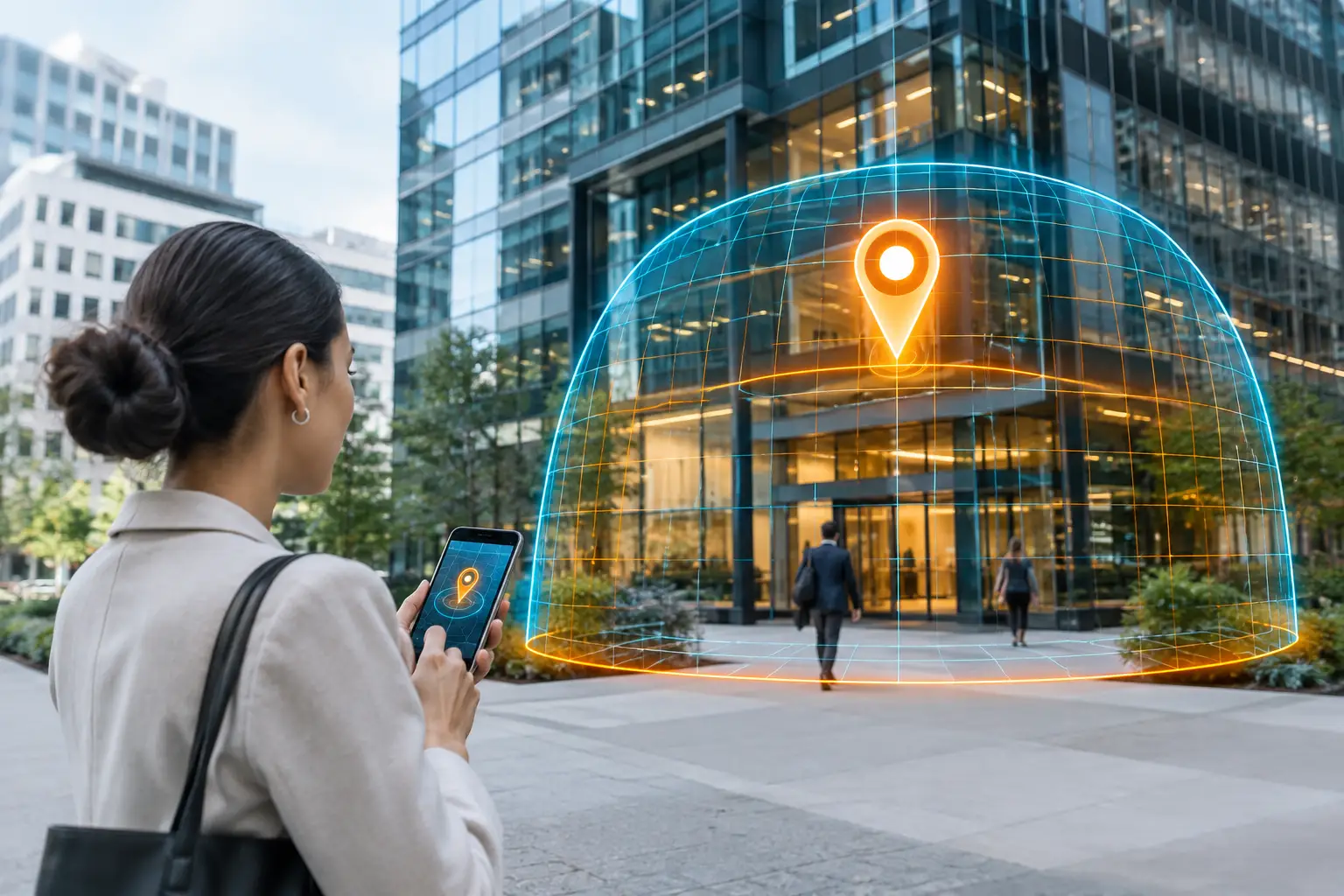

A downtown office tower can hold thousands of potential customers, partners, and decision-makers – but buying ads across the entire city to reach them is expensive guesswork. So, can geofencing target office buildings? Yes. With precise geofencing, advertisers can draw a custom boundary around a specific office building and build an audience from privacy-compliant mobile location signals observed within that footprint.
That is a much different approach from targeting a broad ZIP code or placing a generic radius pin around a business district. It gives local advertisers, B2B marketers, franchises, and agencies a practical way to focus spending on the places that matter most.
How geofencing office buildings works
Office building geofencing starts with the physical location, not a demographic assumption. An advertiser identifies the building they want to reach, then creates a tightly drawn polygon around its footprint. Devices seen within that defined area can be added to a campaign audience using privacy-compliant location data.
Ads are then delivered to that audience across available digital inventory, including mobile display, video, digital audio, desktop, and connected TV. The ad does not have to appear while someone is standing in the lobby or sitting at their desk. More commonly, the campaign reaches the audience later as they use apps, browse sites, stream content, or watch television.
This distinction matters. Geofencing is audience building based on a real-world location signal. It is not a tool for sending a message to every phone inside a building at one exact moment.
A building is not the same as a company
A geofence around an office building can reach people who visited that building. It cannot reliably guarantee that every person works for a particular tenant.
That audience may include employees, clients, delivery workers, visitors, contractors, and people using shared amenities. In a multi-tenant tower, it can also include people associated with many companies. That is not necessarily a problem, but it changes how you should plan the campaign.
If your goal is to reach a broad professional audience near a business district, a full-building geofence may be a strong fit. If you need to reach people associated with one company inside a large shared tower, use the building as one part of a more thoughtful audience strategy rather than treating it as a perfect employee list.
Additionally, keep in mind, that geofencing is using GPS data, so if you target a multi-story building, you will be collecting devices from all floors. You can geofence a section of the building like sectioning off a slice of cake, but you cannot select specific floors.
When office building targeting makes sense
The best office-building geofencing campaigns begin with a clear reason that the people visiting a location are likely to care about your offer. A restaurant with corporate catering can target nearby office towers before lunch. A local fitness studio can promote corporate memberships to workers in a business park. A B2B software company can build awareness around an industry hub, corporate campus, or trade office where likely buyers spend time.
It also works well for competitive campaigns. If a commercial service provider knows which office complexes house competing firms or ideal client types, those locations can become high-value audience sources. The goal is not to blanket an entire metro area. It is to make more of the budget count.
For multi-location brands, office buildings near each location can support a local acquisition strategy. A coffee shop, fast-casual restaurant, salon, dry cleaner, or gym may find that office workers are a meaningful source of repeat business. In that case, the creative should make the next step easy: visit during a specific time, claim a local offer, order ahead, or book an appointment.
Can geofencing target office buildings with real precision?
Yes, but precision depends on the physical environment and the campaign setup. A custom-drawn building footprint is generally more precise than a one-mile radius, but no location audience method is flawless.
Dense urban areas can be challenging because buildings sit close together, sidewalks are busy, and GPS accuracy can vary. A geofence drawn too generously may capture signals from the street, neighboring buildings, or nearby retail. A boundary drawn too tightly may limit scale. The right balance depends on the building layout, expected traffic, campaign goals, and available budget.
Vertical office buildings create another practical limitation. Location data can indicate that a device was at the building footprint, but it does not consistently identify a specific floor or suite. Do not build a campaign around the assumption that you can isolate the 18th-floor tenant from everyone else in a large tower.
The better approach is to be honest about what the location represents. A single-tenant campus may indicate a concentrated audience. A downtown tower may indicate a broader professional audience. Both can be valuable, but they call for different messaging, budgets, and expectations.
When Hyper-Grid Geofencing is the Better Idea
While custom-drawn polygons are perfect for isolating a single building, they are not always the best tool for sprawling commercial zones. This is where Hyper-Grid Geofencing becomes a massive strategic advantage.
Instead of drawing shapes around individual buildings or relying on a wasteful radius, Hyper-Grid divides a market into pre-defined 0.5-mile by 0.5-mile geographic bounding boxes. You simply select the grid squares that cover your target commercial area. Hyper-Grid targeting is the superior choice in three specific scenarios:
- Sprawling Corporate Campuses & Business Parks: If an office park consists of twenty different buildings, drawing individual polygons is tedious and leaves gaps. Selecting the grid cells that cover the entire park captures employees moving between buildings, parking lots, and campus amenities.
- Dense Financial Districts: In a clustered downtown area where workers constantly walk between high-rises for meetings and lunches, a hyper-grid efficiently captures the professional foot traffic of the entire district.
- State Privacy Compliance: If you are operating in states with strict privacy laws that restrict precision building-level geofencing (such as Oregon, Virginia, Maryland, New Jersey, and Connecticut), Qujam’s Hyper-Grid ensures your campaign remains 100% compliant while still penetrating the target neighborhood.
- When hyper-grid’s 3rd party demographic targeting segments are more valuable than extreme precision location targeting. Hyper-Grid enables demographic layering. You can select a commercial grid and layer a filter for specific income levels, ensuring your B2B or premium service ads are only served to high-level professionals within that zone.
Build a campaign around the location, not just the map
Drawing the geofence is only the first decision. The campaign needs an offer and message that make sense for the audience you are trying to reach.
For a lunch-focused restaurant, short mobile ads can promote proximity, ordering convenience, and a time-specific special. For a B2B advertiser, video or display creative may focus on a business problem, a clear proof point, and a simple next action such as requesting a demo. For a local service company, the message could center on serving the workplace or the surrounding neighborhood.
Creative should acknowledge the context without becoming overly personal. “Lunch delivered to your office” is relevant. “We saw you at this building” is not. Good geofencing feels useful because the offer fits the location, not because it calls attention to how the audience was built.
Frequency matters, too. Reaching a qualified audience several times can improve recall, but excessive repetition wastes impressions and can make a small audience feel saturated. Watch reach, frequency, click activity, video completion, and post-click actions in real time. If performance softens, refresh the creative, adjust the budget, or expand to a carefully chosen group of related office locations.
Use office locations as part of a larger audience plan
A single office building may not generate enough audience volume for every campaign. That is especially true for smaller properties, short campaign windows, or niche B2B offers. Combining several relevant buildings often creates better scale without sacrificing the local relevance that made the strategy appealing in the first place.
For example, an agency could group office buildings in a financial district, a technology corridor, or a cluster of commercial parks. A caterer might pair nearby offices with coworking spaces and conference venues. A franchise brand could create separate location-based audiences around office clusters near each store, then customize creative by market.
This is where hyper-grid targeting can help. Instead of relying only on one broad radius, advertisers can use a grid-based approach to cover a defined commercial area with more control over where the campaign gathers signals. It is useful when the target is not one building but a concentrated zone of workplaces, commuter activity, and business services.
The trade-off is straightforward: broader coverage can increase reach, but it can also introduce more audience variation. Keep the geography tied to a real business case. More map coverage is not automatically better targeting.
A practical starting point
Start with a small set of high-value office buildings rather than every workplace in a market. Choose locations based on customer fit, not prestige. Then use clear creative, a realistic campaign duration, and reporting that shows what is happening while the campaign is live.
Qujam makes this approach accessible without enterprise contracts or mandatory daily spend minimums, so advertisers can test precise office-building geofences, learn from the data, and adjust quickly. The smartest first campaign is rarely the biggest one. It is the one built around a location your business can genuinely serve and an offer people have a reason to act on.
Key Takeaways: Geofencing Office Buildings
- Precision Targeting: You can target specific office buildings by drawing custom polygons around their exact physical footprints, capturing privacy-compliant mobile IDs of employees and visitors.
- Vertical Limitations: Geofencing relies on GPS data, which cannot distinguish between floors in a high-rise. Targeting a multi-tenant tower captures devices from the entire building, not a single company.
- The Hyper-Grid Alternative: When targeting sprawling business parks, financial districts, or operating in states with privacy restrictions on custom polygons, Hyper-Grid Geofencing allows you to target 0.5-mile by 0.5-mile commercial bounding boxes compliantly.
- The Ad-Tech Landscape: Enterprise platforms and managed-service agencies gatekeep B2B geofencing behind high minimums. Self-serve platforms like Qujam allow local advertisers to target office buildings with real-time budget control.


