
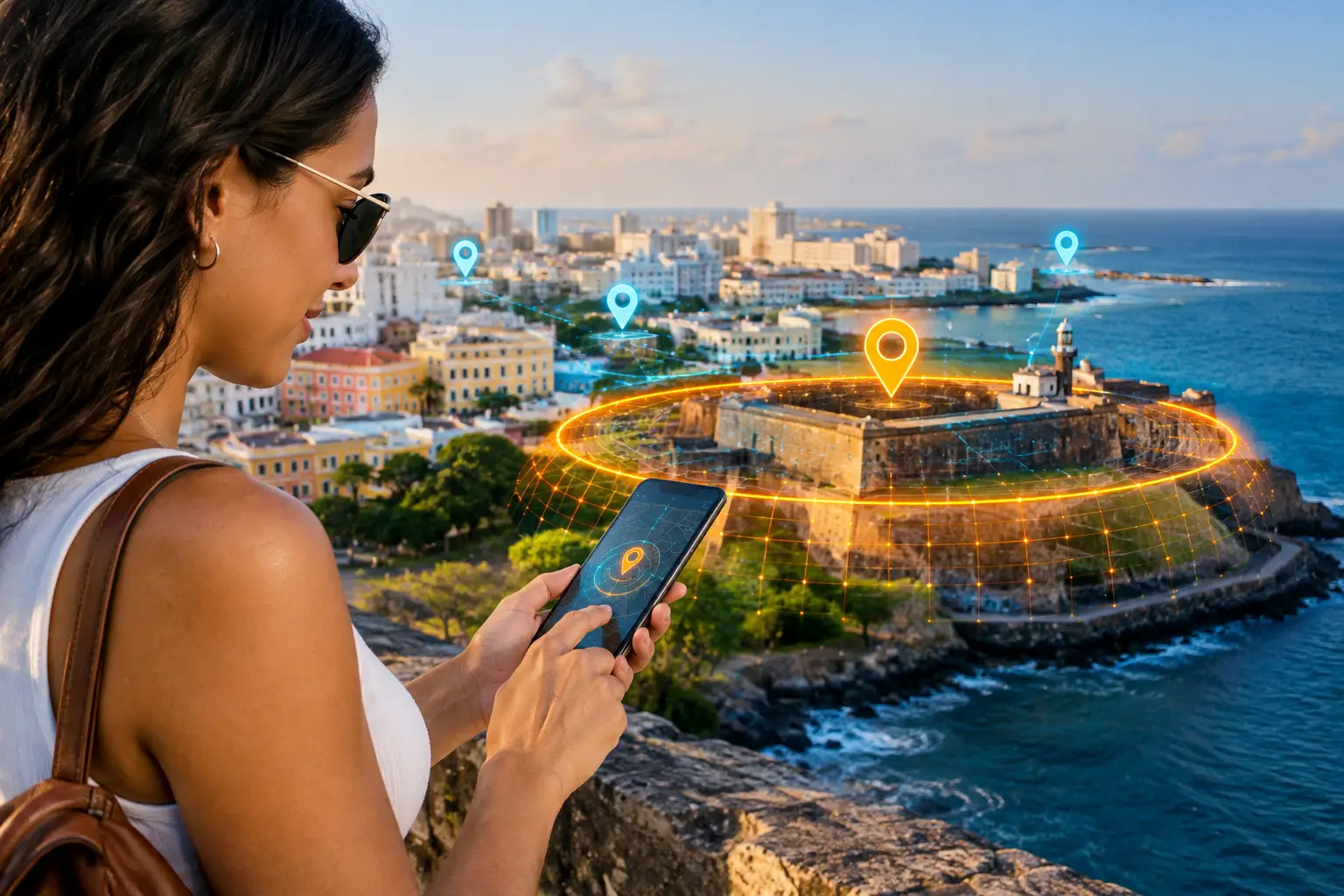

Puerto Rico is not a market where a broad island-wide campaign does much good. A restaurant in Condado, a home services company serving Ponce, and an exhibitor at the Puerto Rico Convention Center need very different audiences. Knowing how to geofence in Puerto Rico lets you draw a meaningful line around the places that matter, reduce wasted impressions, and reach people based on where they have actually been.
For local advertisers, the goal is not simply to put a pin on a map. It is to build a location strategy around real customer behavior, local geography, and a clear business outcome.
Start With the Place That Signals Intent
Geofencing uses privacy-compliant mobile location signals from devices observed inside a defined physical area. Once an audience is built from that location activity, you can serve ads to eligible devices across mobile, desktop, connected TV, video, and digital audio inventory.
The quality of your campaign begins with the zone. A large radius around a neighborhood may look convenient, but it can pull in people who were nearby without ever visiting the location you care about. Precision geofencing works best when the boundary matches the actual footprint: a storefront, hotel, venue, apartment complex, convention hall, parking area, or competitor location.
In Puerto Rico, this matters because customer patterns can shift block by block. Old San Juan has tight streets and dense visitor traffic. Hato Rey has office activity that changes through the workday. A broad zone around a shopping center could include surrounding roads, residences, and unrelated businesses. Draw only the buildings, entrances, or event areas that make sense for your offer.
Before opening an ad platform, answer one question: what location visit is most likely to indicate interest in what you sell? That answer should determine your first geofence.
How to Geofence in Puerto Rico Step by Step
1. Define one campaign objective
Avoid launching with a vague goal such as “build awareness.” Pick a practical outcome you can act on. You may want more visits to a retail location, leads for a local service area, attendance at a live event, or a way to compete for customers visiting another business.
A clear objective shapes everything else. A retailer may target visitors to nearby shopping destinations. A wedding venue may reach people attending a bridal expo. A tourism operator may build an audience around specific hotels, cruise-related areas, or attractions, provided the message matches the visitor’s likely needs.
2. Choose the right geographic shape
There are three common ways to approach location targeting, and they are not interchangeable.
Precision geofencing is the best fit when you need to target a specific physical location. You draw a custom polygon around a business, event venue, or defined property footprint. This is usually the right choice for competitor conquesting, trade shows, retail locations, and tightly defined destinations.
Hyper-grid geofencing divides a larger area into smaller map-based cells. It is useful when your opportunity is spread across a neighborhood, municipality, or service zone rather than limited to one building. A business serving multiple parts of San Juan, Bayamón, or Caguas may use a grid to focus spend on the areas it can realistically serve.
Addressable targeting reaches households rather than people observed at a specific location. It can be useful for a local promotion, but it solves a different problem. If you want to reach people who attended an event last weekend, precision geofencing is generally the stronger starting point.
3. Draw tight, intentional zones
Use the map to trace the location rather than relying on a one-mile or five-mile radius. Include areas that are part of the customer journey, such as a venue entrance or designated event space, when appropriate. Exclude roads, neighboring properties, and public areas that add noise to the audience.
Be realistic about the location itself. A small boutique can use a compact boundary. A large resort, fairground, or convention campus may need multiple polygons to account for separate buildings and activity areas. More coverage is not automatically better. The right coverage is better.
4. Set a sensible audience window
A person visiting a retail store yesterday may be worth reaching soon. Someone who attended a seasonal festival two months ago may need a different message, or may no longer be relevant at all.
Your recency window should match the buying cycle. Short windows often work well for restaurants, retail promotions, and time-sensitive events. Longer windows can make sense for higher-consideration services, but only if your creative gives people a reason to remember and respond. Start with a window that reflects reality, then adjust based on results.
5. Match creative to the location visit
Location data gets attention. The ad still has to earn the click, visit, or call.
Keep the message simple and locally useful. Mention the offer, the next step, and why it is relevant now. If you are targeting attendees from an event, reference the category or experience rather than implying you know personal details about them. If you are targeting a competitor location, focus on your own value: a better offer, nearby convenience, easier booking, or a limited-time incentive.
Spanish-language creative may be essential depending on your audience and market. For many campaigns, testing both English and Spanish versions is a practical way to make the message feel more natural without making assumptions about every individual customer.
Build a Puerto Rico Campaign Around Real Behavior
Puerto Rico presents opportunities that are easy to miss when a campaign is built from a mainland template. Tourism, local commerce, conventions, nightlife, retail corridors, and seasonal events can create concentrated moments of intent. The smart move is to target the moment, not just the municipality.
For example, a local restaurant could build a campaign around a nearby event venue and run ads before and after event hours. A transportation provider could focus on hotel zones and convention activity with a booking-oriented message. A home services company may get better results from hyper-grid coverage across qualifying neighborhoods than from targeting every person in a large metro area.
Campaign timing also matters. Account for local business hours, event schedules, weekends, and holiday activity. Do not assume the same dayparting pattern that works in Chicago or Dallas will work in San Juan. Let performance data guide refinements after the campaign has enough delivery to reveal a pattern.
Measure Visits, Not Just Impressions
Impressions and clicks are useful delivery signals, but they do not tell the full story for a location-based campaign. If your goal is to bring people to a physical business, foot-traffic measurement should be part of the plan from day one.
Set up a conversion zone around your own store, venue, or other eligible destination. This allows you to measure observed visits from devices exposed to your campaign, helping connect advertising activity to a real-world outcome. It is not a perfect record of every customer or every sale. It is a directional measurement tool that helps you compare performance and make better budget decisions.
Look at results alongside operational reality. A spike in measured visits is more meaningful if it lines up with staffed hours, promotions, event dates, or sales activity. If a campaign has strong reach but weak visitation, the issue may be the zone, the offer, the creative, or the landing experience. Do not blame the channel before checking the full path.
Avoid the Common Geofencing Mistakes
The first mistake is drawing zones that are too large. Big circles can create cheap-looking reach while quietly wasting budget on irrelevant audiences. The second is trying to target every possible location at once. Start with a handful of high-intent places, learn what performs, and expand from there.
Another mistake is treating every location visitor as the same audience. Someone who visited a convention center during a business expo may need a different message than someone attending a concert there. Separate campaigns when the event, timing, and offer are meaningfully different.
Finally, keep privacy and platform rules at the center of the plan. Use privacy-compliant location audiences, avoid sensitive locations and prohibited categories, and do not write ads that suggest personal surveillance. Effective geofencing is precise without being creepy.
Get Control Without Enterprise Friction
Location advertising should not require a large agency contract or a hard-to-understand media plan. With a self-serve platform such as Qujam, advertisers can draw custom geofences, activate campaigns with transparent CPMs, monitor delivery in real time, and use conversion zones to evaluate foot traffic. That control is especially valuable when you are testing a few Puerto Rico locations before committing more budget.
Start small enough to learn, but specific enough to matter. Choose the place where customer intent is clearest, build a message that fits that moment, and let real campaign data tell you where to go next.


