
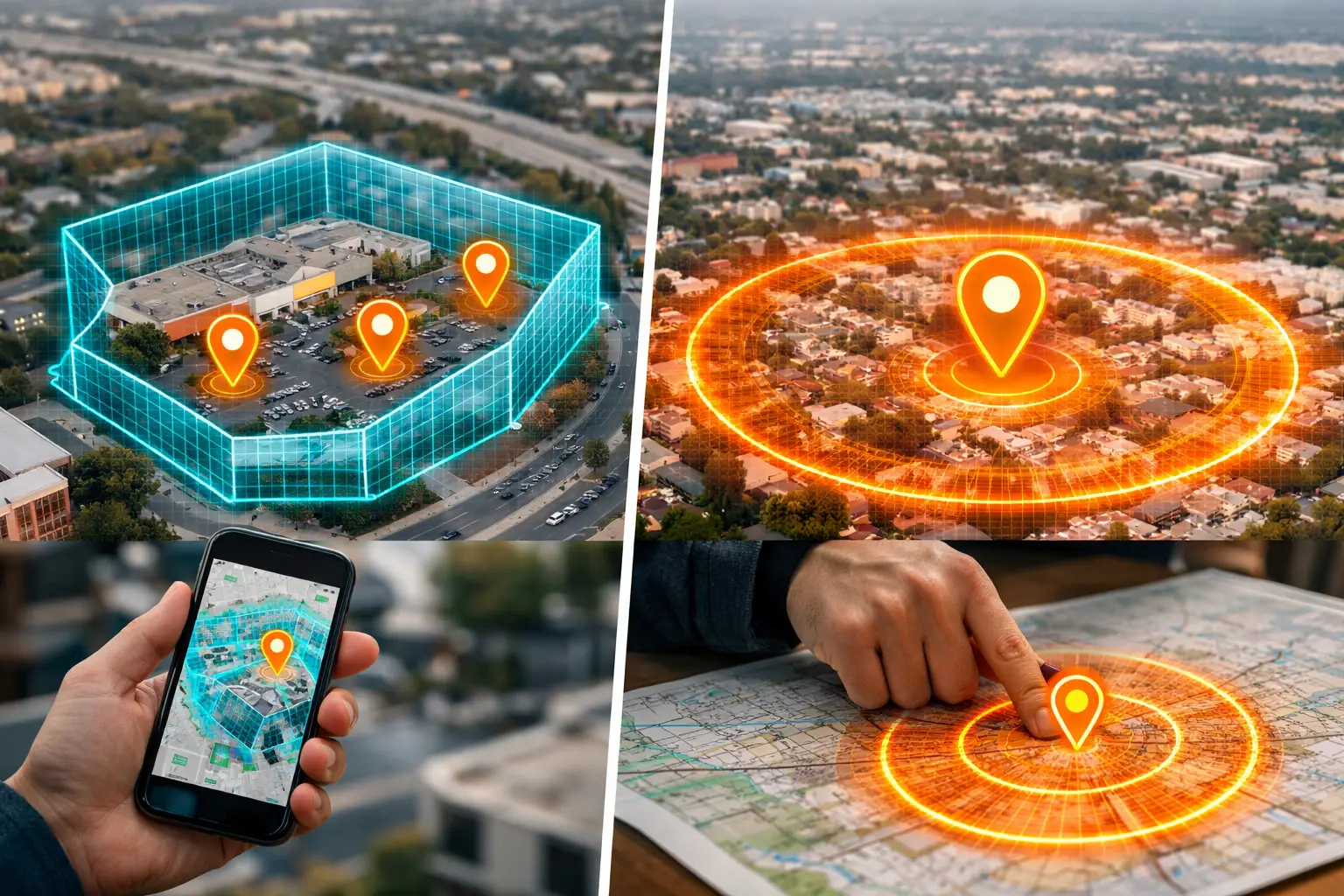

A one-mile radius around a storefront can look targeted on a map while still covering apartment buildings, unrelated retailers, parking lots, and streets where your ideal customer may never go. That is the practical difference behind precision geofencing vs radius targeting: one lets you draw around the place that matters, while the other casts a circle around a point.
For local businesses and agencies trying to make every ad dollar work harder, the choice affects more than a campaign setting. It affects who enters your audience, how much waste you accept, and whether your reporting can support a real business decision.
Precision Geofencing vs Radius Targeting: The Core Difference
Radius targeting uses a distance around a central address or map pin. You choose a location, set a radius such as one, three, or five miles, and ads are eligible to reach people within that circular area. It is quick to set up and can work well when the goal is broad local awareness.
Precision geofencing uses custom geographic boundaries, often called polygons, to define a specific place. Instead of accepting everything within a circle, you can outline an individual building, a shopping center, a competitor location, an event venue, a neighborhood, a campus, or a defined service area. When a device enters that boundary, it can become part of an audience for later ad delivery across connected devices.
The distinction sounds simple, but it changes the quality of the audience. A radius answers, “Who was near this point?” A geofence answers, “Who was at this place?” Neither is automatically better. The right choice depends on how specific your real-world customer behavior is and how much overlap you can afford.
Why Radius Targeting Can Create Hidden Waste
A radius is a broader geographic tool. Its circular shape does not follow property lines, roads, walls, or the layout of a commercial district. In dense areas, even a small radius can include many businesses and residences that have nothing to do with your campaign.
Imagine a restaurant trying to reach people who visit a nearby entertainment venue. A one-mile radius may include the venue, but it may also include several hotels, office towers, competing restaurants, public transit stops, and thousands of nearby residents. That can be useful if the restaurant wants general neighborhood visibility. It is less useful if the offer is specifically designed for event attendees.
Radius targeting also has an operational limitation: the smaller the radius, the more location variability can matter. Mobile location signals are not perfect, particularly in dense urban environments, multi-level buildings, or areas where signals are affected by surrounding structures. Making a circle smaller does not turn it into a precise property boundary.
This does not make radius targeting a bad option. It simply means advertisers should treat it as a coverage tool, not a substitute for hyper-local targeting.
Where Precision Geofencing Earns Its Value
Precision Geofencing is built for campaigns where the location itself is meaningful. If someone visited a competitor’s storefront, attended a trade show, entered a stadium, spent time in a specific shopping complex, or visited a targeted neighborhood, that visit can signal stronger relevance than simply being nearby.
A well-built precision geofence can help reduce exposure to unrelated locations. For example, a home services company may want to focus on a neighborhood where it is actively expanding, rather than everyone within several miles of a central intersection. A franchise operator may want separate boundaries around each location to support localized messaging and clearer reporting. An event marketer may want to create a boundary around the venue instead of paying to reach people at surrounding businesses.
The value is not just tighter lines on a map. It is the ability to build a more intentional audience and follow up with display, video, connected TV, or audio ads after the visit. That gives businesses a way to continue the conversation after a prospect leaves the physical location.
Precision still needs smart setup
A precision geofence is only as useful as the boundary and campaign strategy behind it. Drawing a fence too broadly can recreate the same waste as a radius. Drawing it too tightly may miss entrances, parking areas, or relevant foot traffic. The goal is not always the smallest possible shape. The goal is a boundary that matches the behavior you are trying to capture.
For a retail location, that may mean including the storefront and its immediate entrance area. For an event, it may mean accounting for the venue footprint, attendee entrances, and adjacent registration space. For a neighborhood campaign, it may mean outlining the actual community rather than using a nearby address as the center point.
When Radius Targeting Makes Sense
Radius targeting has a place in local advertising, especially when precision is not the primary goal. It can be a reasonable choice when your audience is naturally broad or when the geography is less crowded.
A business opening in a suburban market may want wide awareness among nearby households. A local brand promoting a general sale may want to cover a surrounding trade area rather than build a visitor audience from one location. A service business with a practical travel range may also use a radius as one layer of its media plan, provided it understands that the boundary is approximate.
Use radius targeting when you are comfortable reaching people who live, work, shop, or travel near a location. Use geofencing when the actual destination matters.
The most effective campaigns sometimes use both, but for different jobs. A radius can support broad awareness around a new location, while a geofence can build a higher-intent audience from a competitor, event, or specific commercial property. Combining them without separating budgets, creative, and reporting can make results harder to interpret, so structure matters.
How to Choose the Right Approach
Start with a plain-language question: what physical behavior would make someone a stronger prospect?
If the answer is “they were in this part of town,” radius targeting may be sufficient. If the answer is “they visited this store,” “they attended this event,” or “they entered this property,” geofencing is likely the better fit.
Next, look at the map. Dense downtown areas, mixed-use developments, shopping centers, and multi-tenant properties usually make a strong case for custom boundaries. A broad rural or suburban trade area may make a radius more practical. Your budget matters, too. A smaller, more relevant audience can often help concentrate spend, but it may need enough time and scale to generate meaningful delivery.
Finally, decide what success looks like before launch. Awareness campaigns may prioritize reach and frequency. Lead-generation campaigns may track website actions, calls, form submissions, or visits to a conversion zone. If you cannot explain what the campaign is meant to accomplish, no targeting method will solve that problem.
Build a Precision Geofencing Campaign Around the Outcome
If you choose precision geofencing, campaign setup should connect the place, audience, message, and measurement.
Begin by defining the location or locations that represent real customer intent. Be selective. Ten carefully chosen competitor locations may be more valuable than hundreds of loosely related addresses. For event campaigns, set the fence around the actual event footprint and plan the campaign timeline around the dates people are likely to attend.
Then match the creative to the audience. Someone who visited a competitor may respond to a clear differentiator, an introductory offer, or a reason to compare options. An event attendee may respond better to a relevant follow-up message than to a generic brand ad. Location-based targeting creates context, but the ad still needs to give people a reason to act.
Set up conversion zones where appropriate so you can measure whether exposed audiences later visit your business location. This is particularly useful for retailers, restaurants, automotive businesses, and other organizations that care about foot traffic. For service businesses, website conversions and lead quality may be stronger indicators than visits.
A self-serve platform such as Qujam gives advertisers direct control over these choices: build precise fences, manage campaigns in real time, review reporting, and make adjustments without waiting on a managed-service team. That control is valuable when a campaign needs to respond to an event schedule, changing budget, or performance data.
Common Mistakes to Avoid
The biggest mistake is treating location targeting as a shortcut to guaranteed results. A precise audience does not fix an unclear offer, weak creative, or a landing page that makes it difficult to contact you. Geofencing improves relevance. It does not replace the rest of your marketing.
Another mistake is fencing every nearby location just because it appears relevant. More locations do not always mean more qualified prospects. Prioritize places that reflect a meaningful customer behavior, then give the campaign time to collect enough data.
Also, do not judge performance from impressions alone. Impressions show delivery, not business impact. Review reach, frequency, clicks where relevant, on-site activity, conversion events, and location-based outcomes together. Look for patterns over time rather than reacting to a single day of results.
Precision geofencing and radius targeting are not competing buzzwords. They are different levels of geographic control. If being near a place is enough, a radius can do the job. If being at a specific place is the signal you need, draw the boundary around what matters and let the campaign reflect that intent.


