
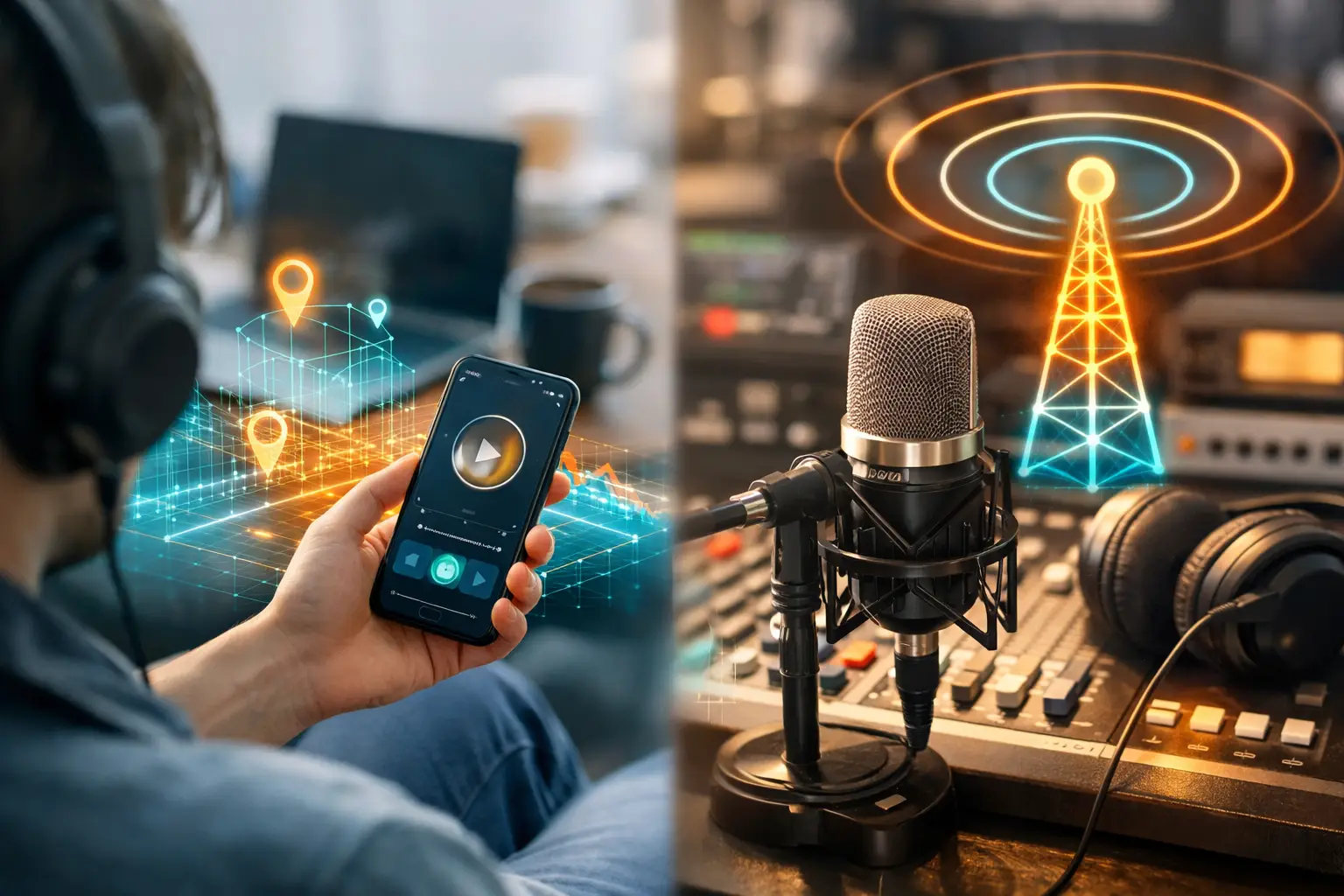

A 30-second radio spot can put a local business in front of thousands of commuters before breakfast. A digital audio ad can reach a person who recently visited a specific neighborhood, event, or competitor location while they stream a podcast, music, sports, news, etc… later that day many days after. That is the practical difference behind digital audio versus radio advertising: one is built around broad scheduled audiences, while the other can be planned around audiences, devices, and measurable actions.
Neither channel wins every time. Radio can still be a strong awareness play in markets with loyal listeners and well-matched stations. Digital audio gives advertisers more control over who hears an ad, where those listeners have been, and what happens after the impression. The right choice comes down to your campaign objective, geographic needs, budget, creative, and ability to measure results.
How Digital Audio and Radio Advertising Work
Traditional radio advertising buys time on terrestrial AM/FM stations. Advertisers choose stations, dayparts, programs, and spot lengths based on listener demographics and estimated audience size. A home services company might run ads during morning drive time on a local news station, for example, because that station reaches homeowners in its service area.
That reach is valuable, but it is largely based on the audience expected to be listening. A station’s coverage area is broad, and an ad reaches whoever has the radio on at that moment. You can select a market and a format, but you cannot isolate one hyper-specific location, a particular event, or people who visited a competing business like with Qujam’s digital audio.
Digital audio advertising runs through streaming music services, podcasts, online radio, and other audio publishers. Listeners hear ads on connected devices, often including smartphones, smart speakers, tablets, and computers. Inventory may be purchased by geography, audience characteristics, contextual content, or behavioral signals, depending on the campaign and available inventory. It’s much more focused on targeting based on the person beyond listening preferences.
For local advertisers, the biggest distinction is that digital audio can be paired with hyper-local location (like on Qujam), behavioral, and demographic targeting. On Qujam, instead of buying all listeners across a metro area, an advertiser can build an audience from people who physically visited a defined location or set of locations, then serve audio ads when those people stream eligible content. This approach is designed for precision, not simply maximum geographic coverage.
Digital Audio Versus Radio Advertising for Targeting
Radio targeting starts with a reasonable question: who is likely to listen to this station at this time? It can be effective when your ideal customer closely matches a station’s audience. A regional restaurant group promoting a new location, for instance, may benefit from a popular local station with a strong reputation in that market.
The trade-off is unavoidable waste. Many listeners may be outside your service area, outside your target customer profile, or simply not ready to buy. That does not make radio ineffective. It means radio works best when broad awareness is the goal and the station’s audience is a close fit.
Digital audio gives advertisers more ways to narrow the audience before an impression is served. A local retailer could focus on people who visited nearby shopping centers. An event organizer could build an audience around attendees at a prior event. A multi-location business could create separate campaigns for the neighborhoods and competitor locations that matter to each store.
The distinction between precise location targeting and a broad radius matters here. A radius around a business often captures people who happened to pass nearby. Hyper-specific geofencing can focus on the actual building, event footprint, neighborhood, complex, or other defined area relevant to the campaign. That can reduce wasted impressions when a customer’s physical presence is a meaningful signal.
Location data is not a magic shortcut to sales. A person who visited a place may have been a customer, an employee, a delivery driver, or a visitor. Campaign setup should reflect that reality. Use location audiences as one strong signal, then pair them with clear creative, sensible frequency limits, and a landing page or offer that matches the ad.
Reach, Attention, and the Listening Experience
Radio has an advantage in shared, habitual listening. People listen in cars, at work, and at home, often with local personalities they trust. A memorable local ad can build familiarity quickly, especially when it runs consistently. Radio also reaches some audiences who may not spend much time with streaming audio.
Digital audio listening is more fragmented, but it can be highly personal. Headphones, curated playlists, and podcast environments can create a focused listening moment. Many placements are not skippable, although ad formats and listener experiences vary by publisher. For a smaller business, the benefit is not necessarily a bigger audience. It is a more relevant one.
Creative still determines whether either channel earns attention. Audio has no image to rescue a vague message. Open with the problem you solve, name the location or service area if it helps, give listeners one reason to act now, and repeat the brand name. Avoid cramming a full website address, five services, and three offers into 15 seconds.
A 15-second spot can work well for a single offer or reminder. A 30-second spot gives more room for a local story, differentiator, and call to action. The best length depends on the message, not a fixed rule.
Measurement Is Where the Gap Widens
Radio reporting generally centers on estimated reach, frequency, ratings, spot delivery, and sometimes promotional response. Unique phone numbers, memorable offer codes, and dedicated landing pages can improve attribution, but radio is still harder to connect to individual outcomes. That does not mean the campaign failed if a listener cannot be tracked. Brand awareness often works gradually.
Digital audio can provide more campaign-level visibility. Advertisers can typically see impressions, spend, reach-related metrics, completion or listen-through information where available, and performance by audience or geography. When digital audio is part of a broader location-based campaign, advertisers can also evaluate whether exposed audiences later enter defined conversion zones, such as a business location.
Measurement should be handled honestly. A conversion-zone visit is not proof that an ad alone caused a purchase. People may have visited anyway, and offline attribution has limitations. Still, comparing exposed and unexposed audiences, monitoring trends over time, and using consistent conversion-zone definitions can provide much more useful direction than guessing.
For businesses that need leads, add a clear next step: a trackable landing page, call extension where supported, offer code, appointment form, or store-specific promotion. For businesses focused on awareness, track reach, frequency, site traffic trends, branded search activity, and location visits alongside sales data.
Cost and Buying Flexibility
Radio is commonly purchased through station packages, sales representatives, or larger market buys. Pricing varies widely by market, station, daypart, season, and demand. A small business may get value through a negotiated package, but it may also face minimum commitments or inventory that does not align perfectly with its audience.
Digital audio is often bought on a CPM basis, meaning cost per thousand impressions. CPM alone is not enough to judge value. A lower CPM can be expensive if most listeners are irrelevant. A higher CPM may make sense when targeting reduces waste and the audience has a stronger connection to your service area or business objective.
Self-serve buying changes the operational side as well. Instead of waiting for a proposal, advertisers can set a budget, choose dates, build audiences, review performance, and adjust a live campaign. Platforms such as Qujam are designed to make that level of control more accessible, particularly for businesses using hyper-local audiences alongside digital audio, display, video, or connected TV.
Traditional Radio tends to have a much lower CPM and greater reach when comparing dollars to dollars against digital audio, but it’s a trade of in being able to target your specific audience.
Before choosing a channel, answer four practical questions:
- Do you need broad local awareness, or do you need to reach people connected to specific places?
- Can you measure success through calls, site actions, store visits, or another defined outcome?
- Is your message simple enough to work in audio alone?
- Do you have enough budget to run consistently rather than appearing once or twice and disappearing?
Your answers may point to radio, digital audio, or both.
When a Combined Strategy Makes Sense
A combined approach can work well when radio supplies broad market presence and digital audio adds precision and measurement. For example, a franchise group might use radio to support a seasonal promotion across a city, then use digital audio to reach people who visited relevant shopping areas or competitor locations. The channels are doing different jobs, not competing for the exact same impression.
This only works when the message is coordinated. Use the same core offer, recognizable voice, and landing page, while tailoring the call to action to each channel. Do not assume a radio script can simply be dropped into a digital audio campaign without changes. The digital version may need a clearer action, more specific location relevance, or a shorter message.
Start with a test that has a real learning goal. Compare two audiences, two offers, or radio against digital audio in matched markets when possible. Keep the rest of the campaign stable long enough to see a pattern. The point is not to prove one channel is universally better. It is to find the media mix that puts more of your budget in front of people who are most likely to matter to your business.
The most useful next move is simple: define the audience you would least want to waste money reaching, then choose the channel that gives you the most control over avoiding them.
Key Takeaways: Digital Audio vs. Radio Advertising
-Targeting: Radio buys broad demographic audiences across a metro area. Digital audio (via platforms like Qujam) allows you to target specific individuals based on their real-world location history (geofencing).
-The Listening Experience: Radio is a shared, habitual experience (e.g., morning commutes). Digital audio is highly personal and fragmented (e.g., curated playlists via headphones).
-Cost & Efficiency: Traditional radio often has a lower CPM (Cost Per Mille) and broader reach. Digital audio has a higher CPM but drastically reduces wasted ad spend by ensuring only high-intent audiences hear the ad.
-Measurement: Radio relies on estimated reach and ratings. Digital audio offers transparent, campaign-level visibility, including the ability to track physical store visits (Conversion Zones).


