
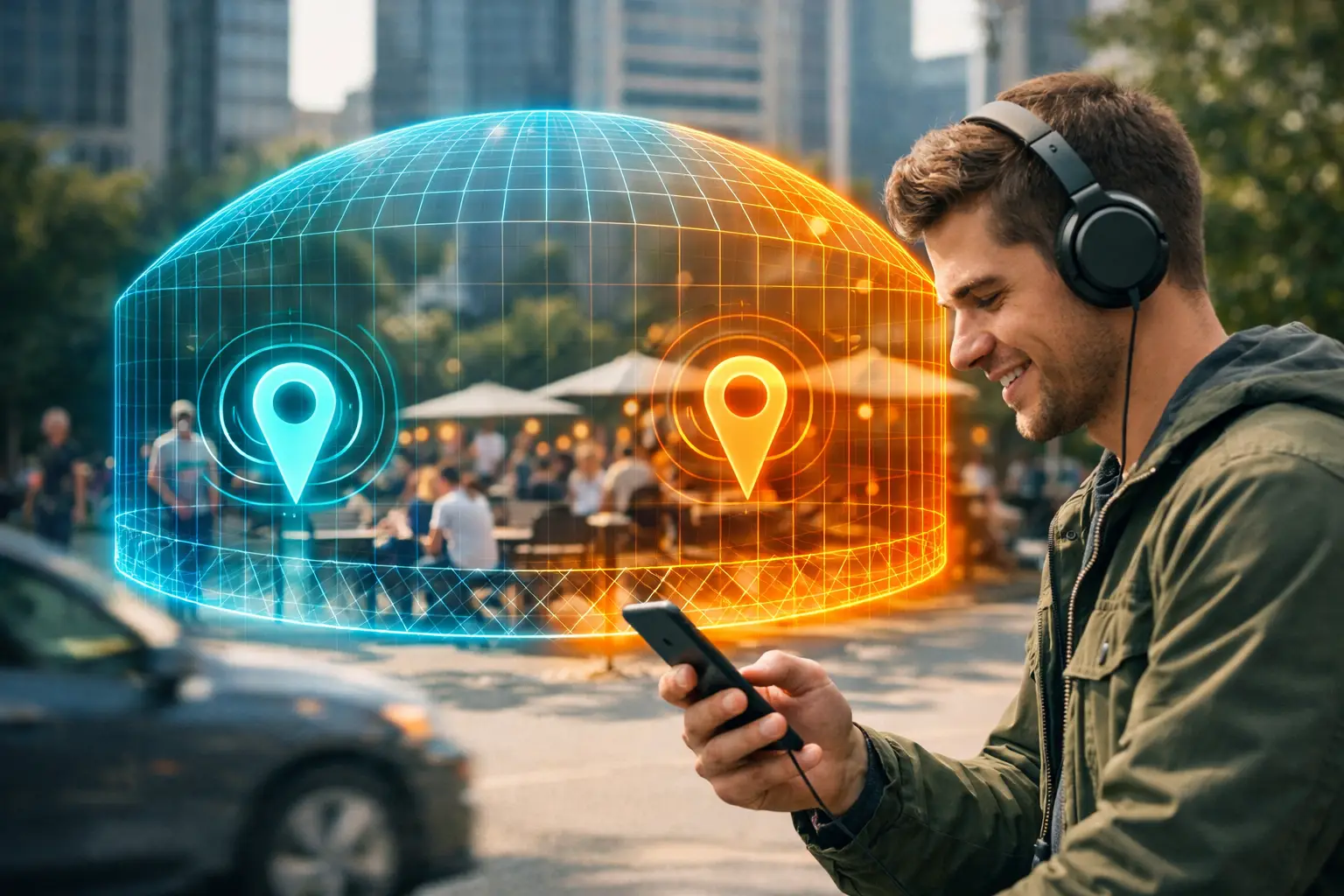

Someone listening to a podcast on the way home, streaming music at the gym, or using a radio app during a commute may be far more reachable than a person scrolling past another display ad. This guide to digital audio geofencing explains how to use that attention without buying broad, wasteful audiences.
Digital audio geofencing combines location-based audience targeting with ads delivered through streaming music, podcasts, and digital radio inventory. Instead of targeting an entire ZIP code or drawing a large radius around a business, advertisers can build an audience from people who physically visited a specific, relevant place. That could be a competitor location, a neighborhood, an event venue, an apartment complex, a retail center, or a defined service area.
The goal is not simply to play an ad near a location. The real opportunity is to reach people after a verified location visit, while they are listening on their phones, tablets, computers, or connected devices. Done well, audio adds a human voice and a local message to a highly specific audience strategy.
What Digital Audio Geofencing Actually Does
A geofence is a virtual boundary placed around a physical location. When an opted-in mobile device appears within that boundary, it can be added to an audience for future advertising, subject to available data, platform rules, and campaign timing. Digital audio geofencing uses that audience to deliver audio ads across eligible streaming inventory.
That distinction matters. Most campaigns are not placing an audio ad on a phone at the exact second someone walks into a location. More commonly, the location visit creates an audience signal, and ads are delivered later when that person is listening to eligible digital audio content. This approach gives advertisers more opportunities to reach the audience without requiring them to be standing at the location.
For a local business, this can be more useful than broad geographic targeting. A home services company, for example, may want to reach people who visited a competing showroom. A restaurant group may want to reach attendees of a local festival. A multi-location retailer may want separate audiences for individual trade areas rather than one generic citywide campaign.
Hyper-local precision is the difference. A carefully drawn geofence can focus on a building, a specific event footprint, a neighborhood, or a competitor storefront. A radius alone can capture people who were merely driving by, working nearby, or visiting unrelated businesses.
When Audio Is the Right Channel
Digital audio works especially well when the message is simple, memorable, and tied to a clear next step. Listeners cannot click an audio ad in the same way they can click a display unit, so the creative needs to do more of the work. A recognizable offer, a short URL, a phone number, a location cue, or a phrase that is easy to remember can make the campaign more effective.
Audio is a strong fit for businesses that benefit from familiarity and local recall. Retailers, restaurants, automotive businesses, real estate professionals, event marketers, fitness brands, home service companies, and franchise operators can all use it to stay in front of relevant local audiences.
It is not the best choice for every goal. If a campaign needs people to compare products, read detailed terms, fill out a long form, or act on a highly visual offer, display, video, or connected TV may be a better primary format. Often, the better answer is a mix: use audio for awareness and repetition, then use display or video to support site visits and direct response.
Guide to Digital Audio Geofencing: Build the Audience First
The audience is the foundation of the campaign. Before writing a script or setting a budget, decide whose location behavior actually signals potential interest.
Start with a business question, not a map. Ask whether you are trying to win customers from competitors, follow up with event attendees, build awareness in a newly opened service area, or increase visits around a specific location. The answer determines which places should be geofenced.
A few practical examples make this clearer:
- A salon could target visitors to nearby beauty retailers and competing salons.
- A roofing company could focus on defined neighborhoods with homes that match its service profile, rather than an entire county.
- An event sponsor could create an audience from event attendees and continue the conversation after the event ends.
- A franchise operator could target individual competitor locations around each store, with separate creative for each market.
The quality of the location list matters more than the size of the list. A campaign built around 10 highly relevant locations can outperform one built around 100 loosely related places. More fences do not automatically mean more value. They can also create overlap, dilute the message, and make reporting harder to interpret.
It also helps to think about exclusions. If your business location is included in the audience, you may spend impressions on existing visitors when the goal is conquesting. If your campaign is for one branch, nearby branches may need to be handled carefully so reporting reflects the right store or territory.
Set a Campaign That Can Actually Learn
Once the audience is defined, give the campaign enough time and budget to generate meaningful delivery. Very short runs can work for time-sensitive events, but an always-on local awareness campaign generally needs more runway. Audio frequency builds recognition over repeated exposures, not just one impression.
A practical setup includes a clear flight date, audience, geographic market, daily or total budget, frequency approach, and conversion zone if you plan to measure physical visits. Keep the first campaign focused. Trying to test multiple locations, offers, audiences, and creative angles in a small budget can leave you with too little data to make a smart decision.
For multi-location businesses, separate campaigns or reporting groups can be worth the extra setup. That allows each market to use its own geofences, messaging, and conversion zones. A generic script that names no location may be easier to produce, but local relevance is often where the campaign earns its keep.
Self-serve platforms such as Qujam make this process more accessible because advertisers can create targeted areas, adjust campaign settings, and review results without waiting through a managed-service workflow. That control is useful, but it still requires thoughtful inputs. Fast setup cannot fix an audience that was poorly defined from the start.
Write Audio Creative for Ears, Not Screens
A digital audio ad should sound like a person speaking clearly, not a banner ad read aloud. Keep the message focused on one offer or reason to act. A listener may be driving, exercising, cooking, or working, so they should understand the main point on the first listen.
A useful 15- or 30-second script generally includes the business name early and later, one specific benefit, a local cue, and a simple call to action. For example, a local flooring company could say it serves homeowners in a particular area, mention free in-home estimates, and direct listeners to search the company name or visit its website.
Avoid cramming in every service, every location, and every disclaimer. The goal is to get them to act, not to over educate them. Audio creative becomes forgettable when it tries to do too much. If you have two different offers, test two distinct scripts rather than combining them into one crowded message.
Voice and production quality matter, but expensive production is not always necessary. A clear, confident voice and clean audio will beat a polished spot with a vague message. If the brand has a recognizable local personality, that can be an advantage. Just make sure the message still makes sense to someone who has never heard of the business before.
Measure More Than Plays
Impressions and completed listens show whether the campaign delivered, but they do not tell the full business story. The right measurement depends on the campaign objective.
For store visits or local foot traffic, use conversion zones around the locations you want to measure. This can help show whether exposed audiences later appeared at those places. For lead generation, monitor calls, form submissions, landing page traffic, and branded search activity. For awareness campaigns, look for reach, frequency, completed audio delivery, and changes in direct or branded engagement over time.
Attribution should be treated as directional evidence, not magic proof. A measured visit does not reveal every reason a person chose to visit, and not every customer carries an identifiable device. Compare results against a baseline when possible, and give campaigns enough time to establish a pattern.
Also watch frequency closely. Too little frequency may not create recall. Too much can irritate the audience and waste budget. The right level depends on the offer, audience size, campaign duration, and how often people use streaming audio. There is no single number that works for every local advertiser.
Common Mistakes That Reduce Results
The most common mistake is using a broad location strategy when the business needs a precise one. If a campaign targets an entire metro area, it may deliver plenty of impressions while reaching many people with no realistic reason to buy. Start narrow enough to be relevant, then expand based on results.
Another mistake is treating digital audio as a direct replacement for every other channel. Audio is excellent for reaching people during screen-light moments, but it may need display, video, or search support to capture demand. Coordinate the message across channels instead of expecting one format to carry the entire funnel.
Finally, do not judge a campaign only by the lowest CPM. Cheap impressions are not a bargain if the audience is wrong. A more relevant audience, a memorable local script, and measurement tied to real business outcomes usually matter more than chasing the lowest possible delivery cost.
The best first campaign is often a focused one: choose a specific audience, give them one clear message, measure an outcome that matters, and use what you learn to improve the next flight. That is how hyper-local audio becomes more than background noise.
Key Takeaways: Guide to Digital Audio Geofencing
-How it Works: Draw a virtual boundary around a location (e.g., a competitor’s store) to capture mobile Device IDs, then serve digital audio ads to those devices later while they stream music or podcasts.
-The Goal: Audio geofencing is built for local brand recall and top-of-mind awareness, not immediate direct-response clicks.
-The Creative: Keep scripts short (15-30 seconds), mention the brand early, and focus on one simple call to action (like a short URL or search phrase).
-The Measurement: Measure success through foot traffic (Conversion Zones), branded search lift, and site visits, rather than direct clicks.


