
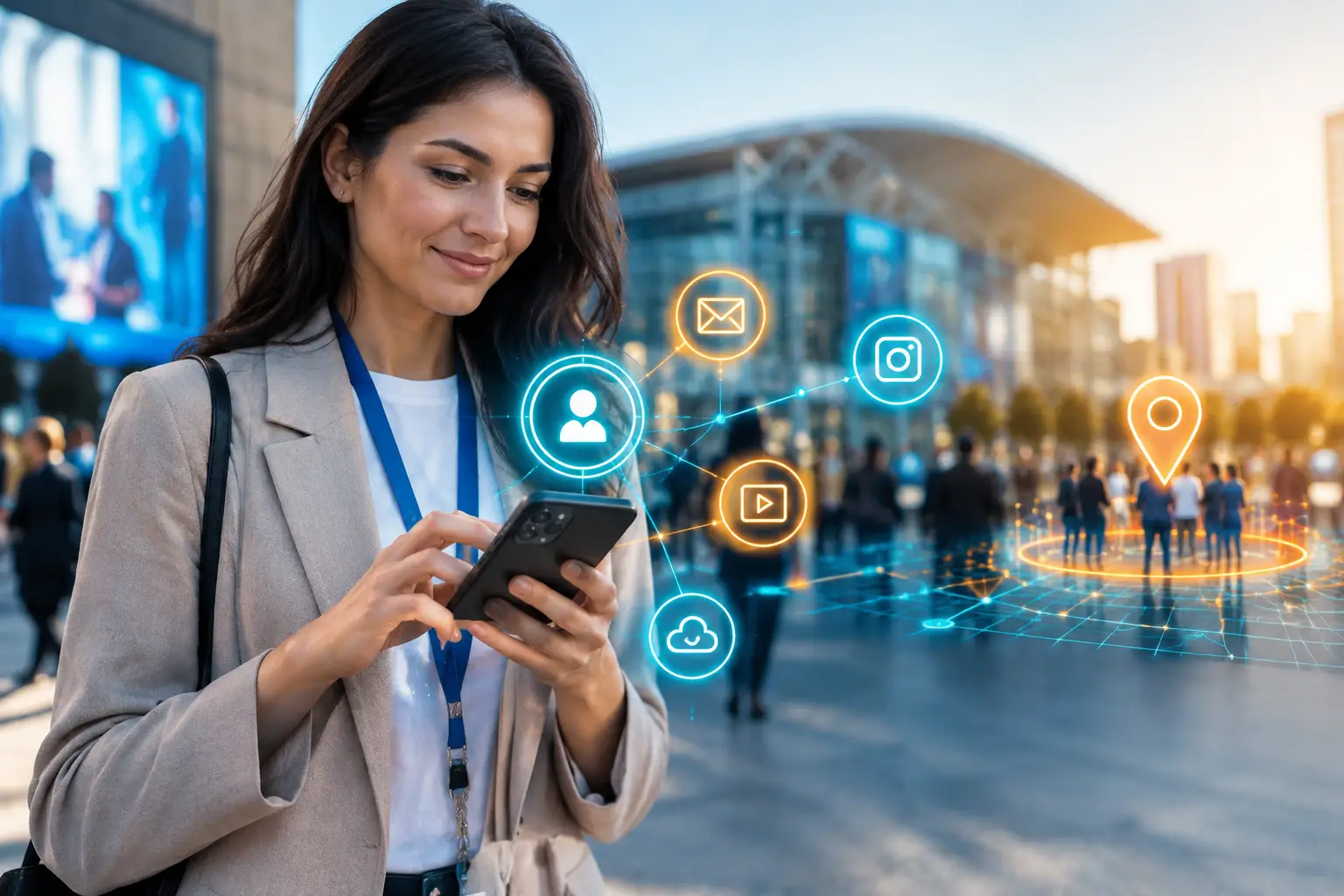

An event can put your business in front of thousands of relevant people in a single afternoon. The hard part is staying in front of them once they leave. The best event retargeting channels turn a short visit to a trade show, concert, conference, festival, or community event into an ongoing local advertising opportunity without relying on a lead form or a booth scan.
For most advertisers, the strongest approach is not to put every dollar into one channel. It is to use location-based audience targeting to reach verified event visitors, then match the ad format to the action you want them to take. A restaurant near a stadium may need quick mobile offers. A home services company exhibiting at a local expo may need repeated exposure over several weeks. A multi-location brand may want broad awareness across phones, TVs, and computers.
How geofence event retargeting works
Geofence event retargeting starts with a tightly defined geofence around the actual event footprint. That might include a convention center, fairgrounds, stadium, concert venue, or a specific building within a large complex. The goal is precision. A broad radius around the venue can pull in people who were simply driving by, working nearby, or visiting an unrelated business.
When a person enters the defined location, eligible location signals can be used to build an audience for later ad delivery across connected devices. The ads do not have to run only while the event is happening. In fact, the days and weeks afterward are often where the campaign does its best work.
A good event setup also accounts for the venue layout and timing. An all-day conference needs a different audience window than a two-hour sporting event. A large convention center may need a fence that excludes adjacent hotels, parking areas, and unrelated halls. Precise setup reduces wasted impressions before a single ad is served.
The best event retargeting channels for most campaigns
1. Display advertising for efficient, sustained reach
Display is usually the foundation of an event retargeting campaign. It reaches attendees as they browse sites and apps on their phones, tablets, and computers. It is cost-efficient, flexible, and well suited to campaigns that need frequency without exhausting the budget in a few days.
For a local business, display works well with a clear offer: “Show your event badge for 15% off,” “Book a free estimate,” or “Visit our nearby location this week.” For brands with longer sales cycles, use display to reinforce the value proposition attendees encountered at the event.
The trade-off is creative space. A banner has to make its point quickly, so avoid cramming in every service, feature, and disclaimer. Use one message, one visual focus, and one clear next step. Refresh creative if the campaign runs for more than a few weeks.
2. CTV and OTT for high-impact local awareness
Connected TV, often called CTV or OTT, puts video ads on streaming television environments. It is an excellent event retargeting channel when the offer benefits from a stronger brand impression, such as a franchise launch, dealership promotion, entertainment venue, or major seasonal service campaign.
CTV is especially useful when event attendees are likely to be decision-makers but may not convert immediately. A 15- or 30-second spot can explain what you do, show the product or service in context, and create familiarity before a follow-up search or site visit.
It is not always the first choice for a small, time-sensitive offer. CTV creative takes more planning than a display ad, and the message must be easy to understand without a click. If you have a good video asset and need local reach at scale, though, it can add a level of credibility that static ads cannot match.
3. Video pre-roll for a message people can see and hear
Video pre-roll reaches audiences before or during online video content. It occupies a useful middle ground between display and CTV: more storytelling room than a banner, but often a more direct path to a website visit or action.
Use pre-roll when a demonstration matters. A contractor can show a finished project. A retailer can feature a product line. An event sponsor can remind visitors where to find them locally. Short, visually clear videos tend to perform better than polished but slow brand films.
Keep the first few seconds useful. Start with the offer, recognizable problem, or local relevance rather than a lengthy logo animation. Many viewers will decide quickly whether to continue watching, so the opening frame has real work to do.
4. Digital audio for frequency without screen fatigue
Digital audio reaches people while they listen to music, podcasts, and streaming radio. It is a smart complement to display and video because it can build frequency during moments when a screen ad is not practical, such as commutes, workouts, or household routines.
Audio works best with a simple spoken message. Mention the business name, a memorable benefit, a local cue when relevant, and a direct call to action. “Still thinking about the home show? Get a no-pressure quote from [brand] this month” is easier to absorb than a long list of product details.
Audio is less ideal when your offer needs heavy visuals, pricing tables, or a detailed product comparison. Pair it with display retargeting so people who hear the message can later recognize the brand and take action on a screen.
5. Social media for audiences you already own
Social advertising can be effective after an event, but it should not be treated as a guaranteed extension of a geofenced attendee audience. Each social platform has its own audience rules, matching requirements, and data-use policies and true geofencing cannot be done on social media. The best way to leverage social media advertising is to gather contact information from the event if possible, or match overlapping demographics to try to reach a valuable audience that may hav also been at the event.
Social is most useful when you have permission-based event contacts, website visitors generated by the event campaign, or engagement from your own event content. It is also strong for promoting timely follow-up content, such as a recap video, giveaway, or local offer.
Think of social as a supporting channel, not a substitute for location-based programmatic retargeting. It can help move people further down the funnel, but its audience construction and reporting will differ from a campaign built around physical event visitation. Advertising and marketing is normally most effective when you can leverage multiple media channels, so a coordinated social media campaign along side event geofencing is a great pairing for push stay advertising.
6. Search for high-intent follow-up
Search is not traditional attendee retargeting, yet it often captures the moment when event interest turns into action. Someone may see your booth, display ad, or CTV spot, then search your business name or service category a few days later. If you are absent from paid search at that moment or have weak SEO/AEO/GEO, another advertiser may collect the lead. Successful programmatic style advertising campaigns like geofencing often result in an increase in search traffic, so you want to be findable.
This channel is most valuable for services and purchases people actively research, including automotive, legal, home improvement, education, and B2B offerings. Use event-specific landing pages or offers only if they make sense for the broader campaign. Otherwise, protect your branded terms and prioritize the highest-intent service searches.
Search can cost more than display, but clicks usually show stronger intent. It works best as a conversion layer beneath awareness channels, not as the sole way to reconnect with attendees.
7. Email for consented event contacts
If attendees opted in through a booth form, registration partnership, giveaway, or meeting request, email can be one of the most direct follow-up channels available. It is also different from location-based retargeting. Email requires a clear permission-based contact relationship, while geofenced retargeting reaches an audience based on venue visitation.
A useful event email should feel like a continuation of the conversation, not a generic blast. Reference the event, share the promised resource or offer, and give recipients a practical next step. Send it promptly while the experience is still fresh.
Build the channel mix around the buying cycle
A short-cycle offer, such as a nearby retail promotion, can lean heavily on display and mobile-friendly creative for seven to 14 days after the event. Add audio if you need more reach, but keep the offer urgent and easy to redeem.
For a higher-consideration service or B2B sale, plan a longer sequence. Start with video or CTV to build recall, use display to maintain frequency, and capture active demand through search. The retargeting window may extend 30 to 60 days, depending on how long prospects normally take to evaluate options.
Budget should follow the role of each channel. Put more spend into display when efficient repetition is the priority. Reserve CTV and video for campaigns where the audience size and creative quality justify the added impact. Do not spread a small budget across every channel just because the inventory exists.
Keep event retargeting precise and measurable
Set a conversion zone around your store, office, showroom, or other meaningful destination before launch. That gives you a practical way to measure whether ad exposure is associated with real-world visits. Website actions, calls, form fills, and online sales can add more context, especially when the campaign has a clear landing page.
Also watch frequency. Seeing an ad a few times after an event can be helpful; seeing it repeatedly in a single day can feel wasteful. Monitor delivery, reach, creative performance, and conversion activity while the campaign is live, then adjust rather than waiting until the budget is gone.
Privacy and platform compliance matter here. Use location-based audiences responsibly, follow applicable laws and advertising policies, and avoid overly sensitive targeting categories. The strongest campaigns are specific about the event and the business goal, not invasive about the individual.
Qujam makes it possible to build highly specific event audiences and manage the campaign yourself, including the geofence, creative, budget, reporting, and conversion zones. That control is valuable when an event opportunity appears quickly and you do not want to wait on a managed-service timeline.
The right channel is the one that matches what attendees need to do next. Give them a relevant reason to remember you, make the next step easy, and keep showing up while the event is still part of the conversation.
Key Takeaways: Geofencing Event Retargeting
- The Strategy: Event retargeting captures the mobile device IDs of attendees inside a precise event footprint, allowing you to serve them ads days or weeks after the event ends.
- The Best Channels: Use Display ads for efficient frequency, CTV/OTT for high-impact brand awareness, and Digital Audio to reach attendees on the go.
- The Social Media Myth: Social media platforms do not offer true geofencing. They are best used as a supplementary channel to retarget overlapping demographics or email lists gathered at your booth.
- The Measurement: Measure success by setting up a Conversion Zone around your physical storefront to track how many ad-exposed event attendees actually walk through your doors.


