
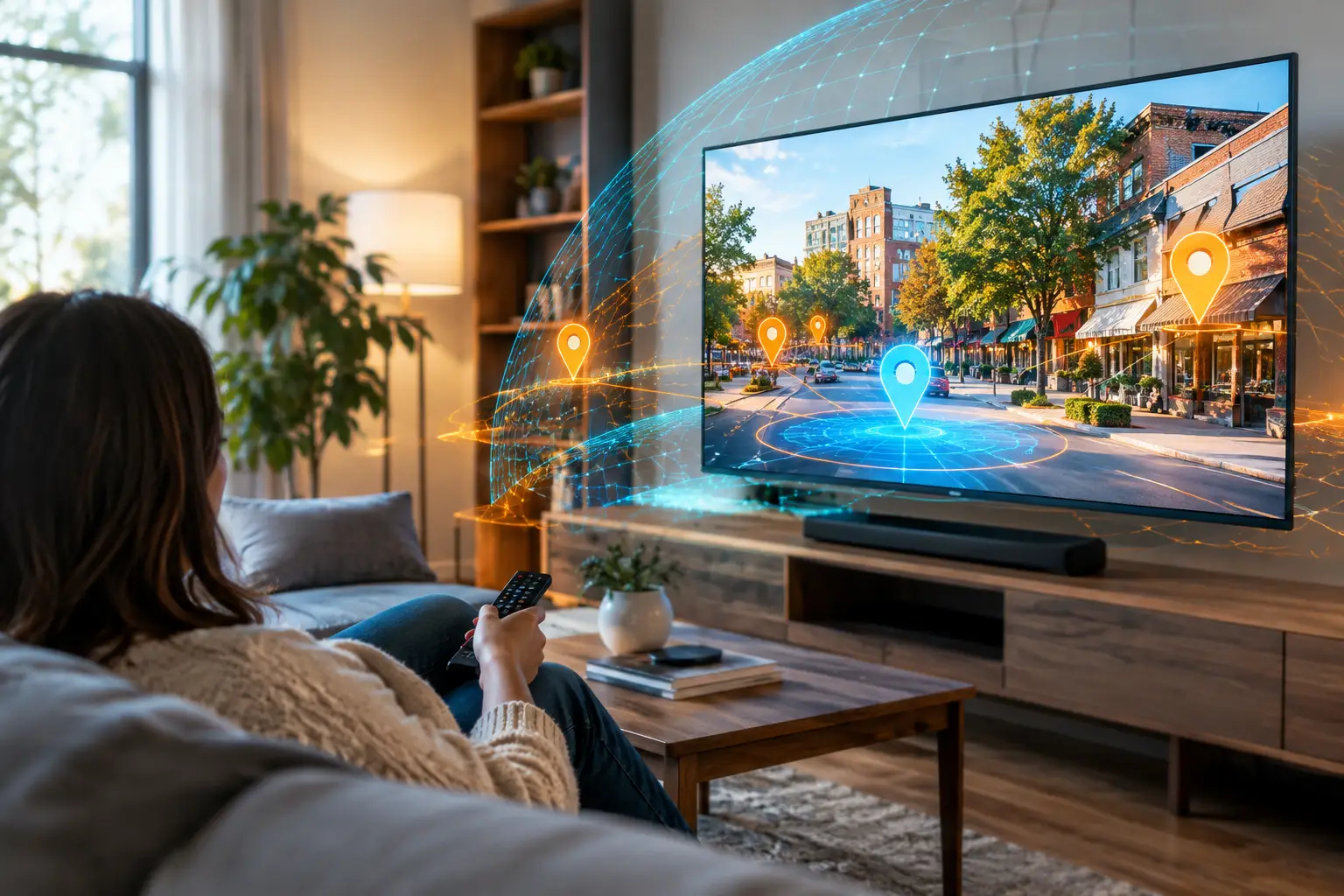

A homeowner settles in to watch a playoff game, a cooking show, or the local news through a streaming app. The big-screen ad they see can do more than build awareness. For a local advertiser, it can put a timely message in front of households near a store, service area, event, or competitor location. This connected TV advertising guide explains how to make that opportunity practical without buying a city-wide audience and hoping the right people happen to see it.
Connected TV, often called CTV or streaming TV, gives local businesses access to television-style video inventory with digital targeting and reporting. The channel is powerful, but it is not magic. Results depend on the audience you select, the offer you run, the frequency you allow, and whether you can connect ad exposure to a meaningful business outcome.
What Connected TV Advertising Actually Is
Connected TV advertising is video advertising delivered through internet-connected television devices. That includes smart TVs, streaming sticks, gaming consoles, and connected set-top devices. Viewers may be watching ad-supported streaming apps, live TV alternatives, or on-demand programming.
For advertisers, the key difference from traditional linear TV is control. Instead of purchasing a broad local TV placement based largely on a program, daypart, and estimated audience, you can buy impressions against defined households or audience segments. Campaigns are commonly priced by CPM, meaning cost per thousand impressions.
CTV is not the same as every kind of video advertising. A video ad viewed on a phone or laptop may be part of a broader digital video campaign. CTV specifically focuses on the television screen. That matters because the format is visually prominent, often viewed with sound on, and usually watched in a shared household setting.
The trade-off is that CTV typically needs a stronger creative standard than a static display ad. A blurry logo, tiny text, or slow opening can waste a premium placement fast.
CTV vs OTT
CTV and OTT can often be confused, so it’s important to share the difference between them. OTT (Over-the-Top) refers to the delivery method of streaming video content over the internet rather than through traditional cable providers, meaning you can watch it on any device from a TV, tablet, smartphone, or computer. CTV (Connected TV), conversely, refers specifically to the physical device—like a Smart TV, Apple TV, or Roku—used to stream that internet-delivered content on a television screen. In short, OTT is the streaming service or content itself (like Netflix or Hulu), while CTV is the specific piece of hardware in your living room where you watch it. Qujam runs ads through OTT which includes CTV inventory.
Why CTV Works for Hyper-Local Campaigns
Many local advertisers assume TV is only for national and regional brands and campaigns with large budgets. That was more true when television buying required large market-wide commitments. Streaming TV changes the equation by making audience selection more flexible.
A restaurant group can focus on households around hyper-specific locations. A home services company can focus on neighborhoods inside its actual service footprint. An event organizer can build an audience from privacy-compliant mobile location signals collected from devices observed within a custom event area, then extend messaging to associated household devices, including connected TVs.
This approach is useful because local advertising is rarely about reaching everyone in a metro area. It is about reaching people who can realistically visit, call, book, or attend. Precision reduces wasted impressions, but targeting too narrowly can also limit delivery. The right audience is specific enough to match your business goal and broad enough to give the campaign room to serve consistently.
CTV is best at awareness with intent behind it
A connected TV ad rarely asks someone to click or even has the ability to be clicked. Its job is usually to create recognition, recall, and action later. That makes it especially effective when the next step is simple: visit a nearby location, search for the brand, use a memorable offer, or respond to a clear call to action.
If you need immediate form fills from every impression, search advertising may be a better primary channel. If you need to put a compelling local offer in front of likely nearby customers at scale, CTV can be a strong addition.
How to Build a Connected TV Campaign
Start with the business outcome, not the inventory. “Get more awareness” is too vague to guide a campaign. A better objective might be increasing visits to three locations, generating bookings within a service zone, supporting an opening weekend, or staying visible around a competitor’s footprint.
Then build the campaign around four decisions: geography, audience, creative, and measurement.
Define the real-world area that matters
Broad ZIP code or radius targeting can be useful for some campaigns, but it often includes people who are unlikely to become customers. If your business depends on physical proximity, draw the places that matter: your stores, neighborhoods you serve, a trade show floor, an event venue, or competitor locations.
Precision geofencing can capture an audience from exact physical spaces rather than an arbitrary ring around a pin. For wider coverage, a hyper-grid approach can help cover a broader local area with more control than city-wide targeting and include demographic segment layers. The right choice depends on your goal. A single-location promotion may need tight zones; a regional service campaign may need broader but still intentional coverage. Also, keep in mind that people only need to enter these zones, but the ads will follow them around even if they level the geofences.
Keep timing in mind. An event audience should be collected while the event is active. A store-visit campaign may need enough time before and after exposure to measure behavior realistically.
Choose an audience strategy that matches the offer
Location is a strong starting point, not the only option. You can combine geographic signals with household or behavioral audience criteria when leveraging hyper-grid geofencing and when appropriate. But every additional filter reduces scale.
For a local gym, a message to households near the facility may be enough. For a franchise with several locations, separate campaigns by location can give each market a more relevant offer and cleaner reporting. For an event sponsor, an audience built from attendees may be more valuable than a general audience near the convention center.
Avoid building an audience so small that frequency climbs before reach has a chance to grow. Repeatedly showing the same 30-second spot to a limited group can create fatigue instead of lift.
Make the first five seconds do real work
CTV viewers can tune out or leave the room. Lead with the business name, the core benefit, or the offer. Do not wait until the final seconds to reveal who the ad is for.
Use large type, clear contrast, and one message. A local ad does not need a national-brand production budget, but it does need to look intentional on a large screen. Show the location, product, team, or outcome people can expect. If an offer has a deadline, say it plainly.
A 15-second spot can work well for a simple promotion. A 30-second spot gives more room for a story, demonstration, or seasonal message. Leveraging both is recommended, but do not change targeting, creative, timing, and offer all at once, so you can better analyze results from your ongoing optimizations. You will not know what caused the result.
Set a budget that can learn
CTV is bought on impressions, so campaign budgets should reflect the audience size and desired frequency. There is no universal minimum that guarantees success. A narrow audience in one neighborhood may need a modest budget, while a multi-location campaign across several markets needs more reach to produce useful measurement.
Give the campaign enough time to deliver. A few days can support an urgent promotion, but two to four weeks often provides a more realistic read on reach, frequency, and visit trends. Watch pacing early. If spend is slow, the audience may be too restrictive, the bid may be uncompetitive, or available inventory may be limited.
Self-serve buying is valuable here because you can make informed adjustments without waiting for an agency request or being locked into a monthly spend minimum. The goal is not to spend more. It is to spend where the signal is strongest.
Measuring More Than Video Completion
Completion rate is useful because it shows whether viewers watched your video through to the end. It is not proof that the campaign drove revenue. Strong CTV reporting should also look at impressions served, unique households reached, frequency, geographic delivery, and any measurable action tied to the campaign goal.
For businesses with physical locations, foot-traffic measurement can be especially valuable. Conversion zones can track privacy-compliant visit patterns from devices exposed to ads, helping advertisers understand whether campaigns are associated with more real-world visits. This is directional attribution, not a perfect record of every buyer or every sale. People can see an ad and visit days later, use another device, or arrive through another marketing channel.
That does not make measurement less useful. It means you should read it honestly. Compare results across locations, periods, and creative variations. Pair visit data with business indicators such as appointment volume, redemptions, sales trends, or branded search activity when possible.
Common CTV Mistakes to Avoid
The first mistake is treating CTV like traditional TV with digital labels attached. Buying the biggest possible area may create impressive reach but weak relevance. Start with the places and households most likely to matter.
The second is using generic creative. “We are here for you” may be true, but it gives viewers no reason to act. State what you offer, where you are, and why now.
The third is judging performance too quickly. CTV can influence action without a click, so a campaign needs time and appropriate measurement. At the same time, do not let a weak campaign run untouched for months. Check delivery, frequency, creative performance, and location-level results regularly.
Finally, do not make CTV carry the entire customer journey alone. It works well alongside geofenced display, online video, audio, search, email, and social efforts. CTV creates the big-screen moment; other channels can reinforce the offer and capture demand when people are ready to act.
A Practical Starting Point for Local Advertisers
Start with one clear campaign goal and one defined local audience. Use a concise video that makes the offer obvious. Run long enough to gather real delivery data, then evaluate reach, frequency, and measurable business movement before expanding.
Platforms such as Qujam make this process more accessible by allowing advertisers to activate hyper-local CTV campaigns with transparent pricing, real-time reporting, and no daily spend minimums. That matters when you want control over a local test instead of a complicated media commitment.
The best first CTV campaign is not the largest one. It is the one that gives you a useful answer: which local audience responds, which message earns attention, and where your next advertising dollar can work harder.
Key Takeaways: Connected TV (CTV) Advertising
- The Definition: CTV advertising delivers video commercials to internet-connected televisions (Smart TVs, Roku), giving local businesses TV-scale attention with digital targeting precision.
- CTV vs. OTT: OTT (Over-the-Top) is the streaming content delivery method, while CTV is the physical television device used to watch it. Qujam delivers OTT content on CTV inventory.
- Location-First Targeting: Use precision geofencing or hyper-grid geofencing to serve TV ads strictly to households that recently visited high-intent physical locations, rather than buying a broad, wasteful broadcast market.
- Actionable Measurement: Success is measured through digital attribution (site visits) and offline foot traffic tracked via Conversion Zones, not just video completion rates.


