
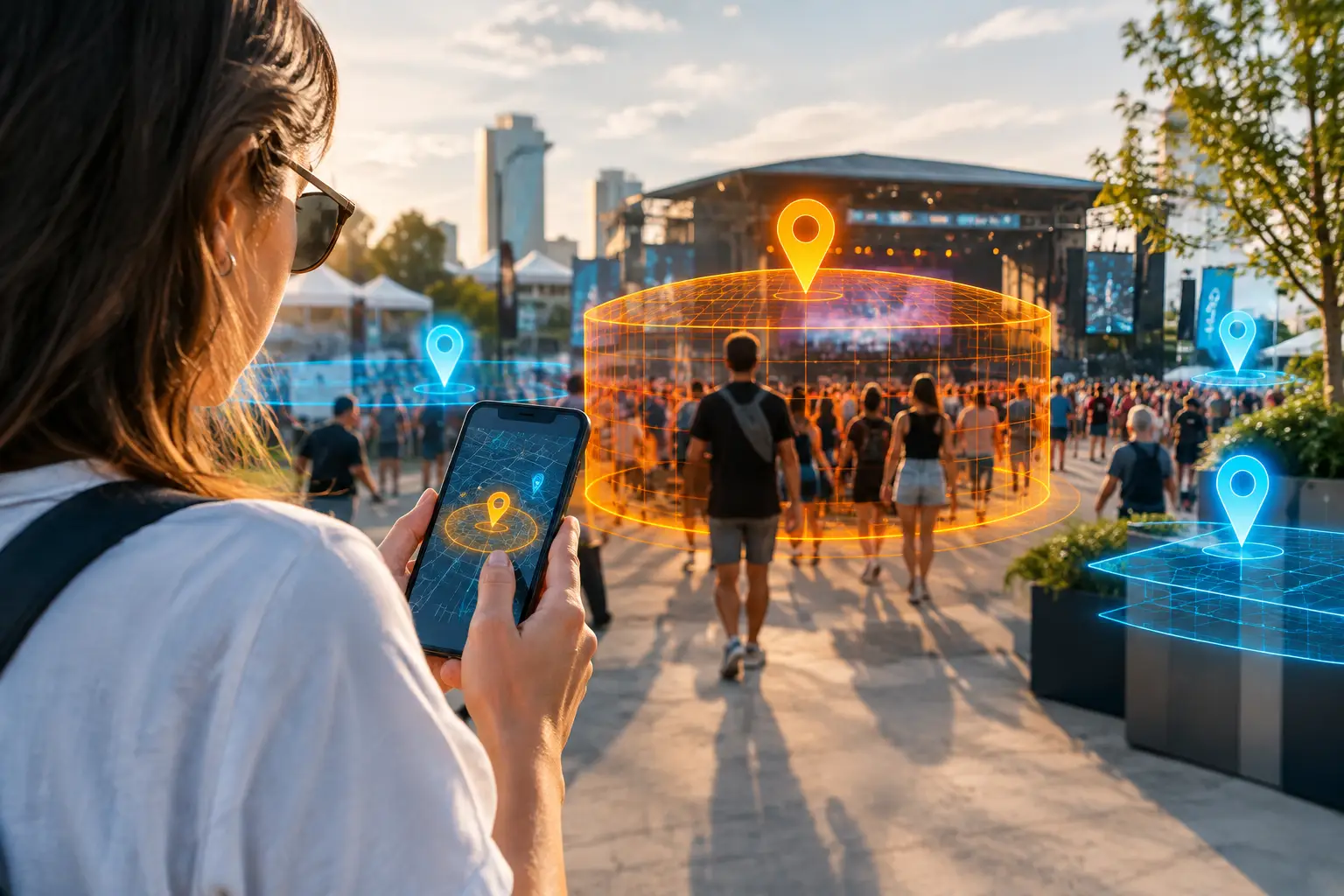

A crowded trade show floor can cost thousands of dollars before anyone visits your booth. The right event geofencing tactics give you another way to compete: reach devices associated with people at the event, then keep your offer in front of them after they leave. That means less reliance on a booth location, a badge scan, or hope.
Event geofencing is not a magic attendee list. It is a location-based advertising approach that uses privacy-compliant mobile location signals from devices observed inside a defined event footprint. When the footprint, timing, creative, and follow-up are planned together, it can turn a short event window into a campaign that keeps working for days or weeks.
Start With an Event Footprint, Not a Radius
The most common mistake is drawing one oversized radius around a convention center. A broad ring may include hotels, parking lots, restaurants, transit stops, nearby offices, and people who never entered the event. Those impressions can look affordable while doing very little for your actual goal.
Instead, build the geofence around the places that matter. For a conference, that may mean the exhibit hall, registration area, keynote rooms, and sponsored networking venue. For a festival, it may include the ticketed grounds and entrances, while excluding surrounding blocks. For a grand opening, the target area might be the store, adjacent event space, and a clearly defined queue area.
Precision matters because events are often held in dense locations. A carefully drawn polygon can reduce ad waste compared with a blanket radius, but there is a trade-off: a tighter footprint generally produces a smaller audience. That is usually the right trade when attendee relevance matters more than raw reach.
Review the map like an attendee would
Before launch, look at the map and ask practical questions. Does the boundary include a public sidewalk that runs beside the venue? Does it accidentally cover a neighboring business? Are the parking structures included for a reason, or simply because the radius made them unavoidable?
The goal is not to make the biggest audience possible. The goal is to create an audience that has a credible connection to the event.
Use Three Campaign Windows, Not One
A strong event campaign rarely begins when doors open and ends when they close. Split the plan into pre-event, live-event, and post-event activity, with each phase doing a different job.
Before the event, use location targeting around relevant venues or locations where your likely buyers may be spending time. This is useful for promoting a booth number, demo schedule, giveaway, appointment link, or limited event offer. Keep this phase focused. If you target too broadly before the event, you can spend budget reaching people who have no plans to attend.
During the event, prioritize simple messages that help attendees act fast. Tell them where to find you, what they can get, and why it is worth a few minutes of their time. A complicated product story rarely wins on a busy show floor. “See the 10-minute demo in Booth 214” is more useful than a paragraph of positioning.
After the event, shift from awareness to follow-up. Reach the event audience with a next step that fits the sales cycle: book a consultation, request pricing, watch a product demo, claim an offer, or visit a nearby location. The post-event phase is often where geofencing earns its value, because attendees have left the noise of the venue and have more time to consider your message.
Match the Offer to the Event Moment
Event attendees are overloaded with signage, emails, tote bags, and sales pitches. Generic ads disappear quickly. Your creative needs to answer one immediate question: why should this person care now?
For an exhibitor, the best live-event offer may be a fast booth visit incentive, a product demonstration, or a scheduled meeting. For an event organizer, it may be a reminder about a session, after-hours event, or next-day ticket upgrade. For a local business near a large event, it could be a time-sensitive offer that reflects the visitor’s likely needs, such as dining, transportation, or entertainment.
Keep the ad and landing experience aligned. If the ad promises a show-only offer, the page should show that offer immediately. If you want meetings, make the scheduling action obvious. Sending event traffic to a generic homepage adds friction at exactly the moment you are trying to make a quick impression.
Build Separate Audiences for Different Goals
Not every person near an event should receive the same message. Segmenting your campaigns makes reporting clearer and budget decisions easier.
For example, an exhibitor may use one audience tied to the main exhibit hall, another tied to a VIP reception, and a third tied to a competitor’s activation area if that location is relevant and permissible for the campaign. Each group can receive creative that matches its context. A visitor near your booth may need a directional message. Someone associated with the broader event may need a stronger reason to schedule a follow-up.
You can also separate past customers or existing leads from prospecting audiences when your customer data and campaign setup support it. Existing customers may respond better to an invitation or upgrade message, while new prospects need a clearer introduction to the value you provide.
Do not over-segment a small event, though. Too many tiny audiences can limit delivery and make results harder to interpret. For a modest local event, one clean footprint and two well-timed creative variations may outperform an overly complicated structure.
Control Frequency Before Attendees Tune You Out
An event audience is valuable, but it is not unlimited. Repeating the same ad too often can make a brand feel intrusive, especially when the event lasts only a day or two.
Set sensible frequency goals and refresh the creative. A live message can emphasize booth location or an immediate incentive. A post-event message can move toward a meeting, quote, trial, or visit. This creates a logical sequence instead of showing the same static banner for two weeks.
Use More Than One Ad Format When It Fits
Display ads are a practical starting point for event geofencing because they can deliver efficient reach and clear calls to action. But the right format depends on the message and what you want the audience to do next.
Short video can work well for a product demonstration, a quick founder message, or a visual event invitation. Digital audio can support awareness when a visual click is not the primary goal. Connected TV can extend a campaign to household screens after the event, particularly when you need a more polished brand story. The best mix is not automatically every format available. It is the combination your budget can support with enough repetition and a message suited to each channel.
Measure the Outcome You Actually Want
Clicks alone are a weak measure of event success. An attendee might see an ad, search for your company later, visit your location, or book a call after discussing the purchase internally. That does not always show up as a direct click-through conversion.
Start by naming the business outcome before launch. For a retail or local service campaign, that may be physical visits measured through a conversion zone. For a B2B exhibitor, it may be scheduled meetings, qualified form submissions, demo requests, or CRM opportunities. For an organizer, it could be ticket sales or registrations for the next event.
Use real-time reporting to watch delivery, reach, frequency, and engagement while the campaign is active. Then compare the results against your baseline or a similar period when possible. If the event generated impressions but no meaningful movement in visits, leads, or sales activity, revisit the audience quality, offer, and landing experience before assuming the channel failed.
A Practical Launch Checklist for Event Geofencing Tactics
Before spending a dollar, confirm four things: the event footprint is accurately drawn, the campaign dates cover the right follow-up period, the creative has one clear action, and the measurement plan matches the sales goal. Then check the budget against audience size and campaign length. A highly specific audience deserves a focused plan, not a broad-reach budget expectation.
Qujam makes this process easier for advertisers who want to draw custom event zones, launch campaigns without mandatory daily spend minimums, and monitor results without waiting on an agency report. But the platform is only part of the equation. The strategy still needs to reflect the event, the audience, and the action you want people to take.
The best event campaign feels useful rather than loud. Give attendees a timely reason to notice you, follow up while the event is still fresh, and let the results guide your next event spend.
When to Use Hyper-Grid Geofencing for Events
While precision polygon geofencing is perfect for isolating a single convention center, Qujam’s Hyper-Grid Geofencing sometimes a good choice for sprawling outdoor festivals, city-wide conferences, or when operating in states with strict privacy laws (such as Oregon, Virginia, Maryland, New Jersey, and Connecticut) that restrict precision geofence targeting.
Hyper-Grid is also a useful tactic when your event strategy requires demographic filtering. For example, if you are sponsoring a luxury auto show, you can target the 0.5-mile by 0.5-mile bounding boxes covering the broader event district and layer on specific household income, interest, intent, life-stage requirements, etc… to ensure your budget only reaches people who were in the general area and meet your demographic criteria.
Because Hyper-Grid typically offers a lower CPM when demographic segmenting is not included and is optimized for digital conversions—like website visits or landing page form fills—it allows event marketers to safely maximize their impression volume. Instead of guessing if your ad reached the right demographic in a crowded district, you can leverage these compliant, pre-defined grid squares to efficiently retarget high-value attendees across connected TV, digital video, digital audio, and display formats long after the event ends.
Key Takeaways: Event Geofencing Tactics
- Precision Mapping: Avoid drawing wasteful radiuses around a convention center. Map custom polygons strictly around exhibit halls and entrances to capture true attendees, not parking lot traffic.
- The Ad-Tech Landscape: Enterprise platforms and managed services often enforce high minimums and slow down campaign execution. Self-serve platforms like Qujam offer real-time, DIY control.
- Actionable Measurement: Measure success by tracking physical visits via Conversion Zones or digital actions like booked meetings, rather than relying on vanity click-through rates.


