
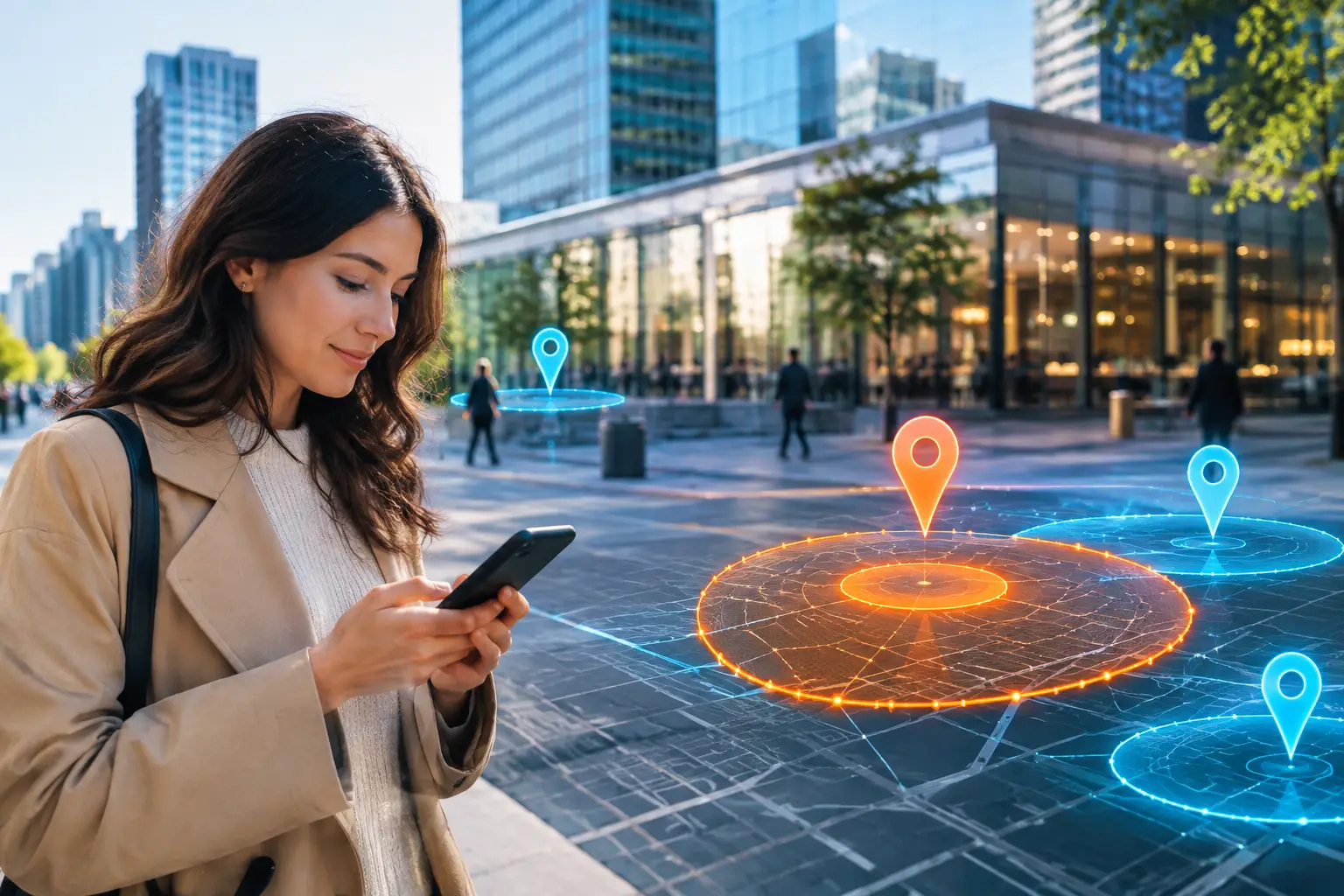

Geofencing is often priced differently from broad audience advertising because it is built to reduce waste and increase the quality of your audience. You are not paying to reach everyone in a city, zip code, market, etc… You are paying for the technology, data processing, and inventory access required to reach a smaller audience connected to a specific real-world place.
The better question is not just, “What is the CPM (Cost Per Thousand)?” It is, “What am I paying to reach a person who could realistically become a customer?”
The Short Answer:
There are more costs to tap into geofencing data that increase the CPM, but geofencing is often a better-performing option because the targeting improves the audience’s quality, increases your frequency, and improves your timing. It’s not that geofence ads are expensive… it’s that their value is often worth more than blanket, general advertising, which results in reduced wasted spend and improved results.
Why Are Geofence Ads Expensive Compared With Broad Display?
A geofence campaign has more moving parts than a broad display buy. A platform needs to define the target area, process privacy-compliant mobile location signals associated with that area, build an eligible audience, and bid for impressions across available ad inventory. Each step adds value, and sometimes adds cost.
Broad display campaigns can cast a much wider net. They may target a large metro area, generic interests, or a broad age range. That reach can produce lower CPMs because there are more available impressions and less precision required. But low-cost impressions are not inherently efficient impressions. If a local roofing company pays to show ads across an entire city when it only serves a few neighborhoods, much of that reach may never have a chance to convert.
Geofencing trades scale for relevance. A smaller, better-defined audience usually costs more per thousand impressions, especially when many advertisers want to reach the same people.
Precision data has a cost
The foundation of geofencing is location intelligence. Rather than relying only on a device’s stated profile or a user’s browsing behavior, location-based campaigns use privacy-compliant signals to identify devices observed within a defined physical area.
That data must be collected, filtered, validated, and made available for advertising use. Quality matters. A sloppy location signal can put a device near a target, not at it. Stronger location methodologies are designed to improve confidence that the audience was actually at the relevant place or within the intended footprint.
This is one reason cheap geofencing offers deserve scrutiny. A low price may reflect a broad radius, less specific location methodology, limited inventory, or a campaign structure with little transparency. The label “geofencing” alone does not tell you how precisely your audience is being built.
Small audiences create less buying volume
A geofence around one building, one trade show floor, or a few competitor locations may produce a highly valuable audience, but it will not produce the impression volume of an entire county. Smaller audiences can be more competitive and may take longer to spend because there are fewer eligible devices and fewer chances to serve ads to them.
This does not mean the campaign is broken. It means the campaign needs a budget and timeline that match the available audience. Trying to force a tiny audience to spend a large daily budget can push bids higher without creating more qualified people to reach.
For a single-location retailer, a defined neighborhood or a set of nearby competitor locations may be a smarter starting point than a microscopic fence around one storefront. The right size depends on the business goal, local foot traffic, and how many people need to enter the audience for the campaign to have room to work.
Premium inventory affects your CPM
Geofenced audiences can be reached across mobile apps, websites, tablets, desktop devices, streaming audio, online video, and connected TV. Those channels do not cost the same.
Display ads generally offer the most economical way to build frequency. Video pre-roll, digital audio, and streaming TV often command higher rates because the placements are more immersive, inventory is scarcer, or completion and viewability expectations are different. Reaching a geofenced audience on connected TV can be especially useful for awareness, but it should be budgeted as a premium channel rather than compared dollar-for-dollar with a basic banner campaign.
The creative also has to match the channel. A static display ad can work well for an offer, opening, or local promotion. A polished video asset may be worth the investment when the campaign needs a stronger brand story, but it raises the true cost of the program beyond media spend alone.
Competition can raise the clearing price
Programmatic ads are bought through auctions. Your campaign enters a bid environment where other advertisers may be pursuing the same audience, inventory, device type, or time of day. If multiple brands want the same local sports crowd, convention attendees, or affluent neighborhood, the winning bid can rise.
Seasonality matters too. Retail-heavy periods, major local events, and election seasons can make inventory more competitive. A campaign that performed at one CPM in February may cost more in November, even with the same targeting settings.
A Higher CPM Can Still Be the Less Expensive Choice
CPM is useful, but it is not the finish line. A $15 CPM that reaches nearby, relevant prospects can outperform a $5 CPM that reaches a broad audience with no local intent.
Consider two campaigns with the same $1,000 budget. The broad campaign may generate more impressions, but if most viewers live outside the service area or have no reason to visit, those additional impressions add little value. The geofenced campaign may generate fewer impressions but more store visits, inquiries, or qualified site traffic.
This is why advertisers should judge location campaigns against business outcomes. For a brick-and-mortar location, foot-traffic lift can be more meaningful than clicks alone. For a service business, the next best measure might be calls, form submissions, booked estimates, or branded search activity in the targeted market.
It also helps to separate CPM from total spend. Some legacy providers make geofencing feel expensive by requiring large monthly commitments, adding managed-service fees, or bundling opaque markups into the media price. That is a pricing model issue, not an unavoidable feature of location advertising.
How to Control Geofence Ad Costs Without Losing Precision
The goal is not to chase the lowest CPM at all costs. It is to buy the right amount of precision for the result you need.
Start by defining one practical campaign objective. If you want to capture attendees at an event, build the audience around the event footprint and run long enough to reach people after they leave. If you want to win local market share, target competitor locations or the neighborhoods most likely to use your service. A vague goal usually leads to vague targeting and wasted spend.
Next, size the geofence for the real opportunity. A larger radius is not automatically better, and a smaller boundary is not automatically smarter. Draw around the actual building, parking area, event footprint, or service-zone segment that supports your strategy. Then make sure the expected audience size can support your desired campaign duration and budget.
Choose channels based on the job each one needs to do. Display can deliver efficient repetition. Video and connected TV can build stronger awareness. Audio can reach people during commutes or workouts. Mixing every channel into a small budget may dilute delivery, while focusing on one or two can make performance easier to understand.
Finally, give the campaign time to produce a useful signal. A one-day test can be appropriate for a short event, but most local campaigns benefit from enough time to build frequency and observe response. Watch delivery, reach, frequency, site activity, and conversion-zone results in real time. If a campaign is not spending, the audience may be too small or the bid too low. If it spends quickly without results, revisit the offer, creative, and targeting logic before simply adding budget.
Transparency Changes the Math
Geofencing should not require an enterprise contract or a mystery invoice. Advertisers deserve to see their CPMs, control their daily spend, pause when needed, and understand what audience and channels they are buying.
A self-serve platform such as Qujam gives local advertisers that control without forcing a daily spend minimum. You can build a precise campaign, fund it with a credit card, monitor delivery as it happens, and adjust based on performance instead of waiting for a monthly report from an agency.
Geofence ads are expensive when the price includes quality data, valuable inventory, and highly specific targeting. They become needlessly expensive when the campaign is oversized, poorly matched to the audience, or wrapped in hidden fees. Build around the real place and real customer you want to reach, then let measurable local results decide whether the investment is earning its keep.
Key Takeaways: Geofencing Ad Costs vs. Broad Display
- Higher CPMs Equal Higher Relevance: Geofence advertising naturally costs more per thousand impressions (CPM) than broad display because you are paying for precise location data and intent, rather than empty reach.
- Efficiency Beats Volume: A $15 geofencing CPM often outperforms a $5 broad display CPM by eliminating wasted ad spend, ultimately driving higher foot traffic and a lower overall Cost Per Acquisition (CPA).
- Audience Size Impacts Auction Bidding: Hyper-local geofences create smaller, highly concentrated audience pools. Because there is less inventory available in a small area, programmatic auction bids can rise.
- Premium Channels Increase Costs: Reaching geofenced audiences on immersive channels like Connected TV (CTV) or streaming audio will raise your average CPM compared to running standard static display banners.
- Platform Transparency Matters: Legacy providers often inflate the perceived cost of geofencing with hidden markups, managed-service fees, and enterprise-level monthly minimums. Self-serve platforms like Qujam eliminate these barriers, allowing you to fund precise campaigns with a credit card and see exactly what you are paying for.


